
Still Struggling With This

SAS

Member
Messages
341
Reaction score
16
Points
18
Location
Connecticut
double sink.jpg


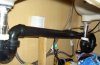
I had posted about this problem a while back. I get a sewer gas smell from the left sink. I know for sure that it's the left sink, because I have plugged the overflow hole with a wine cork and keep the sink pop-up sealed, and then there is no smell until I pop-up the drain.

The one other clue I have is that sometimes when you start to run the shower (which is on the other side of the wall to the right), you get that same sewer gas smell - but only for the first minute or so.

So is it possible that the shower drain is not sufficiently vented? Would that possibly siphon the trap on the left sink (and why not on the right?)? If the shower vent were at fault, why would it smell in the shower for only the first minute or so?

Would adding an in-line vent to the drain pipe just to the right of the left sink help any? If so, do I just put it atop a sanitary tee?

I need to do something, but I'm not quite sure what. Any suggestions?
 
It is hard to tell for sure on the pic, but it could be that there is too much slope to the sink on the left. Put a level on there and let it level. Rest one end of the level on the top of the problem p-trap. Measure from the bottom of the level down to where it connects with the other sink (measuring down to where the line connects to the vent would be even better). If the drop is more than 1 pipe diameter (2" drop for 2" pipe, 1.5" drop for 1.5" pipe, etc.), the vent becomes ineffective (essentially creates an s-trap). As the sink drains, it can pull the trap dry.

For the shower, it is hard to say without seeing how everything is connected together. It might be wet vented through the lav, but it might have its own vent.

We might get some more clues based on what you have to do to get the smell. If you slowly pour water into the left sink, does the smell go away? If the smell goes away, what does it take to get the smell to come back? Does the trap leak at all? If it does, it will rapidly lose its seal.
 
That picture doesn't show the whole hook-up, I would like to know where the pipe goes into the wall, I also don't like that board you are using for a hanger and the crooked lock-nut you have on one of the traps.:confused:
 
It is hard to tell for sure on the pic, but it could be that there is too much slope to the sink on the left. Put a level on there and let it level. Rest one end of the level on the top of the problem p-trap. Measure from the bottom of the level down to where it connects with the other sink (measuring down to where the line connects to the vent would be even better). If the drop is more than 1 pipe diameter (2" drop for 2" pipe, 1.5" drop for 1.5" pipe, etc.), the vent becomes ineffective (essentially creates an s-trap). As the sink drains, it can pull the trap dry.
I thought that I measured carefully to get 1.5" drop per foot, but I'll re-check it.

For the shower, it is hard to say without seeing how everything is connected together. It might be wet vented through the lav, but it might have its own vent.
I really have no idea how anything is connected except what is visible under the vanity. I thought that the combination of the shower sometimes smelling and the sink smelling might indicate that there was a clogged vent somewhere. There's a vent pipe going through the roof above this bathroom. Would it make sense to have someone ensure that it is clear?

We might get some more clues based on what you have to do to get the smell. If you slowly pour water into the left sink, does the smell go away? If the smell goes away, what does it take to get the smell to come back? Does the trap leak at all? If it does, it will rapidly lose its seal.
Yes, adding water does get rid of the smell.

I'll start by lowering the pitch and see if that helps. Thanks for the response.
 
That picture doesn't show the whole hook-up, I would like to know where the pipe goes into the wall, I also don't like that board you are using for a hanger and the crooked lock-nut you have on one of the traps.:confused:

I'm afraid that I don't have any information on anything that you can't see. I don't like the crooked lock-nut either, but that sink neither leaks nor smells, so I'm not anxious to touch it. This was existing work that I re-connected after a new vanity and sinks were installed. What's wrong with the board as a support? The old vanity had a similar one. What would you use instead?
 
I assume that you mean 1/4" per ft, right? What matters is the distance that the trap outlet is above the vent. We can't see the vent, but normally there will be a santee at the same height where it exits the vanity. However, if they did something else, then all bets are off.

It could be a clogged vent, but then I would expect both sinks to have the issue. If there is just one vent above the bath, it is likely that they wet vented everything through the lav. The other possibility is they tied the vents together in the attic and then went through the roof.

Do you use both sinks the same amount? If one sink gets very little use, the trap can dry out. It doesn't sound like that is the case, but something to check out.

What causes the smell to show up? Is it after using a certain fixture (toilet, shower, other lav) or does it come back over so many days/weeks?

It might also be worth filling the trap and then listen to it closely while someone uses other fixtures. If another fixture is pulling the water out, you should hear air being pulled through.
 
I would guess that the right sink is siphoning the left trap when it runs, try not using the right sink for a few days to see if the smell still happens.
 
I assume you are talking about the sink with the long trap arm? If so, everything looks pretty good. If that sink doesn't see much use, perhaps the other one slowly siphons water from it over time (doubtful). If you undo that sink's p-trap union nut, and water comes out, then you know the trap is full.....which most likely means the sink's drain is full of hair/crud and that is where the smell is coming from.
 
I assume that you mean 1/4" per ft, right? What matters is the distance that the trap outlet is above the vent. We can't see the vent, but normally there will be a santee at the same height where it exits the vanity. However, if they did something else, then all bets are off.

It could be a clogged vent, but then I would expect both sinks to have the issue. If there is just one vent above the bath, it is likely that they wet vented everything through the lav. The other possibility is they tied the vents together in the attic and then went through the roof.

Do you use both sinks the same amount? If one sink gets very little use, the trap can dry out. It doesn't sound like that is the case, but something to check out.

What causes the smell to show up? Is it after using a certain fixture (toilet, shower, other lav) or does it come back over so many days/weeks?

It might also be worth filling the trap and then listen to it closely while someone uses other fixtures. If another fixture is pulling the water out, you should hear air being pulled through.

Yes, I did mean 1/4" per foot, but now that I've measured more carefully, it was more than that. Given the length of the run, it may even have exceeded the 1.5" total that you suggested would be a problem. It's now no more than 1/4" per foot. If anything it's less. But if the smell goes away and the drain is slow, at least I'll have the answer to part of the riddle.

Typically the other sink and the toilet are used several times per day and the shower at least once. Since the smelly sink is mine, it gets used early in the morning and is smelly by the time I return home in the evening. Sometimes I've noticed that it is fine before a shower and smells right after one.

One other thing I wondered: are thos ABS p-traps shallower than the typical PVC ones? Would it help to replace the trap?
 
Get a strong drain cleaning liquid, such as LiquidPlummer, and pour it INTO the overflow opening of the sink. You overflow passage is probably filled with "foul" material, and when air can circulate, such as when there is NO cork in the overflow and the drain is open, the odors are carried into the room. It will also happen when you turn the water on and the flow forces air up through the overflow channel. It has nothing to do with the shower.
 
Thanks everyone for your help - it's now fixed! The problem was indeed that the slope of the trap arm was too steep. I knew about the minimum 1/4 inch per foot, but had never heard the rule about not exceeding the pipe diameter over the entire run. In this case, with nearly a 4 foot run, it appears that I was close to the 1.5 inch maximum.
 
You would not have exceeded the maximum until you reached 6', but that still was not the cause of the odor, because siphonage can ONLY occur down to the level of the connection, which would have to have been BELOW the dip of the trap, which would have necessitated a very STEEP slope, NOT 1/4" or anything close to it, AND the pipe would have to have been FULL of water which is almost, if not completely, impossible with a lavatory feeding a short 1 1/2" pipe. Your diagnosis and cure were faulty, regardless of what happened to eliminate the problem.
 
But if I lowered it at least 1/2 inch on the sink tailpiece, and if it's now 1/4 inch per foot for 4 feet for a total drop of 1 inch, wouldn't that mean that it was too steep before I lowered it?
 
1/4" per foot is a minimum; generally, exceeding that does not cause problems. There are limits, depending on the configuration, but a 1/2" difference will not cause problems. SOmething else got changed in the process.
 
If it was 7/16 per foot that would put it at nearly 1.75 inches in total. Lowering it 1/2 inch at the tailpiece overall would bring it back below the 1.5 inch total. Besides nothing else changed and my wife and daughter both confirm that it used to smell and doesn't anymore.
 
Siphonage requires several things.
1. the pipe has to have excessive fall/pitch so that the outlet is at least a full pipe diameter below the inlet
2. the pipe MUST be full of water
3. the outlet of the pipe MUST be below the bottom of the trap, and
4. there has to be NO flow to restore the trap seal after it is lost.

#1, is probably the ONLY one that applied to your drain, if it was indeed over pitched. #3 was "impossible" to apply in your case, and it may the most critical one, since that determines whether siphonage, and loss of the trap's seal, could even occur regardless of the other three requirements.
 
Last edited:
OK, you're the plumber, and I'm mostly just happy that everything is working now. It's just that I do like to understand the "why" of things, and in this case if it wasn't the pitch I can't imagine what it was. Even if #3 was not true (and it wasn't), wouldn't #1 predispose the trap to being siphoned?
 
Back
Top