Proper fitting question

exeunt

New Member
Messages
27
Reaction score
0
Points
0
Location
Stouffville, Ontario, Canada
I'm adding a new shower with a 2" drain, and would like to drain it into an existing 3" stack to the basement. The 3" is wet vented, and comes from a few toilets and a sink.

The accessible area for the 3" ABS is fairly limited, and I can really only access the corner. Would it be proper for me to replace the right angle elbow for the 3" going down to the basement with a 3" ABS Sanitary Tee, then use a 2" reducer on the top to feed the shower in?

Thanks
 

Attachments

  • Bathroom & Master&.jpg
    Bathroom & Master&.jpg
    18 KB · Views: 810
Nuts, the last time I posted, I thought someone mentioned that since I was within 6' and since the other line was vented, I wouldn't need another vent. I think my best option then is to split the horizontal pipe and vent using an AAV in the attic. It would be pretty difficult to lead it over to vent it with the main vent stack.

My other options are to lead the drain the the basement and connect it to the 3" there, but I'm not sure that solves the venting problem. Or I can actually install a new vent through the roof where the shower is.

Only unanswered question is, is it proper to use a reducer to connect a 2" drain to a 3" pipe? I hear the word "reducer" and I think its meant for the other way around, but I can't think of a reason why it wouldn't work.

Thanks for the feedback!
 

Attachments

  • Bathroom & Master&.jpg
    Bathroom & Master&.jpg
    16 KB · Views: 749
Reducer is the right work, but when used in a drain system they are actually "increasers" because the small pipe becomes a larger one. In the "old" days before fittings could be used either way, there WERE increasers and reducers which were different fittings. Your 3" main line would NOT be "wet vented". There are many ways to make the connection to the main line and install a proper vent, but the WAY you show it is not one of them. Conceptually, it is correct, but the WAY you show it is not proper.
 
Thanks hj,

When you say the "way" I'm doing it, do you mean the fitting or the venting? If you mean the venting, do you mean that it shouldn't be using an AAV, instead it should be connecting to the main vent line? If so, the main vent line is only accessible in the attic where there's about 9" of clearance, and I'm not sure I'll be able to get over there to make a connection. Let me show you the overall outlook:
 

Attachments

  • Bathroom & Master&.jpg
    Bathroom & Master&.jpg
    62.4 KB · Views: 800
  • Bathroom & Master&.jpg
    Bathroom & Master&.jpg
    24.1 KB · Views: 773
Nuts, the last time I posted, I thought someone mentioned that since I was within 6' !

This rule does not apply anywhere in Ontario> This rule apllies to a max of 4' 11" in Ontario (unless its been changed under my nose)
 
This rule does not apply anywhere in Ontario> This rule apllies to a max of 4' 11" in Ontario (unless its been changed under my nose)

In this case its just over 3 feet, but it sounds like it would need an additional vent anyway since the opposite vent is behind a toilet.
 
If you are venting off the horizontal, it should be a wye fitting rolled so that the vent is higher then the flow level of the pipe.

That way the vent stays dry.

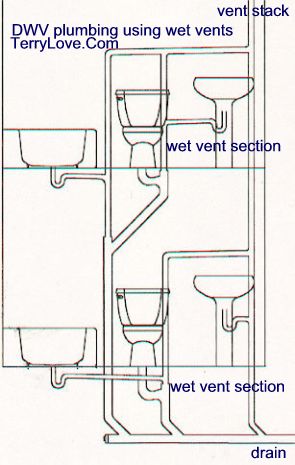
Wet venting examples

dwv_b1.jpg
 
Last edited:
If you are venting off the horizontal, it should be a wye fitting rolled so that the vent is higher then the flow level of the pipe.

That way the vent stays dry.
In Ontario, you are allowed to install a sanitary T on it's back or above the horizontal plane min. 45 degrees to offset the dry vent to the nearest wall.

A Y will work too, but he is not restricted
 
Last edited:
In this case its just over 3 feet, but it sounds like it would need an additional vent anyway since the opposite vent is behind a toilet.

Absolutely, a vent is still required. It would be easier for you to be code compliant to install a 3x3x2 Y at the vertical stack lower than your toilet connection
 
Absolutely, a vent is still required. It would be easier for you to be code compliant to install a 3x3x2 Y at the vertical stack lower than your toilet connection

I completely agree, especially since sawing out the right angle will probably not leave me enough pipe to get another corner piece in. Unfortunately, to connect in below the right angle on the vertical would probably require me to open up a wall in the washroom below. Alternatively, I could lead the 2" in parallel all the way down to the basement, where I could make the connection there, avoiding holes in finished drywall.
 
In response to your question regarding venting through the roof, yes, you can have as many vents through the roof as you want. Most people prefer to minimize those, and combine them in the attic so they only need one. Note too, that the size of the vent going through the roof depends on the things it is venting...i.e., you might need to increase the size of it going through. In cold countries, it often requires it to be expanded before going through the roof to prevent it from closing up with frost.
 
. In cold countries, it often requires it to be expanded before going through the roof to prevent it from closing up with frost.
Ontario's code reuires a min. diametre of 3" through the roof, but inside the house it can be what ever is required for the fixture as long as you have an existing min. 3" stack penetrating through the roof
 
That horizontal vent off the shower arm. You can't do that. Vents must rise vertical until they are 6" above the flood level rim of the highest fixture served.
 
Just being within ANY distance to another pipe, does not mean you do NOT need a vent. WHAT that pipe is, what's connected to it, and WHERE they are connected ALL have a bearing on whether you need a separate vent. In many cases you can be 6" from the pipe and STILL need a vent. I would revise the piping so I did not need that horizontal vent line, and maybe not even the AAV.
 
Just being within ANY distance to another pipe, does not mean you do NOT need a vent. WHAT that pipe is, what's connected to it, and WHERE they are connected ALL have a bearing on whether you need a separate vent. In many cases you can be 6" from the pipe and STILL need a vent. I would revise the piping so I did not need that horizontal vent line, and maybe not even the AAV.

I honestly don't see how I can avoid this situation.. The drain is in the middle of a shower stall, the drain is 3 feet away, during which there are no walls. The vent for that drain is on the other side of the actual drain from the shower. Since the vent is on the other side of the drain from the shower, I need a vent on the shower side, but there are no walls between the drain and the vertical downwards stack. The only new DWV piping is the part from the shower.

I've attached multiple angles for anyone who has a suggestion. This version still has it connecting to the 3" at that level, but I'm planning on connecting it on the lower vertical. Feedback is very much appreciated, thanks!
 

Attachments

  • Bathroom & Master&.jpg
    Bathroom & Master&.jpg
    41.5 KB · Views: 536
  • Bathroom & Master&.jpg
    Bathroom & Master&.jpg
    66.7 KB · Views: 534
  • Bathroom & Master&.jpg
    Bathroom & Master&.jpg
    43.9 KB · Views: 504
If I were doing this in Seattle, I could flat vent the shower, as long as I was using a wye fitting, the vent was raised above the flow level of the waste line, and I use a waste fitting at the 90 going up, not a vent fitting. Any fitting below the flood level would be rated for drainage.

I guess the East Coast doesn't have this option. There, they would bring the waste to the wall where the vent is going up, and attack it from that direction.
Which frankly, is always the best way.

When the inspector looks at it, he will know if it passes your local code.
Have you given him a call yet and shown him the drawings? He's the one you need to please.
 
If I were doing this in Seattle, I could flat vent the shower, as long as I was using a wye fitting, the vent was raised above the flow level of the waste line, and I use a waste fitting at the 90 going up, not a vent fitting. Any fitting below the flood level would be rated for drainage.

I guess the East Coast doesn't have this option. There, they would bring the waste to the wall where the vent is going up, and attack it from that direction.
Which frankly, is always the best way.

When the inspector looks at it, he will know if it passes your local code.
Have you given him a call yet and shown him the drawings? He's the one you need to please.

Apparently all of our building inspectors are on injury leave, so I've been waiting for 3 weeks to get the plans reviewed. Should be hearing from them soon though.

Thanks
 
That horizontal vent off the shower arm. You can't do that. Vents must rise vertical until they are 6" above the flood level rim of the highest fixture served.

Considering there's no wall available between the drain and the stack going down to the basement, how is it possible to vent in this scenario? Consider a drain that goes down to the basement 3 feet away, but is in the middle of a room, how can you vent this?
 
Back
Top