View Full Version : Floor cut too far to mount flange to floor
chiefplt
08-28-2009, 09:41 PM
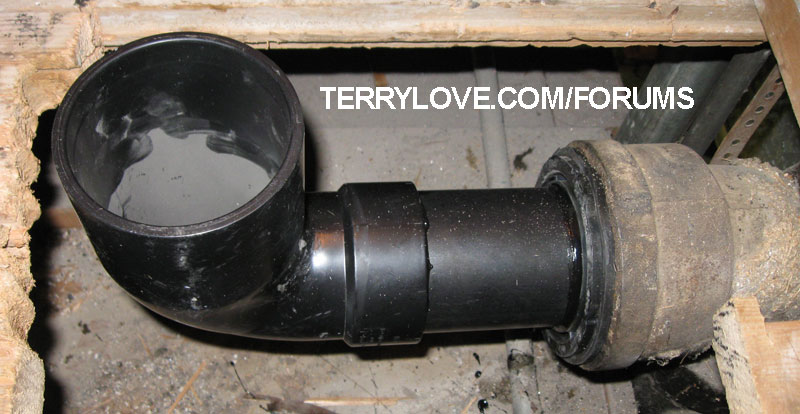
I'm resetting a toilet in one of my bathrooms that has begun to smell - I figured the problem was the wax seal. When I got the toilet off though, I realized that the existing flange was very old and not mounted to the floor at all. It is a cast iron pipe and flange. I purchased a new flange with a rubberized gasket that is supposed to form a seal around the outside of the 4" drain pipe.
My problem is that my entire floor and subfloor is cut so far away that I have nothing to mount the flange to. I can put it on top of the drain pipe, but can't secure it to the floor.
I discovered because I had already put on a new wax seal and placed the toilet when I realized I couldn't get it to stop wobbling. I kept on tightening the closet bolts, but finally realized that when I was tightening the bolts, I was just pulling the flange up off the drain pipe.
Without mounting the flange to the floor, how is it possible to get a good tight seal and a non-wobbling toilet? I looked a bit for something that would go over the flange and extend enough on the sides to allow me to mount it to the floor, but couldn't find anything. Any ideas?
http://farm3.static.flickr.com/2647/3865967715_3fb4014aaa_m.jpg
Gary Swart
08-29-2009, 12:04 AM
You're going to have to get creative, but I would approach it something like this. I would remove the flange and square the hole in the floor up. If you keep the hole within the area the toilet covers, it won't show later. Now I'd take a piece of 3/4" plywood and cut a hole just large enough for the flange to go through. Then attach that plywood to the underside of the sub floor, keeping the flange hole oriented to the closet bend. Cut a filler piece of plywood for the squared out hole and scribe the flange hole on it then cut it out. Screw that plywood to the piece under the sub floor. Don't skimp on screws. You might have to build up the resulting floor a tad to get it level with the rest of the floor. Now you can reattach the flange and screw it down to the repaired floor. Again, as long as you keep the repairs inside the toilet's footprint, it will not show. Use exterior plywood of course.
Dunbar Plumbing
08-29-2009, 12:10 AM
I turned a job down like this today. Too involved for a friday and it was rental property.
The fellow understood that I wouldn't warrant anything unless I brought it back to industry standard, nothing less.
That means the flange resting on top of the finished floor's surface, nothing less.
He was explaining to me that when the wax ring was on the flange, it was flush with the new wood floor that was overlayed. WTF???!??!!?!?!?!?!?!? :eek:
See a previous reply. Have a plumber install a new cast iron flange using a lead/oakum joint, and the install the toilet over it.
Gary Swart
08-29-2009, 12:03 PM
A leak-oakum joint will be the best by far because the toilet will be almost entirely supported by the cast iron drain and flange, but I believe you still should close the hole around and under the flange as I described.
They can fill the opening, but it would not be NECESSARY.
Jeff1
09-01-2009, 01:51 PM
I've now got a very secure flange, and a very secure throne! I hope this gives you some food for thought.
I'm not sure I want any food with that throne:p
Dunbar Plumbing
09-01-2009, 05:54 PM
Knowing the age and degredation of that lead bend, for the # of years that has been in service...
how come you didn't do a conversion and remove that lead, which you know will have to come out someday, knowing how it looked on the outside of that lead?
http://www.terrylove.com/images/replace_lead_bend.jpg
Problems with lead bends are completely different than with a cast iron bend, as are the solutions. The only "good" lead bend is one which is melting in the lead pot.
gardner
09-03-2009, 10:28 PM
There was another similar thread not long ago:
http://www.terrylove.com/forums/showthread.php?t=24778
You can feed some 2x2 or 2x3 reinforcements down beside the riser and screw into them from the top. Then cut a ring of 5/8 or 3/4 or whatever plywood to fill the gap. If you have access from below it would be easier.