
Moving washing machine, this is my plan...will it work?

detz

New Member
Messages
3
Reaction score
0
Points
0
Location
Massachusetts
I'm moving the washing machine to the other side of the basement and I've come up with this plan so I'm checking with the pros to see how valid it is. The currently system consist of 2" copper lines running to the sink and dishwasher upstairs. There is a 2" drain pipe coming just form the sink(and dishwasher) and nothing else which I plan to tap into. At the bottom of the drain pipe(about 6 inches from the basement floor) there is a T that is currently capped(maybe fore a future washing machine?)

So, in my picture the gray sections are the existing pipes and green are the future pipes. Is there anything wrong with this?

I guess my main concerns are.

1.) Can the washing machine and dishwasher be on at the same time and the kitchen sink will still be usable?
2.) Will the drain "suck" the water from the sink trap?
3.) Is the 2" pipe sufficient for the washing machine?
 

Attachments

  • washer.png
    washer.png
    19.5 KB · Views: 1,861
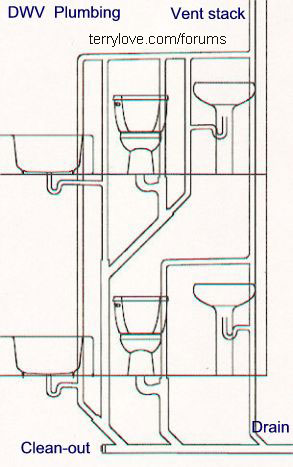
When the sink or dishwasher drain above, it will either suck the water from the washer p-trap, or cause it to overflow.

The washer needs a vent.

The 2" line is fine for the kitchen sink

Some places require 3" to the tee for the washer.
 
When the sink or dishwasher drain above, it will either suck the water from the washer p-trap, or cause it to overflow.

The washer needs a vent.

The 2" line is fine for the kitchen sink

Some places require 3" to the tee for the washer.

Spot on! Time to call a plumber
 
When the sink or dishwasher drain above, it will either suck the water from the washer p-trap, or cause it to overflow.

The washer needs a vent.

The 2" line is fine for the kitchen sink

Some places require 3" to the tee for the washer.

Is this because of the height, does the drop causes this? The vent attached to the current drain wouldn't work? Is there an easy solution to this without running a new vent to the top?


Spot on! Time to call a plumber

I did..three actually. Two never called me back and one wanted $75/hour just to come look at it and give me a quote. :rolleyes: That's when I decided it's worth trying myself.
 
So if I'm understanding this venting thing correctly the vent for the washer would have to go before the p-trap and have to extend up past the sink drain to work properly? See new image.
 

Attachments

  • washer2.jpg
    washer2.jpg
    21.7 KB · Views: 5,641
The vent's good but you still can't dump the washer into a 2" vertical wet stack. It needs it's own 3" branch. $ 75.00 is pretty cheap. Most plumbers will apply it to the final bill if they get the job. We don't leave the shop for less than $ 137.50 an hour.
 
drain

MILLIONS of washers are installed with 2" drain lines and work perfectly. The vent would have to tie in above the SINK, not the sink drain. The washer drain will still overflow if the sink line plugs up.
 
And MILLIONS of them don't meet the 06 IPC code either. Same thing with drum and S traps, backwater valves, crown vents, 1 1/2 washer drains and the list goes on. But if'n you are gonna do it today, do it right.
 
Is this because of the height, does the drop causes this? The vent attached to the current drain wouldn't work? Is there an easy solution to this without running a new vent to the top?


It has nothing to do with the height.

How do you expect a 2" drain with water coming down it, to act effectively as a vent for anything?

Who doesn't anybody want to vent their basement projects properly? Ever?
 
Back
Top