Basement bathroom plumbing

willy1094

New Member
Messages
5
Reaction score
0
Points
0
Hello, I'm working on installing a bathroom in the lower lever of a bi-level. There is no roughed in plumbing so I have to remove slab and tie into the drain. All drains and stack run down into the room that will be the new bathroom and are pvc. They go into cast iron under the floor. The cast iron runs to the left along the footer and, I assume, out the side of the house. I plan on taking out concrete along the drain to the wall ajoining the garage. Then I'll cut the cast iron and replace with pvc. My question is, am I allowed to connect the shower drain just after the cast and pvc connection. I ask because I know you should not run toilet drain upstream from show/sink. If I connect the shower here, the entire house will drain upstream of the shower drain connection. How would I make this connection if this is not allowed. I tried to attach a quick drawing but was too large. Here is a link to it... http://i295.photobucket.com/albums/mm131/bucketwilly1094/1234.jpg
Thanks
 
drains

Since your PVC goes to cast iron at the floor level, what makes you thing PVC is even allowed under the floor in your area, unless you have checked with your building department. A plan view of the plumbing, such as you have, tells us NOTHING about HOW you intend to install the piping, and HOW you install it will determine whether it is legal or not. When you apply for your building permit, they will probably ask you for a drawing of the piping as you intend to install it. Then THEY will modify it as necessary, or tell you the deficiencies so you can revise the drawing. You ARE applying for a permit aren't you, because without one, with its necessary inspections, you could be setting yourself up for a lifetime of plumbing problems by doing it incorrectly. And there is no way WE can keep you from doing it incorrectly.
 
Thanks for the reply.
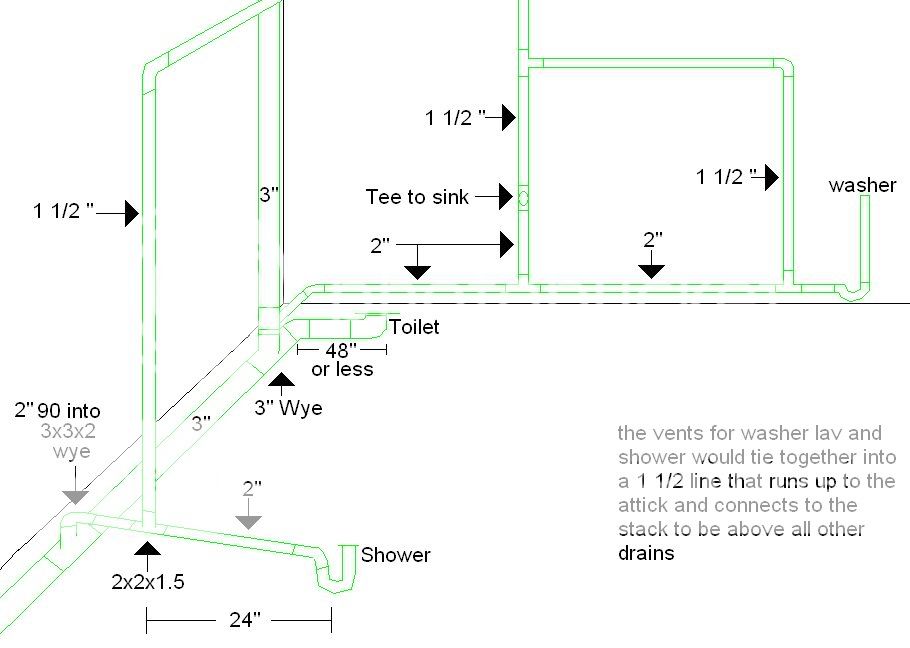
The PVC underground is ok in my area. Cast was installed under the floor 28 years ago (house built 1980). I have made another drawing to help show how I was intending to make the connection. I hope it makes it clearer between the other drawing and this one. I do plan on pulling a permit but looking for some planning advice to maybe save a step. My only concern is weather the shower can be tied into the sewer at the point I plan on doing it given the fact the two toilets would be up stream of that connection (since it is being tied into the main drain). I hope this shows how I intend to make the connection if not please let me know how I can do that.
basement3.jpg

1234.jpg
 
piping

I guess the nicest thing to say is "hit the erase button and start over". The shower will CANNOT be vented the way you show it. I don't think there is a 3" side inlet tee, and even if there is you cannot use it for the toilet connection. As you show it, the lavatory and washer will be improperly vented and you will create drainage problems for the lavatory when the washer drains.
 
Best advice us plumbers can give you is to sit down with your local plumbing inspector and talk to him about your plans. He can help you with properly setting up the drains and vents. But there is a chance like here in Illinois, they will tell you a home owner is not allowed to do such a major plumbing job and that you need to hire a licensed plumber. Illinois code does allow the homeowner, site maintenance person, and handy man to do minor plumbing repairs. Which is defined as replacing a washer in a faucet, flapper in a water closet. If it involves disconnecting a fixture, or piping, it is no longer minor.
 
I'm in Illinois as well (downstate) and in our location, a homeowner is allowed to do any plumbing - major or minor - so long as it is permitted and inspected.

I don't think Illinois has statewide code that controls what homeowners can and cannot do - that is up to the local municipalities, as far as I understand.
 
Adding a basement bath is definitely a pretty big job. You are on the right track by being here on the forum. Maybe someone will be nice enough to "make" a hypothetical drawing for you that you can consider. Don't know. I guess if you make mistakes, the inspector will just tell you to correct(which of course will be time and money). Just make sure you don't burn your house down soldering the copper pipe. I'm pretty sure you have to sign an insurance waiver while you are performing the work. Keep a fire extinguisher on hand and a piece of sheet metal to protect the wood when you are soldering near wood.

That toilet connection should probably go into a wye to it doesn't disrupt flow. Not a pro plumber, so I only have limited knowledge about the codes. I think measurements on your drawings will also help others(ex. how many feet are the walls and other measurements from pipes).
 
I'm in Illinois as well (downstate) and in our location, a homeowner is allowed to do any plumbing - major or minor - so long as it is permitted and inspected.

I don't think Illinois has statewide code that controls what homeowners can and cannot do - that is up to the local municipalities, as far as I understand.

Illinois has a basic Plumbing code law, that is the minimum that any locality is supposed to follow. Localities can make the code stricter but not anything less than what the Illinois code allows for. I was just at a continued education class that was ran by the State in Rend Lake, Illinois. The state inspectors, went over the plumbing code changes for Illinois, and one of the attendees brought up the question about home owners doing their own plumbing repairs and modifications. The state inspector then informed us about the part in the code that states Homeowners, maintenance men are allowed to only do minor plumbing repairs. Before you go off on this project, i would check with your local permit office or building department and ask them if an unlicensed person can do such a major plumbing job.
 
I guess the nicest thing to say is "hit the erase button and start over". The shower will CANNOT be vented the way you show it. I don't think there is a 3" side inlet tee, and even if there is you cannot use it for the toilet connection. As you show it, the lavatory and washer will be improperly vented and you will create drainage problems for the lavatory when the washer drains.

I didn't include any venting in my drawing for lav and washer but was going to vent it. Just wanted to try to keep the drawing on the drains so it would be easier to follow. I guess the problem with the vent on the shower is because it does't vent until the tee? As suggested I would use a wye instead of a side inlet tee for the toilet. I guess if all I'm going to get is "that's wrong" with no info I don't need a reply. I was just looking for help with my layout and looking for suggestions. Thanks to those that did include suggestions (as with using the wye).
 
message

quote; I guess if all I'm going to get is "that's wrong" with no info I don't need a reply.

Sounds like you have got your back up there. We can see when it is "wrong", but there can be many possible "right" ways, but not all of them would fit your situation and until we know more about your situation, and sometimes that requires that "THE PLUMBER" be inside your house, why would you expect us to go to the trouble of advising potentially useless solutions?
 
I've made the changes that were suggested and did some other little changes including the vents. Please if something is wrong tell me what it is and maybe how to fix it (if only one way). Even if I don't sound like it in my replies, I really do appreciate the help! :D
bathroom20.jpg
 
Back
Top