Drain Fittings

Wolf88

New Member
Messages
2
Reaction score
0
Points
0
Location
Arizona
Howdy,

Please clear up the correct usage of a san-tee versus a wye. Which or either can be used in the following instances:
1) 2" horiz. shower drain (after venting) into the main 3" horiz. drain line (the san-tee 2" branch is laying horizontally).
2) 1.5" vertical dry vent off a horiz. toilet drain line.
3) 3" vertical dry vent off a 3" horiz. drain line.

Also, if a toilet 3" drain (after running 4' horiz.) wyes into the main horiz. 3" drain line and there is a 3" vertical vent just 1' further down the main drain, must there also be a vent on the toilet drain before the wye? There are (2) lavs, one tub, and a shower entering the main drain line upstream of the toilet wye (all vented properly prior to the wye).

Thanks.
 
When recieving the waste or discharge from fixtures, sanitary wye's must be placed in the vertical position with the discharge entering the branch. A sanitary may be used in the horizontal position for venting if it is 6" above the flood level rim of the highest fixture served or if the branch is dry. IPC table 706.3
 
tee

quote; When recieving the waste or discharge from fixtures, sanitary wye's must be placed in the vertical position with the discharge entering the branch.

The "Y" can be connected with the "discharge" entering either upstream opening. AND the "Y" can be rotated in any direction above the horizontal. It can also be used in a vertical line for any purpose other than the connection of an otherwise unvented fixture. A tee can only be used in a vertical line for the connection of an otherwise unvented fixture, or in the vent system above the overflow line of the fixtures, or 42" above the floor whichever is highest.
 
Last edited:
It's a bit confusing to explain isn't it. I have the pictures from the code book but I hav'nt found a way to get them on here. Anyhooo. Do not make the mistake of using a vertical wye to recieve the waste from a lav as this puts the trap weir above the center line and creates an S trap.

I like to think of it a bit like this. A wye is generally the right fitting to use horizontally and a sanitary fitting is generally the right fitting to use vertically. There are of course exceptions but thats where having a copy of the code book comes in handy.
 
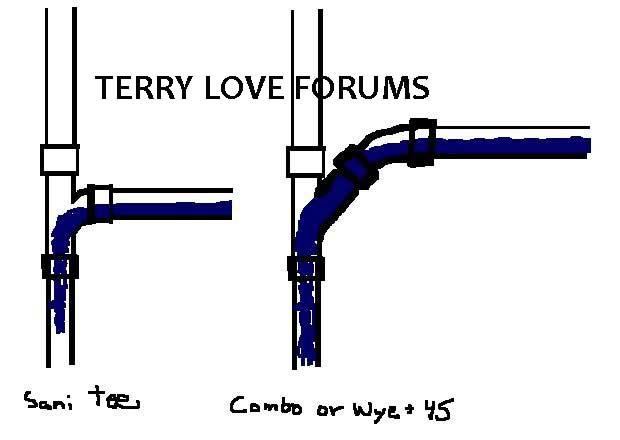
Maybe this will let you see what happens with the 2 fittings on a dirty arm in regards to venting.

ventingsaniteevswye45orcombo.jpg
 
Last edited by a moderator:
Thanks

Thanks for all the responses!

So to recap, only use a san-tee in the horizontal with the branch in the horiz. if you are venting and 6" or higher above the weir.

Below this point, only use a san-tee horiz. with the branch in the vertical and only for discharge (not a vent).

What is not clear is if you have to individually vent a toilet discharge before it enters the main discharge line if there is a dry vent within 5 feet.

I appreciate your sharing of knowledge and patience with explanations.
 
I lost you in translation.

A sanitary tee is used on a the vertical. The waste enters the side and the vent is usually out the top. It could be used as a vent tee abouve flood rim, I think. It is never used horizontal in a waste line.

A wye is not used on the vertical to connect a waste arm. It can be use on the horizontal to connect a branch, and if rolled up 45º it can connect a vent.
 
tee

So to recap, only use a san-tee in the horizontal with the branch in the horiz. if you are venting and 6" or higher above the weir.

IF you are using it for a vent the branch can be pointing in any direction, but it would usually be DOWNWARDS below the horizontal

Below this point, only use a san-tee horiz. with the branch in the vertical and only for discharge (not a vent).

Below this point NEVER use a sanitary tee horizontal regardless of the branch direction or use.

What is not clear is if you have to individually vent a toilet discharge before it enters the main discharge line if there is a dry vent within 5 feet.

The distance is not as important as where it is connected. After all, the refrigerator could be within 5 feet of the kitchen table, but the milk on the table will still go sour.
 
Back
Top