View Full Version : Navien tankless
willl
12-28-2008, 01:00 PM
Hello everyone,
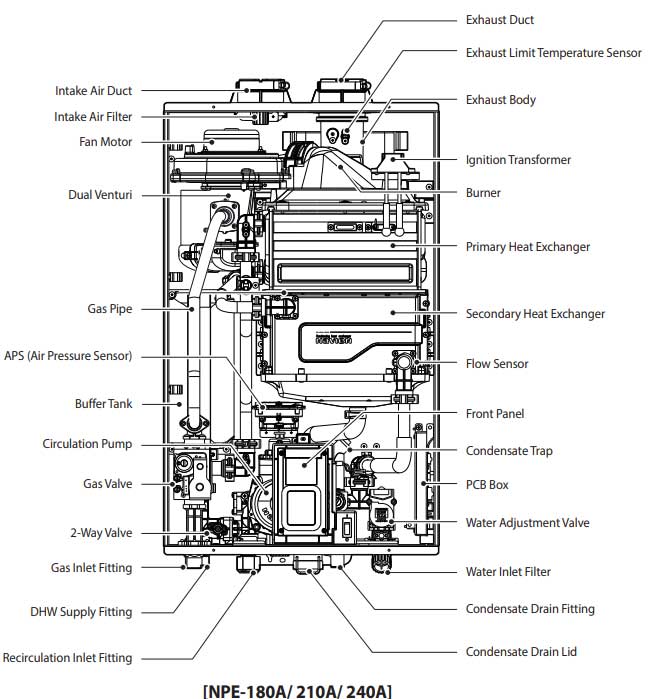
I am considering getting a navien tankless water heater. Originally I decided against tankless because of the maintenance issue but these naviens claim that they don't require any maintenance. My plumber is the one that told me about them. They also can be vented with pvc instead of stainless. Pretty neat. Anybody heard of them or has used them. Thanks
Redwood
12-28-2008, 02:51 PM
Korean Tankless has now hit our shores...:eek:
If I was installing a tankless I would stick with the big 3...
Probedude
12-28-2008, 06:28 PM
Will, I haven't heard of them, nor do I have much experience with tankless but I do question whether they're worth it in the long run.
What's the main reason that is pushing you into buying a tankless?
Gary Swart
01-06-2009, 05:25 PM
Here's an unheard of brand from Korea that is promising a tankless heater that needs no maintenance. Wow! Where do I sign up? Don't kid yourself, everything manufactured will need some kind of maintenance or repair.
Here is a recent article from Consumer Reports posted a few weeks ago by another forum user. I suggest you read it carefully.
Heating water accounts for up to 30 percent of the average home's energy budget. Some makers of gas-fired tankless water heaters claim their products can cut your energy costs up to half over regular storage heaters. So is it time to switch?
Probably not. Gas tankless water heaters, which use high-powered burners to quickly heat water as it runs through a heat exchanger, were 22 percent more energy efficient on average than the gas-fired storage-tank models in our tests. That translates into a savings of around $70 to $80 per year, based on 2008 national energy costs. But because they cost much more than storage water heaters, it can take up to 22 years to break even—longer than the 20-year life of many models. Moreover, our online poll of 1,200 readers revealed wide variations in installation costs, energy savings, and satisfaction.
With the help of an outside lab, we pitted Takagi and Noritz gas-fired tankless water heaters against three storage water heaters. EvenWe didn't test electric tankless heaters because many can't deliver hot water fast enough to replace a conventional water heater if ground*water is cold. in areas with warm groundwater, most homeowners would need to upgrade their electrical service to power a whole-house tankless model.
Our tests simulated daily use of 76 to 78 gallons of hot water. That's the equivalent of taking three showers, washing one laun*dry load, running the dishwasher once (six cycles), and turning on the faucet nine times, for a total of 19 draws. While that's considered heavy use compared with the standard Department of Energy test, we think it more accurately represents an average family's habits. We also ran more than 45,000 gallons of very hard water through a tanked model and a Rinnai tankless model to simulate about 11 years of regular use.
Here's what else we found:
Water runs hot and cold
Manufacturers of tankless water heaters are fond of touting their products' ability to provide an endless amount of hot water. But inconsistent water temperatures were a common complaint among our poll respondents. When you turn on the faucet, tankless models feed in some cold water to gauge how big a temperature rise is needed. If there's cool water lingering in your pipes, you'll receive a momentary "cold-water sandwich" between the old and new hot water. And a tankless water heater's burner might not ignite when you try to get just a trickle of hot water for, say, shaving.
Nor do tankless water heaters deliver hot water instantaneously. It takes time to heat the water to the target temperature, and just like storage water heaters, any cold water in the pipes needs to be pushed out. And tankless models' electric controls mean you'll also lose hot water during a power outage.
Up-front costs are high
The tankless water heaters we tested cost $800 to $1,150, compared with $300 to $480 for the regular storage-tank types. Tankless models need electrical outlets for their fan and electronics, upgraded gas pipes, and a new ventilation system. That can bring average installation costs to $1,200, compared with $300 for storage-tank models.
Tankless units might need more care
During our long-term testing, an indicator on the tankless model warned of scale buildup. We paid $334 for special valves and a plumber to flush out the water heater with vinegar. Many industry pros recommend that tankless models be serviced once a year by a qualified technician. Calcium buildup can decrease efficiency, restrict water flow, and damage tankless models. Experts suggest installing a water softener if your water hardness is above 11 grains per gallon. Ignoring this advice can shorten your warranty.
Efficient storage models are pricey
We also tested the $1,400 Vertex, a high-efficiency storage water heater by A.O. Smith. The manufacturer claims its installation costs are similar to a regular storage model. But its high cost offsets much of the roughly $70 per year the Vertex will save you. Instead, we recommend buying a conventional storage water heater with a 9- or 12-year warranty. In previous tests, we found that those models generally had thicker insulation, bigger burners or larger heating elements, and better corrosion-fighting metal rods called anodes.
Posted: September 2008 — Consumer Reports Magazine issue: October 2008

master plumber mark
01-06-2009, 10:04 PM
I guess if it breaks down,
they will fly over a service tech...
i doubt that their are many in the states yet
I guess if it breaks down,
they will fly over a service tech...
i doubt that their are many in the states yet
There's something to that- it'll be awhile before NavienAmerica is put to the full service test. But the designers & manufacturers behind it aren't 3rd rate slouches.
Scuttlebutt has it that the engineering resources behind the design are former Takagi (a top-end Japanese tankless manufacturer) guys working for the well estabished Korean boiler manufacturer. The condensing design is relatively new, but they're way up there on the true-efficiency end compared to standard non-condensing versions from other manufacturers. Whether the support & service aspects are up to snuff compared to Takagi, Rinnai or Bosch et al remains to be seen. I personally know one person using it as a combination hydronic boiler/HW backup heater for his solar heating system- no problems noted, but it's been in service less than a year. We'll see.
But no maintenance? (Wanna buy a bridge? ;-) ) Cleaning the filters is important, and if you have hard water there can be scaling issues cutting into efficiency with any tankless. But even a scaled-up Navien will be more efficient than any tank except the very-top-of-the-line European stratified-condensing tank heaters (which cost significantly more.)
BTW: That Consumer Union report/article comparing tanks to on-demands is a garbage measurement with even worse advice. See my detailed response on this thread:
http://www.terrylove.com/forums/showthread.php?t=25461&page=2
Gas-fired tanks only achieve their paltry efficiency in very high-volume use profiles, and fall off an efficiency cliff the lower you go. Any tankless, even in worst-case use scenarios will beat best-case use profiles for standard tanks (even beating some more sophisticated expensive condensing tanks!) Tankless HW heaters have their quirks, but they're know, with known measures for mitigating them.
But if your space heating is done with pumped hot water you'll usually get better overall performance at a much lower up-front cost (without the quirks) by adding an indirect-fired HW tank as a priority zone onto the existing heating system. The added value gas saved by the Navien's condensing aspect won't likely be greater than the boost you get to the overall system efficiency by increasing the duty cycle of the heating system boiler- even a lowly 83% AFUE cast-iron boiler.
JM Plumbing & Heating
01-15-2009, 07:03 PM
To who ever commented about the Navien tankless water heater system.
It is all true. Best system we have worked with. Not only do you get stainless steel heat exchangers but Dual heat exchangers with condensing technology.
The system is 16-20% more efficient than any other regular tankless in the industry.
Visit us online and Educate yourself-
WWW.TANKLESSDEALS.COM
Get your Navien Tankless from us Today!
You will not regret it at any moment. Look over our gallery for real installation pictures.
:)
Redwood
01-16-2009, 06:44 AM
One post wonders posting praise of a product....
Sybil attack? Google it!
To who ever commented about the Navien tankless water heater system.
It is all true. Best system we have worked with. Not only do you get stainless steel heat exchangers but Dual heat exchangers with condensing technology.
The system is 16-20% more efficient than any other regular tankless in the industry.
Visit us online and Educate yourself-
WWW.TANKLESSDEALS.COM
Get your Navien Tankless from us Today!
You will not regret it at any moment. Look over our gallery for real installation pictures.
:)
Yadda yadda...
What is your total installed base?
How many of them are being used in combi-systems? (And what percentage is HW only?)
What's the average length of service in your installed base? (And how often have you been called back for service, adjusment or repair?)
They may be the greatest tankless ever, but near as I can tell it's still the thin edge of the market-penetration edge. Real reliablity numbers will show up after there are significant numbers in service for a decade or more (unless there are real lemon-issues.) For the time being I'm agnostic on 'em.
And I've yet to see anything that looked like real test data on their condensing efficiency in combi systems. (I'd be surprised if the combustion efficiency was any more than 86-88% when running fan coils or maintaining heating buffer tanks, a meagre premium over a standard Takagi or Rinnai in those applications.)
JM Plumbing & Heating
01-17-2009, 09:03 PM
Dana,
Are you a plumber, environmentalist, etc? Our base is a solid firm number. Both systems are being used through out the US right now. Our units have been installed in the last 12 months with no call backs or problems what so ever. But if we do get call back, so what! We go, diagnose and find the solution.
Just like any equipment from plasma TV's to Hot water heaters. Its not always going to be perfect, maintenance free.
Navien HWH have over 10 years of field testing DATA.
The CEO of Navien now, used to be the VP of TAKAGI... and Takagi is the worlds oldest leading tankless manufacture in the world.
To me- Rinnai, Takagi, Rheem, Navien, Bosch are all wonderful tankless units that require maintenance and servicing at least once every two years.
No matter what they say- You can't get a unit HWH installed and walk away forever and not look back to check on it!
:):D
Yadda yadda...
What is your total installed base?
How many of them are being used in combi-systems? (And what percentage is HW only?)
What's the average length of service in your installed base? (And how often have you been called back for service, adjusment or repair?)
They may be the greatest tankless ever, but near as I can tell it's still the thin edge of the market-penetration edge. Real reliablity numbers will show up after there are significant numbers in service for a decade or more (unless there are real lemon-issues.) For the time being I'm agnostic on 'em.
And I've yet to see anything that looked like real test data on their condensing efficiency in combi systems. (I'd be surprised if the combustion efficiency was any more than 86-88% when running fan coils or maintaining heating buffer tanks, a meagre premium over a standard Takagi or Rinnai in those applications.)
nhmaster
01-18-2009, 07:59 AM
Here we go again. how many times a month does this same old topic come up? Those of you that like them, install them have them in your house will all say how wonderfull you think they are because you have a stake in the thing. Before you all spout off in either direction, spend a couple Google hrs and get out your code book and then run the damn numbers. If you come up with anything we don't already know then by all means keep us informed but for now this is, as usual, a total waste of time.
gregsauls
01-18-2009, 08:22 AM
Maybe it needs to be said.... Internet opinions are not a true indications of the state of the technology. When you have kids, the unhappy ones are noisy, whiny, complaining... and BLOGGING about it! The happy kids you don't usually hear from and as such may not hear how good it is. I would imagine that complainers of tankless systems on the internet are a very small percentage of the installed base... ie: happy users far outnumber the unhappy users. Possible exception, Bosch users!
Some people, a growing number I might add, don't care about "the numbers". They install them for other reasons, I know I did. Not to worry, the next generation of plumbers will probably embrace technological change readily.
nhmaster
01-18-2009, 01:04 PM
What other reasons? This is a crap statement. I like to spend more money for very little return because what? Give me a break. And don't go telling me they are environmentally friendly because that's crap also. They are manufactured in a factory spewing carbon into the air. They burn gas spewing carbon into the air. So what are the "other reasons" Your house is so cramped you cant take up another 6 cubic feet of space? face it. You got talked into it, bought it and now have to find a way to justify it. So where is the advantage? Oh I know. It doesn't run all day long when I'm not home (that one from Trethewey) News for you guys a newer tank type heater doesn't run either due to the very high level of insulation. In fact last winter I shut off my boiler. Went to Florida for a week. Came home and the tank was still hot (Buderus indirect) You all have been sold a load of crap just like Hybrid cars, wind mills and all that other junk that costs 3 times more than it will EVER pay back and has zero environmental impact. If this junk did what it was supposed to do, why would the government have to subsidise it?
Don't forget to watch the biggest scam of all on Tuesday.
gregsauls
01-18-2009, 03:02 PM
What other reasons? This is a crap statement. I like to spend more money for very little return because what? Give me a break. And don't go telling me they are environmentally friendly because that's crap also. They are manufactured in a factory spewing carbon into the air. They burn gas spewing carbon into the air. So what are the "other reasons" Your house is so cramped you cant take up another 6 cubic feet of space? face it. You got talked into it, bought it and now have to find a way to justify it. So where is the advantage? Oh I know. It doesn't run all day long when I'm not home (that one from Trethewey) News for you guys a newer tank type heater doesn't run either due to the very high level of insulation. In fact last winter I shut off my boiler. Went to Florida for a week. Came home and the tank was still hot (Buderus indirect) You all have been sold a load of crap just like Hybrid cars, wind mills and all that other junk that costs 3 times more than it will EVER pay back and has zero environmental impact. If this junk did what it was supposed to do, why would the government have to subsidise it?
Don't forget to watch the biggest scam of all on Tuesday.
What a crock of bull NHMaster! I didn't get talked into installing a tankless water heater by anyone. No plumber came to my house and gave me an outlandish quote for some inferior technology that he felt comfortable installing because he doesn't want to look at the future and see it about to run over him like a mile long freight train. I made an educated purchase based on my own research... period. I will live with it just fine.
Frankly, NHMaster, your refusal to see anyone elses point of view on this subject and quickly take swipes when posters don't walk lock step with you is very disturbing. I'm sure you won't lose too much sleep giving highly slanted, old world views. Maybe an ignore is best in this situation.
Gary Swart
01-18-2009, 04:37 PM
It never ceases to amaze me how often DIY wanna be's pose a question then want to argue when the overwhelming majority of responses are opposite of what they are looking for.
Sir, I suggest you go ahead an install your tankless heater, it's what you decided you were going to do before you asked the question anyway. I hope you will be very happy with it and that it is everything you expect it to be. Just don't take umbrage when professionals try to warn you of pitfalls.
nhmaster
01-18-2009, 05:24 PM
What a crock of bull NHMaster! I didn't get talked into installing a tankless water heater by anyone. No plumber came to my house and gave me an outlandish quote for some inferior technology that he felt comfortable installing because he doesn't want to look at the future and see it about to run over him like a mile long freight train. I made an educated purchase based on my own research... period. I will live with it just fine.
Frankly, NHMaster, your refusal to see anyone elses point of view on this subject and quickly take swipes when posters don't walk lock step with you is very disturbing. I'm sure you won't lose too much sleep giving highly slanted, old world views. Maybe an ignore is best in this situation.
The Future? If you really had done the research you would have discovered that tankless, instantaneous water heaters have been around for better than 30 years now. You would also have discovered that the operational cost versus the cost of the equipment and installation just don't add up. I have listened too and done a whole lot of research on the subject, check my bio, it's my job. I have absolutly no stake or interest in what your decision is or was. I only point out the facts. That you choose to ignoer themis naturally, your own business. before I bid you adieu though, please inform us as to the "other reasons" for installing your tankless heater.
gregsauls
01-18-2009, 06:02 PM
please inform us as to the "other reasons" for installing your tankless heater.
You have been told in several other posts by myself why I went with one. Go look them up since you obviously have ignored them in the past. I have good reasons to use tankless in my situation and will continue to pass the good word in light of the whirlwind of bad press by a few here.
Viva la Tankless! Viva la solar. Viva la hybrid whatever. Viva la DIY.
Geez!
nhmaster
01-18-2009, 06:38 PM
sorry, I didn't catch that part. But going through your pas posts I really couldn't find a compelling reason other than the great price you got on the unit. That is in itself reason for question since even with my discount I can't buy one for that. Aside from that though, How far did you have to run the stainless steel vent pipe up through the roof because that stuff ain't cheap either. Oh and while we are at it, did you check the maximum allowable length of the vertical vent pipe. Because those darned things can and will condensate on long runs, especially if the pipe passes through a cold attic. probably nothing to worry about though.
Maybe it seems like I and others are dissing you or having sport with you and nothing could be further from the truth. What we are trying do do is educate a public that has been hypnotized into buying this line of efficiency and economy that just flat does not exist. The math is the math. People lie. Numbers do not. So other than the one in a lifetime price you got on the unit, and your ability to self install it (and btw I looked at your pictures and you did a nice job there) why would anyone consider installing one of these. Please don't give us the line about a tank type running all day long when you are not hoem because they don't. If they did the operational cost differential would be much greater than it is, and that runs about 4% normally. 4% projected over 10 or 20 years does not make up for the cost and service.
nhmaster
01-18-2009, 06:40 PM
Oh and one more thing.
Go RED SOX
Ladiesman271
01-19-2009, 02:07 AM
What other reasons? This is a crap statement. I like to spend more money for very little return because what? Give me a break. And don't go telling me they are environmentally friendly because that's crap also. They are manufactured in a factory spewing carbon into the air. They burn gas spewing carbon into the air. So what are the "other reasons" Your house is so cramped you cant take up another 6 cubic feet of space? face it. You got talked into it, bought it and now have to find a way to justify it. So where is the advantage? Oh I know. It doesn't run all day long when I'm not home (that one from Trethewey) News for you guys a newer tank type heater doesn't run either due to the very high level of insulation. In fact last winter I shut off my boiler. Went to Florida for a week. Came home and the tank was still hot (Buderus indirect) You all have been sold a load of crap just like Hybrid cars, wind mills and all that other junk that costs 3 times more than it will EVER pay back and has zero environmental impact. If this junk did what it was supposed to do, why would the government have to subsidise it?
Don't forget to watch the biggest scam of all on Tuesday.
What would it cost to have a Boderus indirect installed in the home of a consumer? Include the cost of the indirect water tank, required pipes, additional accessories, sales tax, markup, delivery, warranty!
You also need to have a boiler (AKA water heater). How much does that add to cost installed as a complete system including venting and all labor and accessories?
http://www.standardplumbing.com/catalog.html?wscdet_show=000000000110135310#top
Details - ST150
BUDERUS 40 GAL VERT INDIRECT
Item # : ST150
Vendor : ZZZ
Vnd. Item # : ST150
Pricing U/M : EA
STANDARD PLUMBING IS $ 1419.990
It is way cheaper for an end consumer to have an indirect water heater installed than to go your way!
Ladiesman271
01-19-2009, 02:21 AM
It doesn't run all day long when I'm not home (that one from Trethewey) News for you guys a newer tank type heater doesn't run either due to the very high level of insulation. In fact last winter I shut off my boiler. Went to Florida for a week. Came home and the tank was still hot (Buderus indirect)
Don't forget to watch the biggest scam of all on Tuesday.
What did you heat your house with while you were in Florida, hot air?:D
nhmaster
01-19-2009, 05:59 AM
What did you heat your house with while you were in Florida, hot air?:D
The boiler has the re-set controller on it. Alows me to shut off the hot water call.
An indirect will cost slightly less than a tankless, never run out of hot water and operate at a much lower cost. However it's only an option if you have a boiler. If not stick with a tank type water heater. There are lot's of comparison charts out there for the various ways to make hot water. It's only a Google away.
Ladiesman271
01-19-2009, 08:12 AM
An indirect will cost slightly less than a tankless, never run out of hot water and operate at a much lower cost. However it's only an option if you have a boiler. If not stick with a tank type water heater.
You also don't need to have an indirect tank, a tankless water heater, or a tank type water heater if you have a boiler. The boilers that I am familiar with (limited) are in effect tankless water heaters that have a small heated tank located inside the unit.
A couple of thousand for an indirect tank could be considered to be a waste of money.
By the way, I have nothing against a standard tank type water heater. I needed the floor space, so I used a tankless. I now have a direct vent gas fireplace taking up part of the floor space where that old water heater was located. I needed to heat my home theater room that I located in the basement, and the gas fireplace was a nice way to provide heat for that zone. The gas fireplace also keeps me away from problems caused by HVAC contractors!
nhmaster
01-19-2009, 08:48 AM
You also don't need to have an indirect tank, a tankless water heater, or a tank type water heater if you have a boiler. The boilers that I am familiar with (limited) are in effect tankless water heaters that have a small heated tank located inside the unit.
A couple of thousand for an indirect tank could be considered to be a waste of money.
By the way, I have nothing against a standard tank type water heater. I needed the floor space, so I used a tankless. I now have a direct vent gas fireplace taking up part of the floor space where that old water heater was located. I needed to heat my home theater room that I located in the basement, and the gas fireplace was a nice way to provide heat for that zone. The gas fireplace also keeps me away from problems caused by HVAC contractors!
The tankless coil is very very inefficient as it requires the boiler to maintain at least 160 degrees year round.
gregsauls
01-19-2009, 09:07 AM
sorry, I didn't catch that part. But going through your pas posts I really couldn't find a compelling reason other than the great price you got on the unit. That is in itself reason for question since even with my discount I can't buy one for that. Aside from that though, How far did you have to run the stainless steel vent pipe up through the roof because that stuff ain't cheap either. Oh and while we are at it, did you check the maximum allowable length of the vertical vent pipe. Because those darned things can and will condensate on long runs, especially if the pipe passes through a cold attic. probably nothing to worry about though.
Maybe it seems like I and others are dissing you or having sport with you and nothing could be further from the truth. What we are trying do do is educate a public that has been hypnotized into buying this line of efficiency and economy that just flat does not exist. The math is the math. People lie. Numbers do not. So other than the one in a lifetime price you got on the unit, and your ability to self install it (and btw I looked at your pictures and you did a nice job there) why would anyone consider installing one of these. Please don't give us the line about a tank type running all day long when you are not hoem because they don't. If they did the operational cost differential would be much greater than it is, and that runs about 4% normally. 4% projected over 10 or 20 years does not make up for the cost and service.
Educating the public is fine and I commend you for taking time to do so. But keep in mind, what does not work in New England may work just fine south of the Mason-Dixon line (ie, Texas). Condensation of the exhaust flue, low inlet water temp, large demand, etc all must be taken into account before recommending a hot water system. Some quality tankless systems take this and other issues into account. Rinnia for example has a kit for collecting flue condensation when the vertical run is more than 6 feet or so. My vertical run was less than 5 feet and no issue. Limited floor space for more than one waterheater and a family of 6 is what caused me to consider a "quality" tankless water heater. The $5 per month savings on my gas bill was not the reason as I NEVER looked at getting my money back on the system.
One other note, I really liked the vent system for the Rinnia. It is an outer 5.5" pvc pipe for combustion air intake with an inner 3" steel exhaust flue. Easy to cut and work with. Cost more than "B" vent but possibly more long lasting and doesn't take combustion air from garage in my case
BTW, My boys and I made the pilgrimage to Mecca and saw the Red Sox play last year at Fenway!
Ladiesman271
01-19-2009, 02:38 PM
The tankless coil is very very inefficient as it requires the boiler to maintain at least 160 degrees year round.
What's the payback period for the indirect, 20, 30 or 40 years?:D
Seems like indirect systems have their own set of problems.
http://www.terrylove.com/forums/showthread.php?t=26048
Ladiesman271
01-19-2009, 02:46 PM
Educating the public is fine and I commend you for taking time to do so. But keep in mind, what does not work in New England may work just fine south of the Mason-Dixon line (ie, Texas). Condensation of the exhaust flue, low inlet water temp, large demand, etc all must be taken into account before recommending a hot water system.
I live in MA, and a tankless works fine in my single family home here even with water coming in at 40 degrees. Just stay within the flow rate of the heater and you will never have the problem of running out of hot water.
If you "need" to run three shower heads at the same time when you shower (AKA large demand), then a tankless is probably not a good idea anywhere.
I am not sure if the electric version of a whole house tankless is a good idea. From what I have read, some utilities prohibit their use due to excessive short term demands on the power grid.
gregsauls
01-19-2009, 03:45 PM
If you "need" to run three shower heads at the same time when you shower (AKA large demand), then a tankless is probably not a good idea anywhere.
Interesting you bring this up... A couple of the upper end tankless units have a communication cable option so up to three units can be paralleled together so they can "talk" to each other and provide a greater flow rate. We are about to install just such a parallel set up at a Boy Scout camp here to supply 6 showers and ditch the 50 gal electric water heaters in favor of propane. Being on the camp inspection cmty, getting those once a year maintenance descalling done will not be an issue! :D
nhmaster
01-19-2009, 05:38 PM
Interesting you bring this up... A couple of the upper end tankless units have a communication cable option so up to three units can be paralleled together so they can "talk" to each other and provide a greater flow rate. We are about to install just such a parallel set up at a Boy Scout camp here to supply 6 showers and ditch the 50 gal electric water heaters in favor of propane. Being on the camp inspection cmty, getting those once a year maintenance descalling done will not be an issue! :D
And pray tell what was the cost of that compared to th one 50 gallon tank?. Do you guy's really ever sit down and run the numbers?
What does 2 Rinnai's, the installation materials, the electronics to "talk" to each other plus installation cost with nothing donated or discounted ?
If you were getting a price from me it would be in the 5 grand range.
And the cost of a 50 gallon electric? Around 300 bucks for the takn and maybe another 250 to put it in.
So $550.00 against $ 5,000.00.
And once again the payoff is --- Drumroll please
NEVER
gregsauls
01-19-2009, 07:26 PM
And pray tell what was the cost of that compared to th one 50 gallon tank?. Do you guy's really ever sit down and run the numbers?
What does 2 Rinnai's, the installation materials, the electronics to "talk" to each other plus installation cost with nothing donated or discounted ?
If you were getting a price from me it would be in the 5 grand range.
And the cost of a 50 gallon electric? Around 300 bucks for the takn and maybe another 250 to put it in.
So $550.00 against $ 5,000.00.
And once again the payoff is --- Drumroll please
NEVER
You just don't get it and probably never will. Keep in mind "our" plumbing supply connection at cost. So, cost to the camp for two units will be about $2k total (free install by pro-plumbers already lined up) and we get unlimited hot water. Get this, UNLIMITED HOT WATER for our campers. Something the current system can't offer. Six showers in use by two hundred campers at Winter Camp 3 weeks ago showed we had to change something when we couldn't keep up with hot water demand. Please note,I never said cost benefit, savings, ROI, nada!
UNLIMITED HOT WATER
Ladiesman271
01-19-2009, 11:03 PM
You just don't get it and probably never will. Keep in mind "our" plumbing supply connection at cost. So, cost to the camp for two units will be about $2k total (free install by pro-plumbers already lined up) and we get unlimited hot water. Get this, UNLIMITED HOT WATER for our campers. Something the current system can't offer. Six showers in use by two hundred campers at Winter Camp 3 weeks ago showed we had to change something when we couldn't keep up with hot water demand. Please note,I never said cost benefit, savings, ROI, nada!
UNLIMITED HOT WATER
It would be interesting to try to follow NHmaster's advice. One little 50 gallon electric heater for six showers in a camp. Funny how you already have multiple electric water heaters and they can't keep up with the demand.
I notice that you have followed some of NHmaster's advice.:D
"The world is full of stupid people. Try not to be one of the crowd."
nhmaster
01-20-2009, 03:54 AM
So you base you undying love for this crap on the fact that you can get the stuff and labor donated. Great, wonderfull, good for you. What about everybody else. I get it just fine. In fact I get paid to GET IT.
If one 50 gallon heater wouldn't do it you could put in 3 more and still have it cost less especially if your gracious plumbing supply sold them to you at cost also.
I'm done with this thread. It's an illogical total waste of time for anybody that is actually considering purchasing a tankless. 99.9% of folks can't get the equipment at cost and 95.9% of folks don't have the skills or tools to install the thing. Basing cost comparisons on essentially "free" equipment is rediculous. However free or not free the operating cost doesn't change and even at "cost" a 4% savings just breaks even. Good by..... Oh and when you start having problems with the thing(s) you only have to answer to a whole campground full of angry campers not just the wife and childdren. :D
gregsauls
01-20-2009, 06:25 AM
So you base you undying love for this crap on the fact that you can get the stuff and labor donated. Great, wonderfull, good for you. What about everybody else. I get it just fine. In fact I get paid to GET IT.
If one 50 gallon heater wouldn't do it you could put in 3 more and still have it cost less especially if your gracious plumbing supply sold them to you at cost also.
I'm done with this thread. It's an illogical total waste of time for anybody that is actually considering purchasing a tankless. 99.9% of folks can't get the equipment at cost and 95.9% of folks don't have the skills or tools to install the thing. Basing cost comparisons on essentially "free" equipment is rediculous. However free or not free the operating cost doesn't change and even at "cost" a 4% savings just breaks even. Good by..... Oh and when you start having problems with the thing(s) you only have to answer to a whole campground full of angry campers not just the wife and childdren. :D
Ignored due to non-factual, biased comments.
Cookie
01-20-2009, 07:10 AM
http://smileys.smileycentral.com/cat/36/36_1_26.gif
chris8796
01-20-2009, 10:25 AM
We are about to install just such a parallel set up at a Boy Scout camp here to supply 6 showers and ditch the 50 gal electric water heaters in favor of propane.
If you have the right physical layout, this would be the ideal situation for drain heat recovery units (lots of showers, high fuel cost). Preheat the incoming cold water with warm drain water. It is easy to get a 20 degree rise in incoming water temp (45 to 65) and has an actual payback.
2.2 gal/min x 6 showers x 20 degree F x 8.8 lbs/gal = 2323 btu/min
Propane is 91600 btu/gal x 80% water heater efficacy / $3 gal= 24400 btu/$
2323 btu/min / 24400 btu/$ = 9.5 cents/min, (When all 6 showers running)
200 campers/6 showers x 6 min/shower =200 minutes of showering
200 mins x 9.5 c/min = $19.00 a showering cycle.
I would assume $1500 in capital costs w/free labor. Thats about 79 shower cycles for full payback, so it depends on how often the camp is used. You also get the benefit of increased capacity and no maintenance issues.
I have to agree with NH on this issue. I looked at the Navian website and was suitably impressed. I was actually thinking about going that route when my water heater dies, until it came to finding out the price and local distributors. The link to the distributors didn't work and through a bit more Googling I found prices of $1500 and up, plus shipping, of course.
I can purchase THREE tank-type water heaters for the price of that Navian. Sure, I'll lose a bit on efficiency and pay a bit more in natural gas purchases but damn, I still think that I'll come out ahead by the time I die by going with the old tank-type.
And just in case someone wants to know, figuring ROI is what I did for a living for too many years.
nhmaster
01-20-2009, 05:47 PM
I have to agree with NH on this issue. I looked at the Navian website and was suitably impressed. I was actually thinking about going that route when my water heater dies, until it came to finding out the price and local distributors. The link to the distributors didn't work and through a bit more Googling I found prices of $1500 and up, plus shipping, of course.
I can purchase THREE tank-type water heaters for the price of that Navian. Sure, I'll lose a bit on efficiency and pay a bit more in natural gas purchases but damn, I still think that I'll come out ahead by the time I die by going with the old tank-type.
And just in case someone wants to know, figuring ROI is what I did for a living for too many years.
You are a brilliant and learned fellow, worthy of high praise.:)
gregsauls
01-21-2009, 07:29 AM
If you have the right physical layout, this would be the ideal situation for drain heat recovery units (lots of showers, high fuel cost). Preheat the incoming cold water with warm drain water. It is easy to get a 20 degree rise in incoming water temp (45 to 65) and has an actual payback.
2.2 gal/min x 6 showers x 20 degree F x 8.8 lbs/gal = 2323 btu/min
Propane is 91600 btu/gal x 80% water heater efficacy / $3 gal= 24400 btu/$
2323 btu/min / 24400 btu/$ = 9.5 cents/min, (When all 6 showers running)
200 campers/6 showers x 6 min/shower =200 minutes of showering
200 mins x 9.5 c/min = $19.00 a showering cycle.
I would assume $1500 in capital costs w/free labor. Thats about 79 shower cycles for full payback, so it depends on how often the camp is used. You also get the benefit of increased capacity and no maintenance issues.
Never heard of such.... Neat idea. Concerned about servicability with a 70+ year old "non-tech" camp ranger.
chris8796
01-21-2009, 11:07 AM
Never heard of such.... Neat idea. Concerned about servicability with a 70+ year old "non-tech" camp ranger.
One of the best things about them is they are essentially idiotproof, since there are no moving parts. It is usually just a copper pipe in the drain stream with a coil of copper pipe around it, which acts as a heat exchanger. Here is a goverment webpage on them. DHRU (http://apps1.eere.energy.gov/consumer/your_home/water_heating/index.cfm/mytopic=13040). They become more attractive with high volumes of hot water use, high energy costs and colder cold water temperatures. I would geuss they start to become viable for residential use with households averaging more than 30 minutes of showers a day and avg cold water temps of 55 F (possibly less with high energy costs). Crunching the numbers at my house I save about 1 cent per min of showering x 30 minutes a day (4 people) x 365 days = ~$110 per year. Capital costs were $500 DIY or probably $800-1000 if professionally installed. The DIY numbers are no-brainers with 20+% ROI. Even 10+% ROI is good for some and below the cost of capital. They are obivously not viable for every application, but have good potential in some applications, such as your camp scenario.
nhmaster
01-21-2009, 12:08 PM
Is this device code approved because it presents a very real possiblity of cross contamination should the exchanger be breached.
sjsmithjr
01-21-2009, 12:55 PM
Is this device code approved because it presents a very real possiblity of cross contamination should the exchanger be breached.
"Double-walled heat exchangers meet most local plumbing codes for potable water. Double-walled heat exchangers are covered by the Uniform Plumbing Code, Section 603.3.4; 1995 CABO (Council of American Building Officials) One and Two Family Dwelling Code, Section 3402.3.1; 1998 ICC (International Code Council) One and Two Family Dwelling Code, Section 3402.4.2.1; and the 2000 and 2003 ICC International Residential Code, Section P2902.4.2 - Heat Exchangers."
At least that's what they tell us...
jchaters
02-19-2009, 07:04 AM
I have read all the posts in this discussion and I am quite amazed. I had a Rinnai tank less providing heat and hot water in my home for 8 years with grea success. Bought a new home with a tank. 5 year rental before I can get rid of it. The day the rental agreement ends (62 DAYS FROM NOW) I will be replacing it with a tank less. Savings whatever they are are great, enviroment benefits excellent I guess, but when I want to fill my beachcomber hot tub, or have a shower after my two girls are done showering, the tank sucks. I want tank less because I want endless supply of hot water and a quiet little box that sits on the wall, takes no space, uses outside air for combustion and is never an issue. Yes I also distribute tank less, Navien as well as Noritz. We have well over 1500 in the market. We have had issues but unfortunately 75 per cent of them are caused by sales reps under sizing and over promising. I have also been called by end users who can not fill their bathroom tubs or fancy showers with their 50 gallon tank and have no room for another. Two tank less and they thank the contractor and myself every time very. Their are many reasons to purchase a tank less as well as not to.The most interesting part of this thread in my opinion is the one that picks on foreign products whoever may make them. Korean cars are winning car of the year awards, Japanese cars seem to have taken over the market maybe it is time for us North Americans to get our head out of the sand and start embracing and producing better products rather than calling them crap as they take over the market. European and Asian countries have paid much higher utility costs for years thus they produce more efficient products as a way to keep their costs down in the long run. When you talk payback don't forget oil, natural gas, propane and electricity are artificially low in price right now and will be going up in the very near future. PS no yelling or screaming is required as these are just "my thoughts"
SewerRatz
02-19-2009, 07:42 AM
I have read all the posts in this discussion and I am quite amazed. I had a Rinnai tank less providing heat and hot water in my home for 8 years with grea success. Bought a new home with a tank. 5 year rental before I can get rid of it. The day the rental agreement ends (62 DAYS FROM NOW) I will be replacing it with a tank less. Savings whatever they are are great, enviroment benefits excellent I guess, but when I want to fill my beachcomber hot tub, or have a shower after my two girls are done showering, the tank sucks. I want tank less because I want endless supply of hot water and a quiet little box that sits on the wall, takes no space, uses outside air for combustion and is never an issue. Yes I also distribute tank less, Navien as well as Noritz. We have well over 1500 in the market. We have had issues but unfortunately 75 per cent of them are caused by sales reps under sizing and over promising. I have also been called by end users who can not fill their bathroom tubs or fancy showers with their 50 gallon tank and have no room for another. Two tank less and they thank the contractor and myself every time very. Their are many reasons to purchase a tank less as well as not to.The most interesting part of this thread in my opinion is the one that picks on foreign products whoever may make them. Korean cars are winning car of the year awards, Japanese cars seem to have taken over the market maybe it is time for us North Americans to get our head out of the sand and start embracing and producing better products rather than calling them crap as they take over the market. European and Asian countries have paid much higher utility costs for years thus they produce more efficient products as a way to keep their costs down in the long run. When you talk payback don't forget oil, natural gas, propane and electricity are artificially low in price right now and will be going up in the very near future. PS no yelling or screaming is required as these are just "my thoughts"
Bradford white makes a nice tanked water heater that can fill your beach comber tub. Also can supply enough water for your two daughtersas well as you. A Bradford White's standard 50 gallon water heater only provides 90 gallons of hot water in the first hour. This unit in their 25 gallon model can provide 155 gallons of hot water in the first hour, the 55 gallon unit can supply 200 gallons of hot water in the first hour..
Here is the Spec sheet on the units.
http://i7.photobucket.com/albums/y292/SewerRatz/Plumbing%20pics/115-B_Page_1.jpg (http://i7.photobucket.com/albums/y292/SewerRatz/Plumbing%20pics/115-B_Page_1.jpg)
http://i7.photobucket.com/albums/y292/SewerRatz/Plumbing%20pics/115-B_Page_2.jpg (http://i7.photobucket.com/albums/y292/SewerRatz/Plumbing%20pics/115-B_Page_2.jpg)
JJplumb
07-04-2009, 06:21 PM
I find you guys very funny with all the back and forth between your opinions from a home owner to a contractor. The contractor has a boiler put is his house and can make adjustments to his systems very easily because he has been to the training seminars and has used the same basic principles of these systems for years and is comfortable with them. The home owner does not have the same resources and relies on a contractor for the advice (with or without research) tank less water heaters are a proven asset from efficiency and life expectancy. both of these installs are better then a hot water tank. The tank less is 3 times more expensive then the hot water tank but also last 3 times longer then the tanks. Keep in mind that they are 3 times more expensive then hot water tanks based on todays prices, we all know that prices only go up!!!!!! hot water tanks also lose their energy factor as they get older do to insulation breaking down and sediment build up. Tank less water heaters don't have problems with either of these, yes you will have to de scale them every so often depending on how hard your water is. Tank less will be the only thing that is logical for domestic hot water in the near future and if you are not a contractor that is a part of this then you will be left in back of the crowd because majority of home owners will want to get rid of the bulky systems for something is more efficient then a boiler. Navien at 98% efficient is better then any boiler has better warranty and is half the price with the same life expectantcy.
SewerRatz
07-04-2009, 09:17 PM
Navien is the worst tankless unit out on the market. It has the highest consumer complaints out there on its performance and reliability. The performance issue is the huge temperature fluctuations it has. They needed to have that buffer tank that they promote so much to help stabilize the fluctuations, but it does not help that much.
If you really want a good quality Tankless unit I would go with a Noritz or a Takagi unit. I myself like the Noritz for their duel flame burner, it has the most stable temperature output of all the tankless units. Also do not be fooled by the claims of energy savings. Tankless systems are more a luxury item if properly sized and installed, as it will provide endless amounts of hot water. Many that went tankless have stated that they take longer showers now, which eats into the so called energy savings.
master plumber mark
07-05-2009, 07:50 AM
Navien is the worst tankless unit out on the market. It has the highest consumer complaints out there on its performance and reliability. The performance issue is the huge temperature fluctuations it has. They needed to have that buffer tank that they promote so much to help stabilize the fluctuations, but it does not help that much.
If you really want a good quality Tankless unit I would go with a Noritz or a Takagi unit. I myself like the Noritz for their duel flame burner, it has the most stable temperature output of all the tankless units. Also do not be fooled by the claims of energy savings. Tankless systems are more a luxury item if properly sized and installed, as it will provide endless amounts of hot water. Many that went tankless have stated that they take longer showers now, which eats into the so called energy savings.
I agree with everything you stated here, but I think itsa close race for last place between the Navien and Bosch...
the Bosch is a real peice of junk...I have not stumbled into a navien yet..
ChuckS
07-05-2009, 12:33 PM
If you really want a good quality Tankless unit I would go with a Noritz or a Takagi unit. I myself like the Noritz for their duel flame burner, it has the most stable temperature output of all the tankless units. Also do not be fooled by the claims of energy savings. Tankless systems are more a luxury item if properly sized and installed, as it will provide endless amounts of hot water. Many that went tankless have stated that they take longer showers now, which eats into the so called energy savings.
I would like to throw the unit I have into the mix. We have the Paloma 7.4 and so far it's solid. It also has a duel flame burner, very stable temp output and did cut our energy bills way down.
http://www.tanklesswaterheaters.com/waiwelaph28ri.html
I agree my wife and daughter take longer showers but that doesn't negate not heating water through the day and overnight. Not to mention if you go away for the weekend etc... Will it pay for itself is another question all together since ours was $2600 installed but I will say we're very happy with it and I don't miss running out of hot water in the mornings (I am the last in the shower).
Scott D. Plumber
07-06-2009, 06:37 AM
At one time the Wright Flier was a “Fad”, Henry Ford was wasting his time with motor cars and copper pipe was for amateurs who could not cut and thread Galvanized. Everything happens in stages and the first stages are more expensive…at first. Remember the first flat screen TV’s?
The Consumer report piece is so obviously a hit piece it’s not funny. One day, I’ll take the time to go through it and blow it up, but not today.
As for Navien, it’s an ok product but plagued by temperature swings at low temp rises. It makes a better boiler than a water heater IMHO. Rinnai is my favorite with Noritz a close second. You might think you are saving $200 in vent with PVC but the unit cost $200-$300 more than a comparable Rinnai and then you have to cut/prime/glue the ugly PVC. Unlike the low profile, single concentric, push-joint Rinnai vent. So what have you gained? Plus the Rinnai gives more hot water and so does Noritz.
The Navien is 90+ Really? If I have a car that gets 50mpg and a car that gets 38mpg in the driveway, and they are both “OFF” which ones is getting better mileage? We are talking about equipment that only runs for a fraction of the day anyway. I would think actual energy difference is negligible.
That said, the there is only one product with a nationwide network of trained Authorized Service Providers, a 24/7/365 tech support (in the USA, Not India) and a highly trained Rep network. That’s Rinnai. Nothings perfect, but some things are better than others.
At one time the Wright Flier was a “Fad”, Henry Ford was wasting his time with motor cars and copper pipe was for amateurs who could not cut and thread Galvanized. Everything happens in stages and the first stages are more expensive…at first. Remember the first flat screen TV’s?
The Consumer report piece is so obviously a hit piece it’s not funny. One day, I’ll take the time to go through it and blow it up, but not today.
As for Navien, it’s an ok product but plagued by temperature swings at low temp rises. It makes a better boiler than a water heater IMHO. Rinnai is my favorite with Noritz a close second. You might think you are saving $200 in vent with PVC but the unit cost $200-$300 more than a comparable Rinnai and then you have to cut/prime/glue the ugly PVC. Unlike the low profile, single concentric, push-joint Rinnai vent. So what have you gained? Plus the Rinnai gives more hot water and so does Noritz.
The Navien is 90+ Really? If I have a car that gets 50mpg and a car that gets 38mpg in the driveway, and they are both “OFF” which ones is getting better mileage? We are talking about equipment that only runs for a fraction of the day anyway. I would think actual energy difference is negligible.
That said, the there is only one product with a nationwide network of trained Authorized Service Providers, a 24/7/365 tech support (in the USA, Not India) and a highly trained Rep network. That’s Rinnai. Nothings perfect, but some things are better than others.
:):):):)
Yeah, I too get a bit of a laugh out of the "98% thermal efficiency" numbers for Naviens, in much the same way that I do with the overzealous mod-con boiler advocates.
An on-demand hot -water heater almost BY DEFINITION short-cycles on most of it's burns. Anything less than 5 gallons would be an efficiency-robbing short-cycle for tankless, condensing or otherwise, and even though the bulk of the water use is indeed bathing/shower draws greater than 5 gallons, the numbers of short-cycles, the fixed-losses per burn (flue purges & ignition sequences) add up- they aren't anything LIKE 98% efficient, or even 90% in real-world situations, no matter what their EF number is. (An EF test takes 10+ gallons at every draw, enough to signficantly inflate the performance of a condensing tankless.)
What determines the real as-used efficiency is how well the unit manages the fixed losses on short-draws of 2 gallons or less, not whether it's condensing/non-condensing. Depending on real world use patterns and the fraction of large/small volume draws, a non-condensing tankless will run anywhere from 75-80% efficiency, whereas a condensing unit might run 75-85%, no more.
Used as a condensing space-heating boiler a condensing tankless can indeed hit 90%+, but only if the return water entering the tankless is below 110F. In order to hit 98% the return water would have to be under 70F. While not-too-likely in a heating system, 98% efficiency possible for high volume hot-water draws, since the water from street is typically well below 70F. But the average efficiency as a hot-water heater will always be considerably lower than it's steady-state thermal efficiency.
Tankless HW heaters see a huge number of ignition & flue-purge cycles, robbing efficiency as well as wearing out some of the sub-systems. Even a small well-insulated buffer tank can cut the number cycles by more than half and increase the overall efficiency (while getting rid of the "cold-water sandwich" issue) for the efficiency cost of a small standby loss (less than 1%). From a fuel-saving point of view it's not always cost-effective for just water-heating, but in a combi space-heating/DHW system it can be. (Systems using a reverse-indirect like a ThermoMax or ErgoMax as a heating system buffer while acting as a DHW heat exchanger tends to work well for homes with low/moderate design-day heat loads of 25-75KBTU/hour. But if it's an already high mass low temp radiant-slab heating system where lower than 110F temp heating water is typical the reverse-indirect-as-buffer approach is less than ideal.)
The best selling point for a condensing tankless is when it can use a cheap PVC vent stack instead of stainless/Z-vent for the standard-efficiency model. In installations with long vent runs the installed cost of a condensing tankless + PVC vent sometimes works out to about the same or less than a standard-efficiency unit + Z-vent. In those cases taking the (very modest) efficiency savings offered by the condensing unit seems fair.
Bring on the heat
07-20-2009, 01:28 PM
Love the way "NHmaster" layed into the whole environmental solar, windfarm, hybrid, et al & etc. things and ALL the other useless crap good money is being wasted on - to control what? - carbon emissions! To save a polar bear? Crapola!
Don't buy it!:p If we continue to allow the powers-that-be to regulate US (and I mean all the USA) for carbon emissions, we grant them the power to legislate US all out of existence. We're all made of carbon and exhale it all day long. If it were not for us, the trees would all die and we wouldn't even have a "geen" planet to worry about.
I WAS considering a tankless WH, but it sure don't make $ense to me. Maybe in 10-15 years when I need a WH again, I'll look into it again. That is, if we haven't destroyed the plannet and I am still here TO look into. Don't get me wrong, I am not damming the innovative spirit. I just prefer to spend MY money on something that has proven its self, rather that gamble on something that may not be better and may be less reliable.
Maybe 10 or 15 years from now, will see that Hybrids and windfarms were the answer. However, I suspect they will go away quietly and we'll not hear from them for much longer.
:)Nice to chat with you guys!
Maybe 10 or 15 years from now, will see that Hybrids and windfarms were the answer. However, I suspect they will go away quietly and we'll not hear from them for much longer.
:)Nice to chat with you guys!
Yeah, and maybe oil will go back to $6/barrel before it hits $120/barrel again (and electricity is going to be too cheap to meter any day now, eh?) ;-)
With or without carbon taxes, unless the worldwide recession becomes permanent, energy prices will be rising before your recently installed tank HW heater craps out- count on it. North of $4/gallon people using the ubiquitous F150 as their commuter car are going to be looking at hybrids, high-efficiency diesels, compressed natural-gas vehicles, ANYTHING to keep from forking over their paycheck at the pump.
A decade from now any purchased-efficiency will be more cost effective than it is now no matter how fast we drill, even if all carbon-taxes get repealed. The developing world won't stop developing just so's we can have cheap energy. By 2040 China alone will add another USA's worth of energy consumption. It's been great while it lasted, but you can kiss cheap oil goodbye even in the intermediate term. In the short term coal-seam natural gas drilling over the past decade is starting to pay off for the US though- enjoy the prices while they last. (If Boone Pickens gets his way, cheap natural gas will be history too.)
What makes you "...suspect they will go away quietly and we'll not hear from them for much longer", anyway? Wishful thinking isn't a very good analysis of energy markets, and the effect of carbon taxes is still quite small compared to the larger market forces.
But whether & where a tankless makes sense depends on more than just the installation cost or the price of energy though.
F'rinstance...
For moderate flow, low volume (and particularly) intermittent users even a cheap low-efficiency pilotless ignition like the Bosch 1600H can make sense. (The basic unit under the cover is now a well-evolved better working variant on the E.L.M. Aquastar from 20+ years ago, many of which are still in use with 15+ years of USA-family type loads on them. The modulation feedback is better, and the ignition system changed, but the heat exchangers & burners are nearly identical.) It's efficiency is only a few percent lower than the whole-house forced draft burners, but higher than the raw combustion efficiency (let alone EF test numbers) of a atmospheric-drafted tank. But it's still low enough that it can be vented into pretty much the same chimney as you would a tank- no need for special vent-pipe materials, and since it's a water-flow-powered magneto type ignition you don't even need to run electrical power to it.
All of this adds up to a very CHEAP installation as a tank-replacement- you may have to run fatter gas line to it, but beyond that it's about the same, and you gain the benefit of no rust-out leakage (I suppose it could happen in high acidity water), and zero standby loss, and somewhat higher combustion efficiency. I'd rather have one o' them in a weekend condo or vacation cabin than a tank- ANY tank. The downside is somewhat limited flow- in a New England winter you can't run both the dishwasher & laundry while someone is taking a shower and not hear about it. (Output is only ~100KBTU/hr- plenty for a shower even with 40F inlet water, but don't push your luck!)
An atmospheric drafted tank with a standing pilot is going to run over 75 therms/year in standby losses. The cheapo Bosch loses less than 10 (and then only if used regularly- in long term standby the standy loss is truly zero.) And when in use, well over 70% of the energy ends up in the hot water, compared to ~60-65% for a pretty good tank, if (and only if) there's 60gallons/day running through it. It doesn't take high math to figure out how long it has to last to have paid for itself in fuel-savings alone.
Then when you figure that you can have 5 or even 10 people in succession taking showers without running out of hot water... There are plenty of situations where they make sense, independently of globule-warming carbon-crap or nickel-squeezin' on fuel. Zero recovery time is nice!
I've recommended this very unit to several people for these very reasons, with the same caveats to boot. None of them have tracked me down to complain... ( ...yet. :-) )
Tankless water heaters aren't new (they're about ~100 years old), just new(er) to the US market. In Europe they became the standard primarily for space-savings. For decades many had to be lit by hand and didn't automatically modulate flame to flow, but modulating versions with mechanical feedback have been around for at least 30 years. It's the 80%+ efficiency high-output versions with all of the electronic controls that try to serve multiple simultaneous & significant flows that are (relatively) new, but even those now have a decade of track record behind them with few nightmare scenarios.
I'm not say they're for everybody, but I've yet to meet anyone who switched over from a tank to a tankless and regretted it later.
But me, I'm still for using bigger-burner tankless heaters as heating system boilers, getting the hot water from an indirect-fired tank that also acts as the heating system's buffer tank. Most components of the tankless will last longer with far fewer ignition & burn cycles per day/year/decade (you may not get a full 25 years out of the heat-exchanger though), and with very low mass it's standby & cycling losses are far lower than cast-iron boilers. Properly designed & set up, you'll get significant modulation efficiency benefits out of them too, further reducing cycling losses. Again, not for everyone (but not a terrible option for many.) But just retrofitting an indirect-as-buffer-tank onto an existing hydronic boiler would usually be a cheaper & more efficient option than adding a tankless (or tank) hot water heater.
Scott D. Plumber
08-01-2009, 06:43 AM
To who ever commented about the Navien tankless water heater system.
It is all true. Best system we have worked with. Not only do you get stainless steel heat exchangers but Dual heat exchangers with condensing technology.
The system is 16-20% more efficient than any other regular tankless in the industry.
Visit us online and Educate yourself-
WWW.TANKLESSDEALS.COM
Get your Navien Tankless from us Today!
You will not regret it at any moment. Look over our gallery for real installation pictures.
:)
JM, a few thoughts to ponder:
How many Rinnai's do you install per year? Does not the Rinnai have better water temperature control and higher flow rates? Doesn't it cost a couple hundred bucks less and have better tech support?
For efficeincy, if you have a car that gets 30mpg and one that gets 35mpg, and they are both in the driveway "OFF" which one is getting better milage?
Now I get the PVC vent thing, however if the venting is up and out the Rinnai is still less expensive with an easy push joint vent kit and a much better hot water source. These things only run for minutes a day, the rest of the time they are off. I think 90+ is over rated for tankless. Seems to me that tgemperature control and flowrate matter more.
JM, a few thoughts to ponder:
How many Rinnai's do you install per year? Does not the Rinnai have better water temperature control and higher flow rates? Doesn't it cost a couple hundred bucks less and have better tech support?
For efficeincy, if you have a car that gets 30mpg and one that gets 35mpg, and they are both in the driveway "OFF" which one is getting better milage?
Now I get the PVC vent thing, however if the venting is up and out the Rinnai is still less expensive with an easy push joint vent kit and a much better hot water source. These things only run for minutes a day, the rest of the time they are off. I think 90+ is over rated for tankless. Seems to me that tgemperature control and flowrate matter more.
80+ is (quite literally) overrated for most tankless in most installations due to the particulars of the EF test: 10.2 gallon minimum draws are nothing like real-world use, and the short-cycle losses for sub-2 gallon draws erodes efficiency dramatically. In real-world draw profiles 0.82EF type tankless units hit in the mid-70s, condensing versions scoring 0.90+ EF numbers run in the high-70s/low 80s. The higher thermal efficiency isn't worth (much) extra for. (Indeed, you'd get better return in fuel savings on drainwater heat recovery on the main shower for the price-delta on the high/mid efficiency units themselves, vent costs not included.)
Steady-state thermal efficiency is a theoretical upper limit, but not a good measure of the real-world performance. Those with tight controls over flue purge cycles losses will do better than those that don't. Those with small header tanks to mitigate cold water sandwich issues that also inhibit fire when the header is above a minimum temp will also suffer fewer cycles, and thus lower purge-losses from multiple low-volume draws, etc. Steady state thermal efficiency or raw combustion-efficiency numbers are only relevant for very large or continuous-draw duty (pool heating, anyone?), not domestic hot water for typical household use. In space heating, commercial laundry/car-wash, health-club showers, or home solar-backup you might beat 90% with a condensing tankless, but not very often (if ever) in straight-ahead DHW apps.
BTW: A a question for any of you who have taken (or will take) the tech courses from various tankless vendors: Is there a modulation level where they typically peak out on raw combustion/thermal efficiency? Do any vendors share any of that data?
Condensing versions likely peak at lower fire in 25-35% of full-fire range (like most mod-con boilers), but I suspect the single heat exchanger types may do better at the high range (like copper-tube boilers), and may be under 80% for raw combustion efficiency at the low end of the modulation range, but 85%+ in the mid/high range. I could as-easily believe the designs have been tweaked to provide peak efficiency at some other burn level, but haven't been able to find test data (which I'm sure is quite proprietary when tested by the manufacturers). Can anybody either confirm/disabuse me of those guesstimates?
SewerRatz
08-03-2009, 05:54 PM
In another thread I posted a comparison between Noritz and Rinnai, its only fair I post the Noritz Condensing unit (PVC venting) against the Navien. http://www.noritz.com/u/noritz_841mc_vs_navien_cr240a.pdf
Dovels INC.
08-24-2009, 05:58 AM
i have had nothing but problems with navien /// not the water heater but with the warranty /////david mills is a jerkoff and is the man incharge of warranty dont do any warranty work because you wont be reinbursed for your expences let them send there man from the factory so so he can fix it ////im not sure wich brand im going to but im sure i wont sell any more navien
master plumber mark
08-24-2009, 05:16 PM
i have had nothing but problems with navien /// not the water heater but with the warranty /////david mills is a jerkoff and is the man incharge of warranty dont do any warranty work because you wont be reinbursed for your expences let them send there man from the factory so so he can fix it ////im not sure wich brand im going to but im sure i wont sell any more navien
I guess that you sell and install this brand??
sounds like youi have been hung out to dry
by their warranty department...
Dovels INC.
08-25-2009, 02:37 PM
i sold 22 units in the last 2 months im selling rheem now so let say navien is typical korean company that has great sales department and wont backup anything they say because they hate america and the american people. i told them to pack there shit and move back to korea
master plumber mark
08-25-2009, 03:19 PM
you are doing pretty good....
where do you reside in the USA...???
I am going to send you a private message also...
zl700
08-26-2009, 10:36 AM
A quick and easy D&B business search of Dovels Inc, returns it as one-man shop with maybe a helper
22 units, sure!
Sounds like a new installer to me that screwed it up
Take his input with a huge grain of salt!
I like all the Jap platform units with each one having it's better parts, but keep an eye on Navien, they didnt move to position #2 in North America recently in sales, behind Rinnai for no reason.
Dovels INC.
09-01-2009, 12:10 PM
im a 4 man shop and 22 units is not that many in 1 month. i own a business how about you. and i agree with most of the people on this forum about navien thats why im selling the reem tankless. wich is good because i also sell rheem heating and airconditioning.the only reason i posted here is so other businesses dont get taken by naviens warranty also most businesses go under for unbillable hours but if you own a business you know that
Dovels INC.
09-01-2009, 12:16 PM
lol zl100 sounds like a navien rep to me its funny when you tell a company that everbody is bashing them on the internet how defencive they get and navien dose have a good product just shitty customer service and if you are a business owner you know how important customer service is so take that with a grain of salt also
zl700
09-01-2009, 02:49 PM
Nope I'm just a specifying and design engineer
SewerRatz
09-01-2009, 05:11 PM
Nope I'm just a specifying and design engineer
Then you should have a look at any other tankless system. Navain is nothing but trouble, there is tons of forums with tons of consumer complaints about their units.
zl700
09-02-2009, 11:35 AM
SewerRatz,
Google "Rannai problem, Bosch problem, Noritz problem"
You will get as many or more complaints about them.
It appears all tend to be plagued by application and install problems.
Dovels INC.
09-05-2009, 02:44 PM
well im just an installer that knows nothing compared to a big eng. like you but the problem is with your tech suport so why dont you put your mind to that problem and tell me how you will fix that. also how can it be a install problem when all you do is hang it on the wall hook up 2 water lines and a gas line plug it in and install a 3 in pvc flue. looks to me that it is over engineered
SewerRatz
09-05-2009, 04:10 PM
SewerRatz,
Google "Rannai problem, Bosch problem, Noritz problem"
You will get as many or more complaints about them.
It appears all tend to be plagued by application and install problems.
I did that. I did not find very many complaints about Noritz at all, Bosch I found tons along with Rheem, and Rinnai has has as many as Navain. Navain is still junk. They brag about having a unit with a built in buffer tank. I fell for this till I found out they did it to help with the massive temperature fluctuations these units have and still have with their little built in buffer tanks.
flamefix
09-05-2009, 04:39 PM
Can someone confirm to me what you mean by Tankless heaters?
I am assuming you mean instantaneous water heaters.
I fit these all the time, and it is mandatory to fit Condensing water heaters in this country. Often the instantaneous water heaters are central heating boiler combined. We call these boilers combi's for short. Typically they are very efficient.
However, they can only heat so much water by a fixed maximum amount of temperature rise so flow rates will be determined by the cold water main supply and the temperature of the cold water supply. At max demand they pull a lot of gas therefore gas supply pipes need to be adequately sized.
A majority of modern homes in the UK are fitted with a form of instantaneous heating systems. Working with solar as I do and ditting the systems I have I would say if there is only a couple in a small household then Combi is suitable. But large hot water demand storage is better and less gas would be used in a well designed system in my opinion.
A 30kW combi boiler will provide 14 litres/min at 30°C, 12.5 litres/min at 35°C, and 7 litres/min at 55°C rise.
Therefore to get 14 litres at 50c you would need the incoming water to be at 20c.
There is no problem with using these boilers they are generally reliable and having only briefly read through this post the talk about fumes etc seems a bit exaggerated.
Perhaps you might like to read through this article?
http://plumbing-help.net/Introduction%20to%20Combination%20Boilers.html
zl700
09-05-2009, 04:47 PM
Sorry to hear about your Navien woes, my experience has been that they are usually attributed to insufficient gas and changing water pressures. Its no secret that the 98% is achieved by not using a bypass valve in the unit and thus not flashing the water. Which certainly helps in harder water applications.
Having used the Navien, the buffer tank was needed for the mass required to maintain temp for no delay. You see if it was for temp swings it would have been on the outlet, not the inlet water as it is.
Regarding the rest, while I don't care for all the Paloma's, Rheem and Ruud included, I do like the Takagi, Rinnai, and Noritz. In fact my first tankless over 20 years ago was the CEC (later Bosch) Aquastar 170. While not the most efficient it was endless hot water and before Takagi introduced the water bypass valve to the rest, a thermostatic mixing valve made the old Aquastar work quite well. After about 14 years I replaced it with a Rinnai, even though it still worked.
There is no denying that Noritz makes a quality unit, but perhaps being #4 or 5 in the shippment ranks in the US puts their problems with less exposure. Having visited many tankless install jobsites of all brands, perhaps 5% were actual unit problems and the rest install, application, misunderstanding or abuse.
I believe that the day plumbers carry and use a quality manometer to check change and adjust the tankless units the majority of issues for all will go away.
zl700
09-05-2009, 04:55 PM
well im just an installer that knows nothing compared to a big eng. like you but the problem is with your tech suport so why dont you put your mind to that problem and tell me how you will fix that. also how can it be a install problem when all you do is hang it on the wall hook up 2 water lines and a gas line plug it in and install a 3 in pvc flue. looks to me that it is over engineered
What are you rambling about Dovels?
Your procedure for installing a tankless is scary I must say.
Do/can you read the manual?
heetmiser
09-05-2009, 06:08 PM
And now for my quick rant.
It gets old hearing a navien guy tell us how great his product is, I get it at the wholesaler, from the rep, and from the factory. bottom line is, something in the unit isnt right. first it was the flow sensors, then the board (by the way what generation software are we on now, and how many upgrades is that) now we have plastic elbows failing in the unit (factory recomends stocking a few of these on the truck now,) and meanwhile our customers are getting pretty pissed off.
I did NOT have any (take that back 1) problems with the last brand we installed,(over 100 units) so I dont think its me.
zl700
09-06-2009, 03:57 PM
Welcome to your first post heetmiser (the original is in Colorado)
"I did NOT have any (take that back 1) problems with the last brand we installed,(over 100 units) so I dont think its me."
Curious, why did you stop installing your last brand and what are you using now and why?
SewerRatz
09-06-2009, 04:59 PM
Welcome to your first post heetmiser (the original is in Colorado)
"I did NOT have any (take that back 1) problems with the last brand we installed,(over 100 units) so I dont think its me."
Curious, why did you stop installing your last brand and what are you using now and why?
Most guys end up changing brands due to their supply house changing brands. My supply house went from Takagi and Noritz to Navain since Navain has a better price margin for them, I started buying my tankless units at a different supply house now. Granted I have to travel an extra 20 miles to pick up a unit that I know and trust that works, but it is well worth it knowing the peace of mind my customer and myself will have.
Dovels INC.
09-06-2009, 07:53 PM
And now for my quick rant.
It gets old hearing a navien guy tell us how great his product is, I get it at the wholesaler, from the rep, and from the factory. bottom line is, something in the unit isnt right. first it was the flow sensors, then the board (by the way what generation software are we on now, and how many upgrades is that) now we have plastic elbows failing in the unit (factory recomends stocking a few of these on the truck now,) and meanwhile our customers are getting pretty pissed off.
I did NOT have any (take that back 1) problems with the last brand we installed,(over 100 units) so I dont think its me.
wow good reply and i agree with you totaly. zl700 name should be zero because the manuals are only as good as the engineers that write them and i must say that the navien manual is week maybee they should put shop service manuals in the box so us non educated plumbers cand help re engineer naviens junk that we hang on the wall
zl700
09-06-2009, 09:03 PM
Ok suggestion received
If I ever write a manual, I will write 2, the second one for a second grade education.
sammy5619
09-24-2009, 07:45 AM
I looked at all tankless models and the bottom line is this. Until an independent neutral party tests all units then you can't believe anything! It's just like politicians saying this and that. When you go to fact checker most of what they say is skewed. Noritz, Rinnai, Takagi, and Navien reps and salesmen are on here with one goal and that is to confuse and create doubt, and make their unit sound like the best.. Here is the 1 constant I have seen in tankless heaters. 90% of the issues are the result of improper heater sizing, improper gas line sizing (I met a plumber who didn't know what a manometer was) or improper installation. All units have training classes for installers so I would suggest going that route. I have put in all heaters and have had general issues with all of them. As for Navien I just started with these and did have to do a software upgrade on some units and older units I had I switched out the boards before I sold them because I heard they had issues with the first release. Anyway I guess I am a little more forgiving as I was defending Noritz and Takagi when they came out. Does anyone remember all of the issues we had with those? Anyway until someone like Consumer Reports or an independent testing facility tests ALL UNITS I take everything with a grain of salt.
master plumber mark
09-24-2009, 09:46 AM
I looked at all tankless models and the bottom line is this. Until an independent neutral party tests all units then you can't believe anything! It's just like politicians saying this and that. When you go to fact checker most of what they say is skewed. Noritz, Rinnai, Takagi, and Navien reps and salesmen are on here with one goal and that is to confuse and create doubt, and make their unit sound like the best.. Here is the 1 constant I have seen in tankless heaters. 90% of the issues are the result of improper heater sizing, improper gas line sizing (I met a plumber who didn't know what a manometer was) or improper installation. All units have training classes for installers so I would suggest going that route. I have put in all heaters and have had general issues with all of them. As for Navien I just started with these and did have to do a software upgrade on some units and older units I had I switched out the boards before I sold them because I heard they had issues with the first release. Anyway I guess I am a little more forgiving as I was defending Noritz and Takagi when they came out. Does anyone remember all of the issues we had with those? Anyway until someone like Consumer Reports or an independent testing facility tests ALL UNITS I take everything with a grain of salt.
Its all smoke and mirrors...
that is the best approach with these tankless units..... it all should be taken with a grain of salt....
prople ahve been indoctrinated into thinking
this it the holy grail....and they must have one
I could not even convince a customer over the phone that they are probably going to burn their house down..... because they tied in their bosch unit into the existing flue off the furnace..
I dont know where my moral responsibility ends
here....
you can tell them ,
but they just dont waant to hear you
let it burn down, I guess.... .
heetmiser
09-28-2009, 08:40 PM
Well, after about a month of noritz installations I am happy to report, no callbacks, no start-up problems and no BS to deal with. Is noritz more money? yep, and worth every penny.
Sorry for the delayed responce to who asked what we were installing, it was rinnai, but started with navien because of the high eff. and the ease and flexiblity of pvc venting. noritz offers all this with MUCH better presure drops thru the heat exchanger, and just a better quality unit.
Dovels INC.
10-05-2009, 04:20 PM
well, after about a month of noritz installations i am happy to report, no callbacks, no start-up problems and no bs to deal with. Is noritz more money? Yep, and worth every penny.
Sorry for the delayed responce to who asked what we were installing, it was rinnai, but started with navien because of the high eff. And the ease and flexiblity of pvc venting. Noritz offers all this with much better presure drops thru the heat exchanger, and just a better quality unit.
i have installed the noritz also only 3 but i agree ///// by by navien //// my main problem is the cost if you put a pensil to it the cost of a tankless will never add up my gas bill is 46 to 56 a month with a 20 dollar meter charge so my gas usage cost me 26 to 36 a month. So the tankless will probably save me 5 to 10 a month providing there is no repairs its still a 15 to 20 year payback
zl700
10-15-2009, 07:34 AM
I think the average savings in a normal household tankless gas over tank is about $120 per year. While many are confused or misled about tankless savings, many buy tankless for other reasons.
It like the logic of buying a hybrid vehicle. You save gas, but the added cost of vehicle, life expectancy, higher service costs in some cases, along with the impending battery replacement and disposal costs, negate all that.
People still buy and drive them though, and like tankless wont go away and only grow in use and popularity.
I think the average savings in a normal household tankless gas over tank is about $120 per year. While many are confused or misled about tankless savings, many buy tankless for other reasons.
It like the logic of buying a hybrid vehicle. You save gas, but the added cost of vehicle, life expectancy, higher service costs in some cases, along with the impending battery replacement and disposal costs, negate all that.
People still buy and drive them though, and like tankless wont go away and only grow in use and popularity.
I don't think I've met ANYONE who went residential-tankless strictly for the fuel savings. The most common reason I get is that they have some monster tub or spa to fill and they didn't need/want/have-space-for a 100 gallon tank to handle the tub-filling load.
For others it's just about saving space.
I've seen commercial food-prep installations where fuel savings was a primary driver though.
For me it was a cheaper/more efficient option than a cast-iron boiler. They're dynamically scalable to the anticipated load at the design phase, and using a reverse-indirect as a HW heater/buffer, can be designed to modulate much of the season on combined DHW + heat loads, at a fraction of the cost of a mod-con + indirect. The difference in fuel use between a mod-con + indirect vs. using a tankless for the radiation I have in place would be on the order of 50-100 therms/year, not more. Installing a drainwater heat recovery at the same time recovers a similar amount of heat for a fraction of the delta in price between a mod-con & tankless, and reduces the peak load from showering by ~25-35kbtu/h, and allows one to set the modulation point closer to the heat load, while still delivering pretty-much endless hot water in showering mode. (I don't have a spa to fill.)
With the indirect acting as buffer and keeping boiler loop flow under 2gpm it may even outlast a tankless used strictly for DHW, since it'll cycle an order of magnitude fewer times, and never short-cycle. (Lifetime TBD, but if it doesn't go more than 10 years, no BFD. But if it craps out in 5, I may do something else.)
When somebody comes out with a condensing boiler that modulates between 15-50KBTU/h for under a grand (or the subsidies for condensing units goes even through the roof) I'll think about it. In the meantime you can buy a stack of bottom-of-the-line Takagis for the current price of a 50-60KBTU mod-con. They don't have to last forever to be cost-effective.
Of course I coulda just went with a tank HW heater & heat exchanger combi with a 60K burner and saved something up front, but if the tankless gives me 10 years I've made back the difference on performance, even at a buck-a-therm-delivered. I'll know in a few years if I made the right gamble, but even if I lose, I won't have lost much.
Previously I'd lived 15+ years with a less efficient atmospheric-drafted tankless serving DHW loads only, which was perfect for our serial-showering/bathing needs- we never ran out. It's output was low enough that mid-winter laundry needed to be scheduled around bathing, but it wasn't a major inconvenience. I'm sure it paid for itself in fuel savings at least 1x over, but for us it was more about 3-4x serial showers/bathing than it was ever about fuel savings.
Clearly YMMD.
BTW: Battery replacement & maintenance issues on hybrid cars is much overstated- they tend to last WELL beyond the warranty period, and the batteries have significant scrap value- (there IS no disposal cost to the car owner.) The majority of Prius owners never replace the NiMh battery, many are retired after 200K miles with the original battery still working. Extreme cold weather areas have higher failure rates. Used-yet-functional Prius batteries can be had for under a grand on the secondary market, so if you're well past the warranty on your high-mileage vehicle you don't really HAVE to sink anything like the $3K dealer price of a brand new battery into a rolling wreck past it's prime. (Newer Li-ion technology is likely to have even lower failure rates though.) The life-cycle costs are still lower for a hybrid in an NPV financial analysis, (to be sure it DOES take awhile), but the added costs of hybrids do not in fact "...negate all that...", in the majority of cases so far.
Runs with bison
10-15-2009, 04:12 PM
I think the average savings in a normal household tankless gas over tank is about $120 per year. While many are confused or misled about tankless savings, many buy tankless for other reasons.
Storage heating is only costing me about $40/year based on a test I ran on my system. Since recovery efficiency is not all that different from tankless there is not much additional there for me except for condensing operation. The venting/air supply changes required would be substantial though in my home.
It like the logic of buying a hybrid vehicle. You save gas, but the added cost of vehicle, life expectancy, higher service costs in some cases, along with the impending battery replacement and disposal costs, negate all that.
Most of those are common misconceptions, at least if one is talking about the most common hybrid:
1. The added cost is pretty slim anymore if you are comparing to the same size/capacity options, and will be recouped if resold--the premium is still there.
2. Life expectancy is really not substantially different since components can be replaced, just as with other vehicles.
3. Service cost can actually be lower because of fewer brake jobs (regenerative braking means the original brakes tend to last extraordinarily long times.)
4. Hybrid component warranties (yes, including the battery) are 8 years, 100,000 miles in most areas, 10 years, 150,000 miles for CA and some other states. So if the pack goes prematurely, you are covered. The new battery pack lists for about $2,500 now if it fails out of warranty (and they can be found at a markdown from some Toyota parts dealers.) Compare this with the chances of an automatic transmission failure in the 100,000+ or 150,000+ mile range and make a guess as to which is a better financial bet.
5. There is no disposal cost of the battery. The nickel inside is valuable and Toyota offers $200 for the old ones.
cassquervo
11-12-2009, 03:15 PM
I can not speak for those that live in the cold, but those that live in warmer climates, I say look into the unit that serves you best. Before I began installing them for customers, I installed one on my home and put it through the paces for a year. I installed a Noritz. Pros: Instant 30 - 40% drop on my gas bill with no notice of electrical increase, great longer showers and no waiting for the water to reheat due to previous use, indoor programmable thermostat with easy to follow error and info codes.
Cons: Annual service is best to maintain unit ( but it is simple to do yourself ), cold water sandwich, location can make installation costly, most installers don't let you know or include in their installation the service valves.
The unit I installed is now considered old. There are now even more efficient units and some of the older units have come down in price. The new Navien units are nice and solve part of the problems with internal buffering tanks to prevent "cold water sandwich" and a built in circ pump to eliminate additional installation charges. The down side is that some of the plastic parts fail soon after installation. Navien will quickly send out a replacement and pay the Navien tech to replace it. That part is not so bad. The only true negative I have for the unit is the noise made by the operation of the gas valve solenoid valve. This wont be a problem if the unit is not installed on a wall to a normally occupied room like a bed rom or family room.
AAnderson
11-14-2009, 10:46 AM
In 36 years of working on tankless, I've seen them go from a campfire in a box to truly amazing marvels. In the last 10 years, it was Rinnai that put tankless on the map. Bosch limped along through CEC until Bosch bought and bit the hand that fed them. As I tell customers, if you love French cars, you'll love owning a Bosch because they are the most counter intuitive tankless o the market. Navien hit the market and as posted, running a sack race with Bosch in last place for tech support. I haven't had any problems with Navien but they are noisier than the others apart from what they claim. I had the city of San Jose, CA reject Navien's exterior Moose head venting configuration and was not pleased with support (severe lack of) regarding that project.. Rinnai's technical support has been consistently superior in every respect but like all technical support, it's only as valuable as the information giving. the tech isn't on scene and many times there are conditions you are not aware off; example a new installation in Morgan Hill, CA had an error code 12 after a few months of operation. The manometer showed 7" W.C and quickly dropped to below 3". I stated it again after 5 minutes and the same thing occured. My first thought, they have a quake safety valve and sure enough, one was at the meter close to the street, do the math. Problems aren't always in the box, most are outside of it.
Because you can hold a tool and have an opposable thumb doesn't mean either you are capable of working on tankless, it takes years and other skills like micro electronics, single and dual digital manometer, combustion gas analyzers, a variety of digital multi meters in your tool inventory and the background and experience to use them correctly is the difference between a happy customer and a bad rap for the industry.
If sized and applied correctly, tankless is clearly the better choice. If we are the last society addicted to tank culture, bigger is better, than plumbers not on board with tankless are going to be extinct in a few years.
Runs with bison
11-14-2009, 01:54 PM
The chances of tanks being extinct in a few years are nil. There are two primary reasons: 1. Massive installed tank user base, small tankless user base. Retrofits are an expensive PITA in many cases, so they are not going to happen. 2. The energy cost of storage is not nearly as great as suggested by the tankless folks.
Then there are other secondary reasons. Condensing storage over the next few years will bridge the efficiency gap for all but the condensing tankless. And they can acheive a high burn rate without the usability pitfalls of the tankless. There is a lot of room to maneuver for condensing storage designs.
Passive solar is another problem for the idea that storage will disappear. There will be a storage tank with passive solar. And if I was targeting energy efficiency in the South, I would start with passive solar, leapfrogging any fuel consumption tankless could accomplish. What it is paired to for supplemental heating is a smaller concern.
AAnderson
11-28-2009, 05:24 PM
In 1976 few if any households had a computer, give tankless the same time frame. I started installing Paloma in the 70's along with Aqua Star before Bosch bought them. The industry has come a long ways since then.
At my primary wholesaler, Ferguson, tankless far out sell tanks. No other country in the world uses tank technology to the degree we do in the US.
As tankless becomes more widely accepted, tanks will go away like the 7 gpf wall mounted toilet tank of the 1920's, cast iron residential waste and threaded galvanized steel water pipe. All replaced with material easier to install and handle. They all had there time. It;s taken the unions in my area 10 years to accept PEX and some are still fighting it. They fought copper and ABS for decades.
zl700
11-29-2009, 04:06 PM
Tankless outsell tanks?
That would be the only FEI branch in the world where that happens
Actually according to gas residential shipment reports tankless sales are about 12% of all gas residential water heaters in the US
This year a dip in sales is being experienced but also with tanks with an industry that is down almost 35% compared to 2008.
MechGuy
12-05-2009, 12:44 PM
What other reasons? This is a crap statement. I like to spend more money for very little return because what? Give me a break. And don't go telling me they are environmentally friendly because that's crap also. They are manufactured in a factory spewing carbon into the air. They burn gas spewing carbon into the air. So what are the "other reasons" Your house is so cramped you cant take up another 6 cubic feet of space? face it. You got talked into it, bought it and now have to find a way to justify it. So where is the advantage? Oh I know. It doesn't run all day long when I'm not home (that one from Trethewey) News for you guys a newer tank type heater doesn't run either due to the very high level of insulation. In fact last winter I shut off my boiler. Went to Florida for a week. Came home and the tank was still hot (Buderus indirect) You all have been sold a load of crap just like Hybrid cars, wind mills and all that other junk that costs 3 times more than it will EVER pay back and has zero environmental impact. If this junk did what it was supposed to do, why would the government have to subsidise it?
Don't forget to watch the biggest scam of all on Tuesday.
Gosh it's nice to know people who know everything. Plumbers love tanks because, especially in emergencies, no one questions your charges or cost or efficiency they just want it fixed. You draw down the old heater, snap 2 water connections off/on, 1 single wall or "B" vent exhaust and the cash is in your pocket.
You can make a ton of money a week just doing tanks but in my area the tankers are known as the N*****s of the plumbing fraternity.
Insulation didn't beef up in tanks until the FVIR system came along with it. Wholesalers bought literally a million extra tanks the year before FVIR came in just to avoid it as long as possible.
NH you're familiar with tankless if you're using the Buderus GB142 with a Priority circuit for DHW so don't shame tankless.
Show me a tank capable of producing 250 gals per hour?
And you Combi criers.....radiant despite it's real efficiency and comfort will always be backseat to FA till people give up CA/C. Paying for Ducts and tubes isn't rational in a less than luxury house.
And as to Market penetration it comes with Marketing. Tankless had it so easy coming ashore in CA they have no idea how to market to the rest of America. I deal daily with Noritz, Takagi, Rinnai, Navien, Eternal, Rheem/ECO, Bosch and most of their RSM's and Mfrs Reps are clueless.
I reinstall 100's of units a year installed by DIYers, handyman and, yes, fellow licensed Master Journeyman Plumbers who miss or screw up important installation requirements.
New rules or ideas have never been welcomed into plumbing; FVIR omg no, indoor plumbing, Mr Rudd's Water Heater,
When you started installing tanks there were no 7 head human car washes flowing 17.5-22 GPM. New Technology.......I was installing tankless Burkay coil units in 1979 in conjunction with 300 gal storage to produce huge gph.
Cold water sandwiches can be overcome by about 3-4 methods every plumber should know or have been taught (I know them and there ain't no big red "S" on my chest).
In Japan in new building the water heater is universally piped and actually moves with the homeowner from residence to residence as they buy/sell their units. Except for the initial piping, plumbers are cut out of the loop there after in dealing with moving or replacement of water heater.
Jist is get familiar with the future. Feedback improvements to Mfrs and maybe, just maybe you'll stay in Plumbing or Fittings and not lose your way preaching the old tyme religion.:eek:
Yesterday ain't tomorrow and it sure as heck ain't next week.
jadnashua
12-05-2009, 06:20 PM
Show me a tank capable of producing 250 gals per hour?
Many of the indirects can produce that and more. Mine is rated at over 266 gallons, it's actually more since the boiler fires up a bit hotter than the 180 and less than the higher value. And, it does it at mid-90% efficiency all day long, which a tankless won't do. I do have a nice wall-hung Buderus unit. Can fill my 6' air tub while doing dishes, washing clothes at the same time without worring about flow issues or running out of hot water.
http://www.htproducts.com/literature/lp-81.pdf
Many of the indirects can produce that and more. Mine is rated at over 266 gallons, it's actually more since the boiler fires up a bit hotter than the 180 and less than the higher value. And, it does it at mid-90% efficiency all day long, which a tankless won't do. I do have a nice wall-hung Buderus unit. Can fill my 6' air tub while doing dishes, washing clothes at the same time without worring about flow issues or running out of hot water.
http://www.htproducts.com/literature/lp-81.pdf
An indirect is only as "big" from a first-hour rating point of view as it's volume and the boiler behind it. In MANY instances you'd have to oversize the boiler for the heating load in order to deliver anything like 250gallons/hr.
My indirect is rated for 907 first-hour 140F gallons, but it takes a 500KBTU/H burner to deliver that. It'll deliver 267 first hour gallons with a 200K burner behind it, but my design day heat load is under 30K, and a 200K burner would make absolutely NO sense, even a 100K burner is 3x oversized, and would only deliver ~150 first-hours gallons.
But using a tankless as a boiler, and the indirect as a buffer, the tankless will modulate to match the load for the DHW, and it's average output under heating loads is less than 1.5x oversized, with decent minimum-burn times to keep the efficiency from falling off a cliff. I won't be filling a 100 gallon spa with 115F water with this system in the dead of winter, but with the extra kick from drainwater heat recovery I can run showers continuously, even under more-severe-than-design-day heat loads and never run cold.
MechGuy
12-07-2009, 12:13 PM
If you have the right physical layout, this would be the ideal situation for drain heat recovery units (lots of showers, high fuel cost). Preheat the incoming cold water with warm drain water. It is easy to get a 20 degree rise in incoming water temp (45 to 65) and has an actual payback.
2.2 gal/min x 6 showers x 20 degree F x 8.8 lbs/gal = 2323 btu/min
Propane is 91600 btu/gal x 80% water heater efficacy / $3 gal= 24400 btu/$
2323 btu/min / 24400 btu/$ = 9.5 cents/min, (When all 6 showers running)
200 campers/6 showers x 6 min/shower =200 minutes of showering
200 mins x 9.5 c/min = $19.00 a showering cycle.
I would assume $1500 in capital costs w/free labor. Thats about 79 shower cycles for full payback, so it depends on how often the camp is used. You also get the benefit of increased capacity and no maintenance issues.
Basically unless you designed it from the start any shower waste water would have to be lifted to flow through your Waste Water Heater Recovery System.
This adds a cost you're ignoring. Also a BTU return loss in your recovery calculation.
These system are most efficient when gravity designed.
Manly men plumbers hate them as they constantly whine that graywater will eventually contaminate freshwater in these systems while these systems are U/L and UPC listed.
Just as out friend nashua is so opposed to tankless 50+ year ago he would have raged against copper vs. galvanized pipe.
Tankless isn't perfect but improved and lowered in cost and designed in from the beginning it will eventually replace tanks.
Ever visited a flooded basement to see a tanks damage? And nash, admit it 2nd line recircs are beautiful but they waste energy magnificently. The real basis of tankless problems for Mfrs coming is ashore is the Americans who want 4-6-8-17 GPM hot water flow rates. NO WHERE IN THE WORLD BUT AMERICA DO YOU SEE THIS HIGH A FLOW DEMAND.
Do people really need the 5-7 head human carwashes?
And your 50gal gas tank it's more or less standard first hour delivery is 83 GPH. Flow more than 2 heads at 2.5GPM and you don't have much shower time. I love you folks with your 6 min shower.......ever had a teenager or two?
MechGuy
12-07-2009, 12:33 PM
Many of the indirects can produce that and more. Mine is rated at over 266 gallons, it's actually more since the boiler fires up a bit hotter than the 180 and less than the higher value. And, it does it at mid-90% efficiency all day long, which a tankless won't do. I do have a nice wall-hung Buderus unit. Can fill my 6' air tub while doing dishes, washing clothes at the same time without worring about flow issues or running out of hot water.
http://www.htproducts.com/literature/lp-81.pdf
You guys just don't get it....A Buderus and a indirect isn't a normal tank. It's really a tankless with an alternate heat source.
No 100-125 gal or less residential tank will produce 240-268 GPH. Don't muddy the waters comparing apples to pomegranates.
Also you're going to have to temper that production at anything above 125F as you can't legally deliver residential hot water over that temp.
And fess up on that Buderus if it's a GB142 or such that's a $4000 equipment cost you seem to overlook although the indirect does help wring cost out of the whole set up.
zl700
12-07-2009, 12:55 PM
A indirect can never be confused with a tankless as being the same.
Get the meaning of the word tankless? It means less tank.
An indirect water heater is a storage vessel with an indirect means such as a coil or tank-in-tank that heats the water indirectly from an external source, such as a boiler.
Tankless holds no appreciable measurable stored water and have their own burners, heating as used.
Certainly as indirect tanks dump their water and depending on the BTU input of the indirect heat source, it can approach near instananious heating of DHW based on flow and input, but still not entirely the same.
No confusing the 2
MechGuy
12-07-2009, 01:23 PM
Love the way "NHmaster" layed into the whole environmental solar, windfarm, hybrid, et al & etc. things and ALL the other useless crap good money is being wasted on - to control what? - carbon emissions! To save a polar bear? Crapola!
Don't buy it!:p If we continue to allow the powers-that-be to regulate US (and I mean all the USA) for carbon emissions, we grant them the power to legislate US all out of existence. We're all made of carbon and exhale it all day long. If it were not for us, the trees would all die and we wouldn't even have a "geen" planet to worry about.
I WAS considering a tankless WH, but it sure don't make $ense to me. Maybe in 10-15 years when I need a WH again, I'll look into it again. That is, if we haven't destroyed the plannet and I am still here TO look into. Don't get me wrong, I am not damming the innovative spirit. I just prefer to spend MY money on something that has proven its self, rather that gamble on something that may not be better and may be less reliable.
Maybe 10 or 15 years from now, will see that Hybrids and windfarms were the answer. However, I suspect they will go away quietly and we'll not hear from them for much longer.
:)Nice to chat with you guys!
just burn your house down to heat water?
You all keep sticking your heads up your arse and relying on cheap NG and Petroleum prices (under $12 for propane) and by the time you realize what hit you you'll be Arab Camel dung.
And by God , thank God, in America we have the right to be just as stupid as we like.
You guys just don't get it....A Buderus and a indirect isn't a normal tank. It's really a tankless with an alternate heat source.
No 100-125 gal or less residential tank will produce 240-268 GPH. Don't muddy the waters comparing apples to pomegranates.
Also you're going to have to temper that production at anything above 125F as you can't legally deliver residential hot water over that temp.
And fess up on that Buderus if it's a GB142 or such that's a $4000 equipment cost you seem to overlook although the indirect does help wring cost out of the whole set up.
Methinks it's YOU that just doesn't get it- a Buderus & indirect isn't very much like a tankless AT ALL! (How do you figure? Just because it's low mass & wall hung?) It's far more similar to a standalone tank, just one with (typically but not always) more burner behind it (and lower standby loss on the tank itself.) And so what if it needs a tempering valve? (In MA where I live tempering valves are required for standalone tanks too.) With enough heat exchanger in the indirect you need not maintain the indirect storage above 125F anyway (although there may be valid efficiency reasons to let it run higher to get longer burns out of the boiler.
Boiler + indirect vs. standalone tanks is more like apples vs. pears. If there's a pomegranate in the mix of choices it's the tankless, not the indirect. The near-zero thermal mass & inherent short cycling of the tankless make it distinct from the others.
But you correctly state the obvious when you assert that no conventional standalone tank delivers 250 first-hour gallons (which takes ~150kbtus of storage + burner-output to pull off.) IIRC there's at least one condensing tank that can deliver it though (at a price.)
And the boiler + indirect is usually the net efficiency winner, since tankless units never actually meet their EF numbers in residential apps (due to the effects of short cycling on low volume draws). High mass boilers may have lower-than tankless summertime HW heating efficiency, but during the heating season it's right up there, and increases the AFUE of the boiler by a significant amount if properly designed & controlled. Low mass boilers (and tankless units configured as boilers) will beat standalone tankless units on efficiency for just DHW when coupled with an indirect, in most residential apps since they can't short-cycle, and have extremely low standby losses compared to standalone tanks.
Since you seem concerned about the equipment cost factores, calculate this: Using a cheap ~82-84% efficiency Takagi instead of a Buderus as a boiler, with a ~$1000 reverse-indirect acting as a heating system buffer & hotwater heater it'll meet-or-beat condensing tankless real-world efficiency(!) at hot-water heating for less than the in-the-crate cost of a condensing tankless (or a Buderus without the indirect).
BTW: Who the hell really NEEDS 250 first-hour gallons in a residence, anyway? :) Lessee, the teenager is taking an endless shower while mi esposa is fillin' the soaking tub, and I want to clean up... I s'pose it's theoretically possible. But 250gallons/hr is like having two full showers going for that full hour. I might be able to pull that off with my system AND heat the house at the same time due to the drainwater heat recovery returns, but probably not in tub filling without tweaking the primary loop flow in the system, and even then it'd be marginal- at highest modulation you only get ~150KBTU/hr out of a Takagi T-KD20. But with the kickback from drainwater heat recovery, at full flow in a dual shower condition it's apparent-output would be over 200K.
Also, you don't need expensive radiant for radiation to pull off an efficient combi design- coils in air handlers are easily up to the task. (Indeed that's my "hail mary" second stage heat for extended design-day heat load periods &/or setback recovery on my staple-up.) There are many ways to slice the combi-apple without spittin' pomegranate seeds.
Runs with bison
12-07-2009, 04:10 PM
Also you're going to have to temper that production at anything above 125F as you can't legally deliver residential hot water over that temp.
Bullshit. I keep seeing this claim but it isn't true.
jadnashua
12-07-2009, 05:34 PM
Where I live, you are required to have a tempering valve on the output of the WH. Now, that doesn't say where you have to have it adjusted, just that you must have one. Unless changed, they normally come set at 119-120 degrees. I run my tank at 140, but have the boiler set to allow it to cool off more before it rewarms it. Often, with no use, it may not need to fire for a day. Adds to the efficency, especially in the summertime.
Now, I started a whole bunch of comments when I threw in an indirect. I know it isn't a tankless. But, I was responding to a comment that said you can't get a tank to provide 250 gallons the first hour. To that comment, BS! There are lots of tanks that can do that. Now, is it reasonable or economical, that's another story altogether. But, with a decent sized indirect tank (mine's 60-gallons) vs a typical tankless, you can get UNRESTRICTED FLOW at all locations at full output temperature that would take a VERY large tankless system, especially where I live in the winter. I can be filling the tub, washing clothes, running the dishwasher, and have someone washing hands, etc. all at the same time and have full use of the hot water. I've measured my inlet water at 33-degrees in the deep of winter. So, depending on your circumstances, there are good reasons to avoid a tankless. Now, again, lifestyle comes into play here, and I'm not going to comment on that and about how spoiled we are. Also note one of the comments on tank verses tankless are the standby losses. The tank I have is rated at less than 1/2-degree per hour of loss. So, if the power was off for a day, it still may not trigger the boiler to come on, if it could. If you were quick, you could probably get a few days worth or hot showers out of it without power. Try that with your tankless! A normal gas-fired tank would lose a lot more, but it's still not horrible. Fired by a mod-con, my system is rated at 94%. Since it modulates, and it is sized to be able to provide about 1/3 the normal design day needs at low end, it can run at barely 'idle', but ramp up to what's needed on a cold day, or to reheat the tank. Not all mod-cons have as large a modulation range. The tank is SS, and should outlive me. Expect the boiler will need replacing before the tank, but the guts are SS on it, too.
If you have a boiler and aren't using an indirect, I don't think you're being very efficient. If you live where the incoming water doesn't get really cold, a tankless has some benefit. If you don't want to put up with variable water temperatures, no hot on a low flow use, or need a high flow rate, then avoid a tankless. It can be set up to overcome that, but it gets more complicated, and a boiler may be a better choice. Ganging tankless units to get high flow is quite expensive in both the infrastructure (large gas lines) and available combustion air and flues. In some places, your no-use gas charge is based on possible demand, so you're paying more for gas, even when you aren't using any.
So, pick your poison, understand the benefits and limitations of the choices and make an informed decision. My energy use compared to my neighbors is about 1/3 less, and is without compromises they have. People can shower one-after-the-other all day.
A boiler is going to require less service than a tankless system since it is using less 'fresh', mineral laden water, so there'd be little scale. An indirect doesn't see high enough temperatures at the heat exchanger to precipitate out any amount of mineral deposits, so efficiency should stay reasonably constant. On a tankless, the goal is to heat the potable water very fast, and you'll get the mineral deposits (unless you also have a softener).
No one system is 'best' for everyone. Pick the best for your circumstances. To exclaim only one choice is viable is not taking into the whole account of use patterns, volumes required, existing equipment, tolerance for restrictions, and amount of money you wish to spend. Energy costs here may approach many other country's, but only if the tax rates go up. It costs the Europeans about the same for gas as here, but their taxes are MUCH more. There should be a move to make things more efficient. This is a good thing, but you have to weigh the costs/benefits. We could all drive mopeds and get 70mpg, but it just wouldn't be the same...not one answer is best for all.
zl700
12-07-2009, 08:24 PM
Wow did this take a derailment off course of the title post (Navien)
Ladiesman271
12-09-2009, 11:13 AM
Bullshit. I keep seeing this claim but it isn't true.
It depends on where you live.
"The standards apply to every owner-occupied or rented dwelling, dwelling unit, mobile dwelling unit or rooming house unit in Massachusetts which is used for living, sleeping, cooking and eating. Dwelling unit shall also mean a condominium unit. These regulations have the force of law. Local boards of health have the primary responsibility for their enforcement."
and
"Hot Water Facilities
Facilities for the heating of water must be provided (i.e. supplied and paid for) and kept in good working order by the owner. The owner must supply hot water in sufficient quantity and pressure to satisfy the normal use of all plumbing fixtures which generally require hot water to function properly. The temperature of the hot water is not to exceed 130° Fahrenheit (54° Celsius) nor fall below 110° Fahrenheit (43° Celsius). Under certain leases, an occupant may be required to provide the fuel for the heating of the water. [410.190]"
http://www.sec.state.ma.us/cis/cissfsn/sfsnidx.htm
.
Ladiesman271
12-09-2009, 11:36 AM
Where I live, you are required to have a tempering valve on the output of the WH. Now, that doesn't say where you have to have it adjusted, just that you must have one. Unless changed, they normally come set at 119-120 degrees. I run my tank at 140, but have the boiler set to allow it to cool off more before it rewarms it. Often, with no use, it may not need to fire for a day. Adds to the efficency, especially in the summertime.
Now, I started a whole bunch of comments when I threw in an indirect. I know it isn't a tankless. But, I was responding to a comment that said you can't get a tank to provide 250 gallons the first hour. To that comment, BS! There are lots of tanks that can do that. Now, is it reasonable or economical, that's another story altogether. But, with a decent sized indirect tank (mine's 60-gallons) vs a typical tankless, you can get UNRESTRICTED FLOW at all locations at full output temperature that would take a VERY large tankless system, especially where I live in the winter. I can be filling the tub, washing clothes, running the dishwasher, and have someone washing hands, etc. all at the same time and have full use of the hot water. I've measured my inlet water at 33-degrees in the deep of winter. So, depending on your circumstances, there are good reasons to avoid a tankless. Now, again, lifestyle comes into play here, and I'm not going to comment on that and about how spoiled we are. Also note one of the comments on tank verses tankless are the standby losses. The tank I have is rated at less than 1/2-degree per hour of loss. So, if the power was off for a day, it still may not trigger the boiler to come on, if it could. If you were quick, you could probably get a few days worth or hot showers out of it without power. Try that with your tankless! A normal gas-fired tank would lose a lot more, but it's still not horrible. Fired by a mod-con, my system is rated at 94%. Since it modulates, and it is sized to be able to provide about 1/3 the normal design day needs at low end, it can run at barely 'idle', but ramp up to what's needed on a cold day, or to reheat the tank. Not all mod-cons have as large a modulation range. The tank is SS, and should outlive me. Expect the boiler will need replacing before the tank, but the guts are SS on it, too.
If you have a boiler and aren't using an indirect, I don't think you're being very efficient. If you live where the incoming water doesn't get really cold, a tankless has some benefit. If you don't want to put up with variable water temperatures, no hot on a low flow use, or need a high flow rate, then avoid a tankless. It can be set up to overcome that, but it gets more complicated, and a boiler may be a better choice. Ganging tankless units to get high flow is quite expensive in both the infrastructure (large gas lines) and available combustion air and flues. In some places, your no-use gas charge is based on possible demand, so you're paying more for gas, even when you aren't using any.
So, pick your poison, understand the benefits and limitations of the choices and make an informed decision. My energy use compared to my neighbors is about 1/3 less, and is without compromises they have. People can shower one-after-the-other all day.
A boiler is going to require less service than a tankless system since it is using less 'fresh', mineral laden water, so there'd be little scale. An indirect doesn't see high enough temperatures at the heat exchanger to precipitate out any amount of mineral deposits, so efficiency should stay reasonably constant. On a tankless, the goal is to heat the potable water very fast, and you'll get the mineral deposits (unless you also have a softener).
No one system is 'best' for everyone. Pick the best for your circumstances. To exclaim only one choice is viable is not taking into the whole account of use patterns, volumes required, existing equipment, tolerance for restrictions, and amount of money you wish to spend. Energy costs here may approach many other country's, but only if the tax rates go up. It costs the Europeans about the same for gas as here, but their taxes are MUCH more. There should be a move to make things more efficient. This is a good thing, but you have to weigh the costs/benefits. We could all drive mopeds and get 70mpg, but it just wouldn't be the same...not one answer is best for all.
The majority of people have no need for a boiler installation, so what are those people supposed to so? I have a forced hot air system, so I use a furnace for heat. That leaves a tank or tankless for domestic hot water.
You also forget to mention the installed retrofit retail cost of a modulating boiler, vent system and indirect tank. A tank type water heater is way less expensive than that setup. A tankless water heater will also be less expensive.
Note that my tankless works fine during power outages.
Hey, jadnashua- I don't care WHAT your boiler is rated, it's giving you nowhere near 94% when heating the indirect:
http://www.csemag.com/photo/167/167345-boiler_efficiency_vs_temp_2.jpg
Indirects don't stratify enough to give you 100F return water to the boiler from the heat exchanger coil in the indirect if you're running normal DHW temps. If you're letting the indirect drop as low as 120F you might hit 90% combustion efficiency at the beginning of a burn not more. By the time it's back up to 140F it's more like ~85%. (And that's just raw combustion efficiency at the boiler's heat exchanger, where 10-15% of the energy has gone up the flue, not total thermal efficiency of the hot water heating system, which is boiler, indirect, & plumbing-insulation dependent. You WILL have other losses.)
Condensing tankless units run higher efficiencies because the incoming water is typically well-under 70F, but they give up a lot in short-cycling. In real-world use they're similar to mod-cons with indirects kept at lower storage temps like yours.
But the rest of the arguments you're making ring true. If you got 150K+ output at the boiler and an indirect that can use it, you can indeed get your 250 first/second/third hour gallons out of it. (For what, we'll never know! ;-) )
zl700
12-09-2009, 01:37 PM
Good points Dana,
All similar for the folks that install modcons on baseboard or whatever and run the temps right up to 180 all heating season with elevated return temps.
They could have saved money and put in a less expensive boiler and achieve near equal efficiencies.
Good points Dana,
All similar for the folks that install modcons on baseboard or whatever and run the temps right up to 180 all heating season with elevated return temps.
They could have saved money and put in a less expensive boiler and achieve near equal efficiencies.
If they fit the outdoor reset curve reasonably, even a 180F design day temp requirement it can run at condensing temps much of the season. With better load modeling it could run lower temp MOST of the season (but that level of sophistication isn't likely to be used in a residential app, and the setup costs would be ridiculous.) Design day temps represent less than 3% of the hours in heating season, and a small fraction of the actual fuel burned. But even on the afternoon of design day it's not unusual to have a heat load that's less than 15% of what it was in the bitter pre-dawn hours. The modulating factor alone (even when not condensing) produces very real fuel savings, just not nearly what it does when in the condensing zone. Anybody who runs baseboard at fixed 180F temp with a mod-con is throwing away money (double-digit percentages of the total heating bill.) Since they all come with outdoor reset built in, I can't imagine why anybody WOULD run 'em at 180F??
Still, it's not always worth it to go mod-con. If you get the total heat load low enough it's hard to rationalize the expense even WITH low-temp radiation. I never need more than 130F heating water at my place but:
A: "right sized" mod con for my actual design day heat load doesn't exist, and
B: The smallest mod-cons might still do OK for heating, but would be marginal for my peak DHW loads without a large indirect.
C: A mod-con would save me at most ~100 therms/year over running the whole shebang combi-mode with the $500 tankless (or was it only $400? I forget- but it was cheap) plumbed as a boiler, and a reverse indirect, with burner to spare on the DHW front. The fact that a tankless modulates and is very low mass makes it easy to design a system that maintains near-maximum operating efficiency on the tankless, especially when combined with the thermal mass of the reverse-indirect plumbed as a heating buffer (not a heating zone.)
Since I need to maintain an indirect at ~125-130F for DHW anyway, I'm already suffering that standby, and the financial benefits of going with lower radiation temps are marginal, it was easy to head toward the buffered combi solution, if not the mod-con. Until/unless NG gets a WHOLE lot more expensive I'm not likely to swap in a mod-con. But if/when it does, the system as-is runs in the condensing zone for majority of the burn time, and well into condensing on heavy DHW draws, but still over 100F. With a mod-con it would realistically get 90-92% efficiency as-is, and I could reconfigure it slightly and probably squeak another percent or two out of it in heating mode but again, the difference in annual cost even at 4x the current fuel price wouldn't necessarily make it worth the effort to make those changes.
But that's my situation- YMMV.
Still most homes in the US have design-day heat loads well under that of a tankless, and peak DHW loads well OVER what a perfectly sized boiler for heating will deliver. The answer to making them both maximally efficient is usually mass, and combining the thermal mass for both DHW and heating buffering is something that SHOULD be done more often that it is. Modulation has it's limits- the most you get out of residential sized mod-cons is about a 5/1 turn down ratio, (most are around 4/1). The real difference in LOAD is more than 5/1 on every day of the heating season, but with sufficient mass cycling losses can be minimized even with fairly oversized boilers.
AAnderson
12-30-2009, 08:54 AM
Hello everyone,
I am considering getting a navien tankless water heater. Originally I decided against tankless because of the maintenance issue but these naviens claim that they don't require any maintenance. My plumber is the one that told me about them. They also can be vented with pvc instead of stainless. Pretty neat. Anybody heard of them or has used them. Thanks Back to the original question. With many of these in place now, I feel they warrant the slightly higher cost than the others if recirculation and the stainless steel heat exchangers are the consideration. The leak detection is a great feature. They are how ever more complex than the others.
The problem Navien and any other manufacture's have to over come except Rinnai (who has done a great job) is service and has is to create a national service program.
When CEC imported and distributed Bosch, you couldn't ask for better technical support. When Bosch acquired CEC, they seemed to completely down play service, maybe not understanding the north american market. the fast development of new products, lack of parts and support killed them in their tracks, for now. the B series is bullet proof and no one has anything like Bosch's H1600. The 2400 and 2700 series are a mile stone and all Bosch has to do now is build confidence back because these are both superior units. Bosch's C800 condensing is also a worthy contender. Rheem's ECO line holds its own.
What matters at the end of the day is service and not just calling customer support but someone local who knows the product, has the experience and can take care of the problem and you just can't do this over the phone. When the customer has no hot water and you have to wait for parts to arrive, the customers experience with a tankless goes south in a heart beat.
If auto manufactures treated repair and service the way most tankless treat service, we'd be riding horses.
Who has the greatest influence on a purchase in my experience, the plumber, for better of worse. All manufactures need to increase training of installers and service personnel. If we were trained as plumbers the way manufactures train installers, we'd still be in the 18th century. I've sat in on too many late afternoon installation classes where the trainers have flown through the material and lost most after 5 minutes. Training should be a day long affair, not an hour or even two and include live fire, practice an installation and at least some limited trouble shooting to understand problems due to short sided installations.
Tankless is clearly hear to stay and the old excuse for using tanks is in the history books. Does anyone still install galvanized water piping, no! Are homes built with cast iron waste except in the second story, not many.
When I first started Plumbing in the 1970's, there were still lead closet flanges that had to be repaired, 7 gallon wall hung with 14" rough bowls were still in use. I remember working on a Rhuud water heater that was copper tank with rivets from the 20's with gas and air levers for adjustment.
I still have my roughly 60 caulking irons and asbestos Italian runners for lead work when I first trained and my gas torch and lead pot. Who would have thought of a fraction of the tools and materials now available much less micro chips on a water heater? To sit and deny what is changing is a fools death. Tankless is here and not going away and more manufactures will enter the market. How they treat plumbers and service personnel will influence who will be around at the end of the day...
zl700
12-30-2009, 03:16 PM
Having taught plumbing and heating classes, you can't teach common sense nor, preach anymore than we can how important it is to read and follow the installation manual. If a "installation tech" comes to an advanced class we should be able to assume they understand gas piping, venting, power and controls. That's where we lose them in the first five minutes.
AAnderson
12-30-2009, 08:11 PM
In my area, most that attend installation classes have never even opened a code book, read gas charts much less understand how to calculate for them. I have yet to see another plumber who owns, much less use and understand a manometer or a digital multi meter. Manufactures have a large gap to close as do plumbers too.
California does not require the individual to hold a license or training certificate but the plumbing contractor must have 4 validated years and pass a test, have a bond and insurance. I worked for the state contractors board to help re write the test in an attempt to stave off the contractor schools from selling answers. We are sadly behind many other states in this regard.
I just happen to have a background that has involved build desalination equipment world wide and have taken AC/ Dc theory, motor controls, designed and built water, waste equipment and fluid processing equipment and happen to have a degree in mechanical engineering/
happy
02-09-2010, 11:24 AM
I live in Colorado at 6200 feet elevation. I have a Navien Tankless hot water heater and I am extremely satisfied with it. The 12 year waranty on the entire unit is the best in the industry. They may be made in Korea, but that country is one of the coldest climates in the world (in winter) so they got it "right" in their own country before shipping it to the U.S. I don't know how tough it is to find a trained tech to do the installation in your area. You might want to check their website. But I really appreciate being able to use PVC instead of stainless for air intake and exhaust. That saved a bunch of bucks. It easily services 2 simultaneous showers.
:-) :-) :-) :-) :-) :-)
That's pretty funny- of the many places I've spent whole winters, I'd be hard pressed to say Korea was even in the coolest five. Seoul's heating season is only ~5000 HDD, well below most locations at 6.2K' in Colorado. See:
http://kgeography.or.kr/publishing/journal/15/02/01.pdf
(http://kgeography.or.kr/publishing/journal/15/02/01.pdf)
(If you can't read Han-gul, there are some koringlish bits toward the end. Heating degree data are presented in celcius. Multiply by 1.8 to come up with 'merican degrees. )
BTW: Were/are there any alitude adjustment tweaks made to optimize it for 6.2k' elevation? Very few populated places in Korea are that high- not sure if they thought to design it in...
Gary K
02-16-2010, 07:29 AM
I have personaly installed over 50 of these units, I have the new NR-210A in my home for testing. There are pros and cons to every brand of tankless including Navien. Bottom line Navien delivers what is promised,
My Web Site (http://www.alpineheat.com)My Web Sites Blog (http://www.alpineheat.com/blog)My Personal Photo Site (http://garykirkendall.com)
Donald
03-14-2010, 05:52 PM
Was installed by plumber in area and It runs all night and keeps me awake. Live in big bear city 7000 ft. altitude. is there any solution?
By "runs all night" I presume you mean the blower never stops after the flue purge, in which case there's something defective on the control board or a sensor. This is one to run by a Navien trained tech, but it may be diagnosable via phone. Have you run it by the installer?
ionltd
03-15-2010, 12:16 PM
We just had a Navien installed last week and what a HUGE mistake!
It took 2 guys (plumbers) almost 12 hours to install, but that would have been fine if had turned out to be everything it had been touted to be.
First of all, it takes over 2 1/2 minutes of running full blast to get hot water to my kitchen sink. When I asked the owner of the plumbing company he said, "Yea that's normal"
Then I asked him why was there this weird noise every time we turned on the hot water? A noise that shakes the whole house? (Pause while he's thinking "lady you're a nut") Then he says "never heard of that before.
Then I explained that since we live in the country and have well water, that to get any type of water pressure we had to turn both the hot and cold faucets to full when bathing. If not you would get a drip bath. He said they didn't want to turn the temp past 130 because of scalding reasons.
I've run my dishwasher twice and noticed things not getting clean like they did with our old water heater.I don't want to blame this on the tankless yet, but give me time.
Washing your hands, or washing dishes by hand is useless unless you don't mind cold water or don't mind chancing running your well dry by leaving the faucet running for 20 minutes.
How many of you professionals would have recommended a tankless water heater to someone on well water? Just curious.
This isn't a problem with the Navien- it's a problem with the installers!
2-1/2 minutes to call hot water to your sink is distinctly NOT normal- it's an indication that it isn't operating correctly. If it's "normal" in the installers' experience, it means they have no business installing a tankless!
A noise that shakes the whole house on startup is also distinctly not normal, and potentially an indication of a hazardous condition. (Improperly purged flue and a flue explosiong on igntion would be my first guess, but not having heard it I won't make that call outright. If I'm right it's a fire hazard now and may turn into a carbon monoxide hazard later if it cracks the plastic flue.)
Tankless units are running just fine with well water all over the world. Water hardness can be a longer term maintenance issue (annual de-liming/descaling), but other than that, the fact that it's on a well isn't an issue.
If it's taking 2-1/2 minutes to get water to the sink, your diswasher is never getting hot water- EVER. If yours is a particularly low-water use dishwasher it may short-cycle the tankless resulting in lower efficiency draws, but unless it fills in 10 second bursts the tankless should be able to serve it.
ionltd
03-15-2010, 10:38 PM
This isn't a problem with the Navien- it's a problem with the installers!
2-1/2 minutes to call hot water to your sink is distinctly NOT normal- it's an indication that it isn't operating correctly. If it's "normal" in the installers' experience, it means they have no business installing a tankless!
A noise that shakes the whole house on startup is also distinctly not normal, and potentially an indication of a hazardous condition. (Improperly purged flue and a flue explosiong on igntion would be my first guess, but not having heard it I won't make that call outright. If I'm right it's a fire hazard now and may turn into a carbon monoxide hazard later if it cracks the plastic flue.)
Tankless units are running just fine with well water all over the world. Water hardness can be a longer term maintenance issue (annual de-liming/descaling), but other than that, the fact that it's on a well isn't an issue.
If it's taking 2-1/2 minutes to get water to the sink, your diswasher is never getting hot water- EVER. If yours is a particularly low-water use dishwasher it may short-cycle the tankless resulting in lower efficiency draws, but unless it fills in 10 second bursts the tankless should be able to serve it.
Thank you thank you thank you
And it really IS 2 1/2 minutes to get hot water. I timed it.
The plumber acted like I was crazy and everyone knew 2 1/2 minutes was normal and that I was hearing things as well. How long SHOULD it take to get hot water to a fixture?
He was supposed to come to check things out today, but didn't show up or call. My husband called him at 7 pm and he was short with him because he was at his accountant's office.
The noise is a rumbling, vibrating noise that vibrates the whole house, not an explosion noise. Should I still be worried about fire and CO2 hazards?
So I wasn't dreaming that my dishwasher wasn't cleaning?? what do you know. So speeding up the 2 1/2 minute heat time will fix that?
How about my HE frontloader washer? Is it getting hot water if the water takes 2 1/2 minutes to heat?
Thanks again
A normal startup sequence on a modern tankless takes no more than 2-6 seconds:
seconds 0-1: Flow is detected.
seconds 1-2: the blower starts purging the flue of any potential unburnt fuel
seconds 2-3: The gas & igniters come on
seconds 3-6: flame it detected and the gas & combustion air flow are modulated to produce the programmed output temperature.
The exact timing varies with model and manufacturer, but I've never seen it take longer than 6 seconds (which seems interminably long compared to faster units.)
The time to get the hot water to your sink is a function of pipe diameter and flow, but it should take no more than 6 seconds longer for the hot water to reach the tap than when a tank type heater was installed in the same location. If it's taking 150 seconds where it used to take 10 with a tank heater, it's having SERIOUS startup problems. The rumble & vibe may in fact be a series if micro-explosions as it's trying to ignite a too-lean mixture or flucutating mixture due to gas pressure/regulation issues. The operational gas pressure, combustion mixture & combustion efficiency is something a competent boiler-tech would verify with manometers & combustion analysers before calling the installation complete.
Gas pressure & too narrow gas line pipe diameter issues are possible culprits, but I'm not a certifiied tech, haven't seen the installation, and don't feel it's safe or sane to web-diagnose this one. I can say with a high degree of certainty base on your info that these installers are not competent to diagnose or fix this problem, and that something is terribly wrong with either the unit (less likely, since it's new) or the installation (highly likely, since the installers deemed these eggregious symptoms "normal".)
Many HE front loaders fill with short bursts of hot water, but as long as the bursts of flow are long enough to establish ignition on the tankless some hot water should be reaching the washer. If it's taking several 10s of seconds to establish ignition you're probably not getting much (if any) hot water to the washer. As a short term fix many HE washers have high-heat "sterilize" or "steam" cycle which super-heats the water electrically in the washer. But you really need to have the tankless problems properly diagnosed, and the entire installation inspected by a competent party. Document what has transpired so far, including the where/when/what of the conversations you've had with the installers- you may need to go after them legally to recoup the cost of fixing their likely-botched job.
Call Navien America, see if they can't find a certified installer in your area to come deal with this. Don't wait. The Illinois sales reps might be able to help you find a factory certified installer (and need to know about the screwup installers):
Metropolitan Industries
Tel : 815-886-9200
Fax : 815-866-6277
http://metropolitanind.com
Download their diagnostic manual (http://www.navienamerica.com/customer/trouble.aspx?skin=trouble) and familiarize yourself with as much of it as you can absorb so you can get more out of the conversation with the techs.
FRANKHE
03-20-2010, 07:23 AM
I am new to this forum. I have a question regarding tankless efficiency. Dana posted a chart on 12-09-10 regarding condensing efficiency. It showed that if the return water temp was too high heater efficiency was greatly reduced. I realize the actual transfer of heat through the heat exchanger is decreased because of the smaller delta t. If concentric venting were used wouldn't the exhaust temp approach the air intake temp? Would the overall efficiency be higher? Thanks
jwall29
03-20-2010, 08:27 PM
It never ceases to amaze me how often DIY wanna be's pose a question then want to argue when the overwhelming majority of responses are opposite of what they are looking for.
Sir, I suggest you go ahead an install your tankless heater, it's what you decided you were going to do before you asked the question anyway. I hope you will be very happy with it and that it is everything you expect it to be. Just don't take umbrage when professionals try to warn you of pitfalls.
Rinnai R85V2532 Tankless heater
I am one of those people that do not care about numbers; I just wanted endless hot water. After some searching around, I decided on the above hot water heater. It delivers endless hot water just like they said it would. I installed it myself (No harder than a regular hot water heater) it took me about a day and a half.
It was delivered to my door for about $1100. On 09-06-06 with all the parts, vent pipe system, isolator flushing valves. It has been running all these years, with the only maintenance consisting of pumping 5 gallons of vinegar through it for an hour, once a year. The only time the cover was off it, was when I installed it. I just took a look at what was there.
My original tank hot water heater is still piped into the line, if this ever stopped working I can just close two valves and open two more and its back on line. So far it has never been needed. I have no financial interest in Rinnai.
I am new to this forum. I have a question regarding tankless efficiency. Dana posted a chart on 12-09-10 regarding condensing efficiency. It showed that if the return water temp was too high heater efficiency was greatly reduced. I realize the actual transfer of heat through the heat exchanger is decreased because of the smaller delta t. If concentric venting were used wouldn't the exhaust temp approach the air intake temp? Would the overall efficiency be higher? Thanks
The short answer is no.
A concentric vent raises the temp of the incoming air, raising the temperature of that 2000F+ flametip exhaust ever so slightly, which results in a very microsopic DROP in raw combustion efficiency, since to get the heat into the water the stack temp needs to be low enough at the water/exhaust heat exchanger to condense, transfering that heat to the water, not the incoming combustion air. Condensation in the flue doesn't buy you any further efficiency, since that heat isn't transferred to the water.
But if the vent is long, pre-heating the cold combustion air in winter with the outgoing flue exhuast may make a very small difference in the space-heating load.
ionltd
03-23-2010, 07:39 PM
A normal startup sequence on a modern tankless takes no more than 2-6 seconds:
seconds 0-1: Flow is detected.
seconds 1-2: the blower starts purging the flue of any potential unburnt fuel
seconds 2-3: The gas & igniters come on
seconds 3-6: flame it detected and the gas & combustion air flow are modulated to produce the programmed output temperature.
The exact timing varies with model and manufacturer, but I've never seen it take longer than 6 seconds (which seems interminably long compared to faster units.)
The time to get the hot water to your sink is a function of pipe diameter and flow, but it should take no more than 6 seconds longer for the hot water to reach the tap than when a tank type heater was installed in the same location. If it's taking 150 seconds where it used to take 10 with a tank heater, it's having SERIOUS startup problems. The rumble & vibe may in fact be a series if micro-explosions as it's trying to ignite a too-lean mixture or flucutating mixture due to gas pressure/regulation issues. The operational gas pressure, combustion mixture & combustion efficiency is something a competent boiler-tech would verify with manometers & combustion analysers before calling the installation complete.
Gas pressure & too narrow gas line pipe diameter issues are possible culprits, but I'm not a certifiied tech, haven't seen the installation, and don't feel it's safe or sane to web-diagnose this one. I can say with a high degree of certainty base on your info that these installers are not competent to diagnose or fix this problem, and that something is terribly wrong with either the unit (less likely, since it's new) or the installation (highly likely, since the installers deemed these eggregious symptoms "normal".)
Many HE front loaders fill with short bursts of hot water, but as long as the bursts of flow are long enough to establish ignition on the tankless some hot water should be reaching the washer. If it's taking several 10s of seconds to establish ignition you're probably not getting much (if any) hot water to the washer. As a short term fix many HE washers have high-heat "sterilize" or "steam" cycle which super-heats the water electrically in the washer. But you really need to have the tankless problems properly diagnosed, and the entire installation inspected by a competent party. Document what has transpired so far, including the where/when/what of the conversations you've had with the installers- you may need to go after them legally to recoup the cost of fixing their likely-botched job.
Call Navien America, see if they can't find a certified installer in your area to come deal with this. Don't wait. The Illinois sales reps might be able to help you find a factory certified installer (and need to know about the screwup installers):
Metropolitan Industries
Tel : 815-886-9200
Fax : 815-866-6277
http://metropolitanind.com
Download their diagnostic manual (http://www.navienamerica.com/customer/trouble.aspx?skin=trouble) and familiarize yourself with as much of it as you can absorb so you can get more out of the conversation with the techs.
Thanks Dana for all your help
I printed out your response to my post about the 2 1/2 minute time for the hot water to reach the kitchen sink faucet for my husband to read. (he's not computer literate) When we finally got the plumber to get here to check out the situation, after 2 missed appointments, and at first he still seemed to think that 2 1/2 minutes was fine. Until my husband decided to show him the print out of what you 'd said...lol
Then all of a sudden he agreed that 2 1/2 minutes WAS too long. I said I was glad he believed me. He said he'd always believed me, he just didn't know I'd timed it...HUH? That means you didn't believe me.
So he came back 3 days later when we were out of town (we told him we wouldn't be home but he forgot) to work on it. We got home late last night and found the water pressure had been cranked WAY up from our well pump. The noise is still there, of course he says the noise is normal anyway, and the hot water take a little over 2 minutes instead of 2 1/2.
Also waiting for us was our bill from him. The amount he charged us or the water heater was pretty close to what he quoted us, but ht had charged us 22 hours labor (2 young guys at 11 hours each) for the installation. I don't have a clue if the guys were licensed plumbers or not, but I'd be surprised if they were. They were full of uncertainty throughout the install, and made 10 trips up and down the stairs every hour. They even had to drive back to their shop (23 miles away) to get different parts because the vent the boss had sent with them wouldn't work. Then they left after 10 hours and had mistakenly shut the system off when they left and had to turn around and drive back to our house. We were charged for both young guys time to drive back and forth both times to correct their screw ups.
They didn't have to repipe our house. This was the first Navian they had ever installed and the boss wasn't there, but he had never installed one either.
The boss had quoted us 6 hours labor each for 2 guys. The charge was $70 per guy per hour.
How many hours is "normal" to install a Navian tankless heater, because I think we got screwed AND it's still not right
Installation time is all over the place- highly dependent on much plumbing & re-routing is required to place it where it needs to be for adequate gas supply and code-compliant venting etc. It's far more complicated than a simple tank-swap. A 2-8 hour day for a couple of competent installers would be in the reasonable range, neither the low nor the high. A full man-week would be on the high side for a competent installer in most situations. "They didn't have to repipe our house. This was the first Navian they had ever installed ..." tells me they're trying to get YOU to pay for their education at full-retail rates.
But the fact is, the job's not done.
The noise is not normal and probably IS dangerous, and 2 minutes is ridiculously long to wait. The unit is not properly installed, and needs to be fixed. Don't pay the bill until it's done. Photograph the installation and any changes that are made in the process of fixing it (whether you let these clowns keep at it, or hire an experienced pro.) Keep notes with dates & times, who was there, what they did/said. Then it comes time to negotiate the bill you'll have the documentation.
How long and what is the diameter of the gas line? (Is it propane? Natural gas?) Did they monitor the fuel pressures on start-up and at high-fire? Did they test the combustion-efficiency at low & high fire, and document it on a card or label?
How many feet away is the tap that it still takes 2 minutes for? How many gallons (test it with a bucket- try to be accurate) does it take before hot water arrives?
What was, and what is the new water pressure on the system? It sounds like they just reduced it from 150 to 125 seconds by increasing the flow rate with high water pressure rather than fixing the startup time/ignition problems. There IS a minimum operational water pressure for tankless units, but it's pretty low for most- 25psi would be plenty for any of them. Navien specifies 15-150psi as an operational water pressure range.
Contact Navien with that information. They don't need installers like these handling their goods.
ionltd
03-24-2010, 10:53 AM
Dana
Thanks again for all your help.
The new water pressure is a little over 60 psi. We think it was around 30 before. It's really blasting out of the faucet now. We've lived here 25 years and I've never seen so much water pressure.
I'm going to do the gallons used check this afternoon and redo the time check as well.
The unit is in the basement right below the sink in question, so I guess that would be 10-12 feet away, but going up.
I have no idea if the monitored or checked the fuel pressure in any of the circumstances you mentioned. He just showed up unannounced again when we were out of town and he has not contacted us with anything but a bill for 22 hours labor.
I do realize there are many variations in time necessary to install a tankless water heater and that it is much more complicated than a tank heater, and everything I've read says an experienced licensed plumber should be able to do a simpler install like ours (the only extra pipe was pvc for the exhaust) in 8 hours or less. That's why when we got the bill for 22 hours at $70 an hour for 2 less than experienced kids, it was like adding insult to injury. They were up and down the stairs 100 times with different pipe lengths for the exhaust alone.
I'm going to do the tests you suggested and get back to you. Then I'll probably call Navian
Thanks again
It typically takes a lot fatter gas-line to serve a tankless, and the further it is from the gas meter, the fatter it needs to be. Many tank heaters are fine with half-inch gas lines over some distance, but no Navien is. If you have 15' of half-inch fuel line between the water heater and the meter it'll NEVER work right. If you have 30' of 3/4" gas line it MIGHT work, as long as that's the only burner (no tees off to furnaces/boilers/stoves). Many/most installations call for 1" gas line to have any margin, which is WAY more than standard tank heaters ever need.
There could also be capacity & pressure regulation issues at the meter, etc. but this is what any idiot who drives a truck with "Heating & Plumbing" correctly spelled on the side of the truck SHOULD know, and be able to diagnose when there are issues. It has more in common with installing a wall-hung modulating/condensing heating system boiler than with installing a tank heater (which Dumb & Dumber probably could have handled, but I dunno... that would be assuming facts not in evidence.) My suspicion is that the gas piping is under-sized and the fuel pressure isn't constant or correct, even when it manages to start up, but that's a testable thesis, one that any competent installer would have checked- and RE-checked with it behaving as it is.
If the sink is 12' over and 10' above the water heater you should be getting hot water in under 10 seconds (maybe under 5 at full blast) if the unit is installed correctly & working properly, assuming the plumbing is relaively direct.
Do not pay that bill. They've given you nothing like 22 hours of professional service, the thing isn't installed right and is barely working. They've proven themselves incapable of being able to fix it (on your dime OR theirs), and don't deserve another bite at the apple here. Call Navien. Some other tankless vendors (notably Takagi) have telephone-tech who can talk the average homeowner/installer through a full diaganosis- hopefully Navien has someone who can walk you through the simple stuff to rule things out and zero in on it. (Did you look at that downloadable diagnostic manual?) With that information, hiring a heating contractor who installs condensing boilers to finish the job shouldn't be too outrageous. Anything you pay the second contractor should come directly off the amount originally quoted, but you may have to settle for taking it off their hose-job of an inflated bill if they choose to fight it in court.
ionltd
03-24-2010, 07:49 PM
OK
From what you've told me so far, I think you're going to get a good laugh out of this.
The fuel is propane and the gas line comes into the basement on a 1/2 inch hose that T's off into 3 directions.... one line goes to the furnace (still 1/2" line) and another goes to our dryer, and the third 1/2" line goes to about 1 ft above the tankless heater where it has an adapter which changes it to a 1 inch hose going into the water heater. With the few physics classes I took in undergrad, taking something through a small tube, splitting it 3 ways then expanding the flow space x 2 is really going to reduce the pressure.
It takes right at 3 gallons of water run at full blast to get hot water....it starts to feel warm after the 2nd gallon.
So them turning up the water pressure up is pretty much a make shift minor help that didn't even touch the real problem
I need to make a list of the things I need to discuss with the plumber. Could you help me with it?
1. Was I charged for the time the boys drove back to the shop to get different parts the hadn't brought because the boss told them incorrect information?
2. Were the boys licensed plumbers deserving of $70 per hour each?
3. What happened that made the quote for 12 hours turn into 22 hours of labor?
4. Did he check the gas pressure (how do I word this?)
I'm sure there's a lot more
I doubt if we'd be much help working on this ourselves...we're screwed
thanks Dana
ionltd
03-24-2010, 07:52 PM
BTW
We haven't received a call explaining what he found wrong and/or fixed. He also said he was bringing out "a company man" to check things out. My friend was here when we were out of town house sitting for us. She said only one person and one vehicle was ever here
nukeman
03-25-2010, 07:46 AM
I'm not a pro, but that 1/2" line is not going to cut it. This is one reason why installing a tankless is expensive: the usual 1/2" gas line is too small and needs to run back to where it can tie into 3/4" or better (and just expanding the 1/2" line to adapt to the fitting on the tankless is not going to do it). This may mean running a new line all the way to the meter depending on how the house it setup.
I would fight to get it fixed, but it seems like these guys do not know what they are doing. Even if they do fix it, I would only pay for the quoted 12hr as it seems like most of the additional hours were their fault (inexperience, forgetting things, etc.).
Edit: Check the manual and use the information there to help form your questions. Check the plate on the unit and make sure they didn't install a NG unit while you are using Propane. It also clearly states that the gas line is not to be less than 3/4" and also should be the first appliance connected after the meter. Good luck.
http://www.navienamerica.com/PDS/ftp/NavienCondensingTankless/DownLoad_Brochure_Manual/NavienCondsing98_InstallationManual_CR-CC_180_210_240(A).pdf
OK
From what you've told me so far, I think you're going to get a good laugh out of this.
The fuel is propane and the gas line comes into the basement on a 1/2 inch hose that T's off into 3 directions.... one line goes to the furnace (still 1/2" line) and another goes to our dryer, and the third 1/2" line goes to about 1 ft above the tankless heater where it has an adapter which changes it to a 1 inch hose going into the water heater. With the few physics classes I took in undergrad, taking something through a small tube, splitting it 3 ways then expanding the flow space x 2 is really going to reduce the pressure.
It takes right at 3 gallons of water run at full blast to get hot water....it starts to feel warm after the 2nd gallon.
So them turning up the water pressure up is pretty much a make shift minor help that didn't even touch the real problem
I need to make a list of the things I need to discuss with the plumber. Could you help me with it?
1. Was I charged for the time the boys drove back to the shop to get different parts the hadn't brought because the boss told them incorrect information?
2. Were the boys licensed plumbers deserving of $70 per hour each?
3. What happened that made the quote for 12 hours turn into 22 hours of labor?
4. Did he check the gas pressure (how do I word this?)
I'm sure there's a lot more
I doubt if we'd be much help working on this ourselves...we're screwed
thanks Dana
From a cold start, with 20 feet of plumbing between the tap and the tankless you should be seeing hot water before the first gallon drawn. If it's 50 feet of plumbing it should be before the second gallon.
It doesn't matter how much time the guys spent on it- if they didn't do the job right the first OR the second time, you shouldn't have to pay more than the quote. YOU didn't screw it up- THEY did. On successive draws you might experience intermittent dips in temp related to the startup delay, but no more than 5-6 seconds of "cold water sandwich" between the leftover warm stuff that was left in the pipe from the previous draw and the full-on hot.
If you choose to continue dealing with them, ask them if they monitored the gas pressure during startup, at low flow, then during transitions to high flow on the hot water, or when the furnace is firing during a draw, or if the furnace is starting up during a hot water draw. (How many BTU is the furnace rated for? The dryer is about 22-25,000BTU/hour, but the furnace is likely to be over 60,000BTU, and the Navien is 180-199,000BTU/hr. With propane piping you only get about 10' of half-inch before it drops below the BTU rating of bigger Naviens by themselves (without any other load on that line) or ~15' for the smaller whole house units. I'm sure the recommended minimum is 3/4", which gives you about 40-50' before it craps out on capacity for a tankless on it's own. But if there are other loads Teed off from it, they also have to be properly factored in. Startup pressure glitches often require derating the lengths from the standard pipe capacity charts, which is why you MEASURE the pressures rather than assume.
Then ask them for the results of the combustion-analysis test to prove that it's actually burning correctly. (Which it probably isn't, and they surely didn't perform the test.) The job isn't done until they've completed a combustion analysis (which requires special equipment, and a trained operator.) If they can't do it, they shouldn't be in this biz, but tell them they're on the hook for paying for getting it done right by a third party.
Odds are near-certainty that you'l have to upgrade the fuel lines to fatter stuff before it'll work correctly, and that SHOULD HAVE been included in the quote.
nukeman's comment is something I hadn't even considered, ( maybe I should have, considering the quality of the services rendered) but needs to be verified: If this is a unit set up for natural gas it'll NEVER work correctly on propane. It should say somewhere on the unit, maybe where the fuel line hooks up, maybe on an internal or external rating plate, but if it says if it has no mention of propane anywhere write down the model and serial # and call Navien right away.
Seriously- were it me I wouldn't let these guys in the house for yet a 3rd shot of burning the place to the ground. If they can show up with a certified Navien tech for a walk through, maybe... Talk to the Navien distributor, give them the full scoop, and get a recommendation for someone ELSE to commission the thing properly. Then negotiate the bill with Dumb & Dumber after the fact. Document EVERYTHING.
nukeman
03-25-2010, 09:55 AM
The link that I gave you will show you where to look for the plate on the unit. They also mention that is cannot be converted in the field from one fuel to another. Based on what you have told us so far, I would not be surprised if they did drop in a NG unit.
I agree with everything that Dana posted above. It sounds like these guys have never installed any tankless before and do not know what they are doing. Sounds like they didn't test anything and they tell you the problems are normal (maybe normal for their installs..lol) in hopes that you will drop it and just live with it the way it is.
Good luck.
ionltd
03-29-2010, 04:18 PM
One last question
What is the going hourly rate range for an apprentice plumber? We're in the midwest and our town is 1700 people and the town the plumber is from is 19,000
We were charged 22 hours (11 hour each) for 2 apprentice plumbers at $60 to install
I talked to Navien and they said it was insane. The plumber said it was actually more like 13 hours but he only charged us 11 hours each.
this has been a nightmare
zl700
03-29-2010, 05:44 PM
A quoted price is a contract, anyone that would agree to be billed an unknown amount When the install is completed will probably have this happen, difficult to argue now.
A manufacturer would make a labor and wage opinion site unseen? I have a tough time believing that.
ionltd
03-29-2010, 06:18 PM
I can't remember ever being told I was a liar before...ever, and I'm 56 yo. I'm sure you'll have a "tough time" believing that as well.
I spoke for an hour and with the tech at Navien. I answered THEIR questions about what was installed which was the tankles unit, the gas line connection, the exhaust going outide, and small amount of pipe. He asked if the repiped the entire house, which they didn't. He asked if they installed recirculating pipe and told me where to look to see if they did. They did not. He then told me that it should take 7 hours per apprentice in the WORST CASE scenario, but more like 4-5 hours for each of 2 people.
And since the plumber said it would take HIM (not 2 apprentices) 6 hours to to the install, I thought the Navien tech was generous.
We THOUGHT we were getting the licensed plumber when we made the agreement with him. And we DID ask about the time frame.
How on earth would we have known to ask if he was BSing us and was sending someone besides himself to do an installation that they had never done before??
nukeman
03-30-2010, 07:04 AM
Did you get a chance to check the plate to see the model and what type of fuel it is setup for? Have you had someone else come to check it out/fix it? Have you had the original guy back out to try to fix it?
I wouldn't be too worried about the number of hours at this point. The install is not complete until the thing is working correctly. At that point, I would only pay the original quoted hours. If he wants to fight it, you have the installation manual to back up your position and prove that it was a bad install. The manual is your best defense (except for testimony from a Navien tech). Asking another installer why the install is wrong is helpful, but the manual carries the most weight. I say this because different installers may have a different way of doing things and some do it a certain way because they think it is better. However, the manual is gospel as far as the install is concerned. If they didn't follow the clearly marked instructions/warnings, you have proof that it is a bad install.
It sounds like you are holding all of the cards here. They have no wiggle room. If you already paid them for the whole thing, I would request for a refund for the labor (assuming they used the right unit) and then get someone who knows what they are doing to install. If they don't agree, then take 'em to Small Claims and get your money back that way. Take pictures of the install and show how it doesn't meet the req. in the manual. We also know they didn't do any testing as the 1/2" wouldn't support the gas flow to get the proper WC readings, not to mention the other problems with the unit. Ask them if they checked the WC and ask what the reading was. If you had some email exchanges with Navien about the problems with the install, that would be icing on the cake.
zl700
03-30-2010, 07:50 AM
At first it was $70 and hour, now its $60 an hour. What was the total bill for the install (install correct or yet to still be corrected) And did you or they supply the heater, still no mention of heater cost.
How much for the install?
ionltd
03-30-2010, 08:14 AM
Actually I was charged $125 an hour for 2 apprentices at 11 hours, so you can do the math since mine wasn't perfect. Total $1375
Was charged $2469 for a navien nr-210(a) Also charged $431.17 in materials
How's that?
My son is a doctor with 11 years training so far and doesn't make $687.50 a day.
Hope I got that math right. I don't want to lie
zl700
03-30-2010, 01:07 PM
Total cost $4,275.17?
What does he do three billings? Or breaks out costs?
He needs a business education
ionltd
03-30-2010, 01:43 PM
I'm at work now without the bill in front of me, but yes it was $4200 something and if that's what you added it up to be, then assume that's the amount. I'm afraid to say without having the bill right in front of me because I don't want to be accused of being a liar again.
And why would you say it was 3 billings? There was plenty of room for that info on one 8 1/2 x 11 sheet of paper.
And NO, there was absolutely no breakdown except what I wrote above (minus the per hour amount)
the bill showed the cost of the unit (not the model number, I added that) the total labor for 2 "men", the materials, then a total.
So perhaps you're seeing why this has been such a PIA and I feel we're getting screwed.
And I want to thank you for giving me the idea to check the retail pricing for the nr-210A. I totally understand why you asked if we had purchased the unit ouselves and the plumber only did the installation. My husband and I each have businesses of our own and would understand an upcharge for labor if that was the case. But as you can see we paid a premium price for the unit at $2469 since I found that it retails for anywhere from $1129-$1899. And that's retail where anyone can purchase it, not just licensed plumbers, builders, or contractors.
And on top of being gouged, the damn thing doesn't even work right.
zl700
03-30-2010, 05:01 PM
Yes the $ excessive in my opinion, even if it worked right
ionltd
03-30-2010, 06:04 PM
So what would a job like this cost?
When I asked him about the $125 charge per hour for the apprentices and was that normal, he said "that's not how we look at it" and the the apprentices didn't actually make that.
I'm sure a majority of licensed plumbers are honest and fair and really are experts at their jobs. I think so even more now after reading and writing on this board. I'm certain many of you are embarrassed by this guy.
I will be contacting the BBB in my region and won't be paying this full amount even if he gets it to work right. He'll have one more chance to fix it, then I think it's best to find someone else.
AAnderson
03-31-2010, 04:13 AM
I'm jumping in here late in this thread. i have been installing tankless for over 30 years and was named the Authorized Service Provider of the year (western region) for Rinnai and have installed Navien as long as they have been available here in northern California. There are several things to consider when purchasing a tankless and the first is the model based on requirements. The second is, will the gas in the home provide enough BTU to function and this is calculated at full demand of all gas appliances in the home combined. If the home is natural gas, is the meter large enough to supply the addition of a tankless. In your case of a 210, less than 180K BTU. Is the total run including branch lines sized to the job? Replacing the the old tank with a tankless and using the existing 1/2" will work but only to the degree of gas available but is not correct for the application here.
Considering this has been installed, I would ask the company owner to bring a manometer and first check static gas pressure and then run the Navien with about a 3 gpm flow and note the difference in gas pressure measured in inches of water column. Secondly, over ride the thermostat and fire up the HVAC and note the drop in gas pressure and record this. Now turn on each of the remaining gas appliances in the house and does this drop pressure below the minimum for the 210 model?
If you do not have a recirculation system in the house a non A model might have been a better choice if the plumbers did not program the A model for internal recirculation causing it to fire on a regular basis to keep the 1 liter buffer tank hot in stand-by.
As far as navien offering any opinion as too installation costs, they have no business doing so. They are not plumbers nor installers and should be taken to task for doing so. It takes me about 10-15 hours to install a tankless which includes installing a dedicated gas line from the meter, bringing electricity to within 4' of the installation site, proper venting and reconfiguration of water lines including an install kit for future service. navien's are up to 90 lbs and mounting them on a wall takes care and planning. here in earth quake country, even more attention than normal. Their hours are not out of line but it depends on exactly what was done?
navien is not gas convertible and I' m not clear if they attempted to change the gas type? I did replace a 240-A last thanksgiving where the original contractor installed an NG where LP was the gas and the heat exchanger failed in less than a year.
As far as the apprentice charges, it's not out of line but sending two apprentices out, I question. it should have been one journeyman/ one apprentice. Regardless, navien is still new on the market and few companies have enough experience with them to fully respect and understand their complex installation and service requirements. They are an excellent product and navien has yet to understand the need for trained service providers and on-going training of installers.
A complete professional installation for tankless with a company charging a base of $120 hr can result in a cost of between $3-4,500 so the total is not out of line. If they are charging for travel time, this adds to the total cost.
What a company charges and what they pay employees is an internal matter and not relative to your installation. Plumbing companies have high fixed operating costs not associated with many businesses. Here, many companies have 2, four color pages in the phone book at $3,400 per month per page. Add monthly liability, workman's comp, vehicle expense, brick and mortar fixed cost, communication, utility and office support and management cost and one can develop a fairly comprehensive cost accounting to determine P & L statements. So don't assume you are being unduly over-charged.
Could you specifically list the problems in order of magnitude?
ionltd
03-31-2010, 06:57 AM
Thanks AAnderson for your reply
You sound very experienced and I wish you had been the one to install my water heater.
The differences I see here have a lot to do with location. I don't know if you read all the posts where my situation is involved, but I'm located in a small town of 1700 people in the midwest. The cost of living is exponentially different here than it is in California. A $250,000 house here could be worth $1,000,000 so what is normal labor costs for you aren't normal here. I have been to your beautiful neck of the woods and can attest first hand that your costs can't be compared to ours. It is NOT normal for an apprentice plumber to make $62.50 an hour here and according to my research, it isn’t even where you are.
In response to your other pricing considerations...This plumber is a 3 man group works out of the "owners" garage, so I doubt that overhead is much of a consideration to their "high fixed operating costs". He has no advertisement in the yellow book, his total telecommunications consists of the 3 cell phones that he and his 2 apprentices carry. No office support, extra management, none needed. So I doubt if they spend as much time with their accountant going over "P and L" statements as they do keeping possums out of the garage.
In the 25 years we’ve lived in our house, we used 2 other plumbers. One has retired and the other has recently taken a large construction job and has been unavailable, so we do have some experience of the going rate of a plumber in our area. When we needed some work done (a new sink and toilet) for our machine shed, my husband was happy that this guy was available to come out within 1 week. For those simple jobs the time spent was reasonable and the job done correctly. But I guess we should have been more curious as to why he was so easily available when we called to ask him to replace our leaking PROPANE tank water heater.
I say PROPANE to assure you that no new gas lines were run. Wouldn’t have made a lot of sense to install a new Navien that needed a different gas source when propane was what was there already and Navien has a propane heater…..Since it was installed in the exact spot of the old tank heater next to the furnace, no new electricity was run. No recirculation water pipes were installed. And obviously the time spent didn’t go towards “respect and understand the complex installation and service requirements”
In my neighborhood (central MA) condensing tankless installations (done CORRECTLY) run ~$3-4KUSD, and non-condensing units run ~$2.5-3KUSD, but often more if they require a lot of stainless venting (in which case it's often cost-competitive to go with a condensing version & plastic venting.)
Tankless manufacturers usually make both propane and natural gas versions since the differences required at the manufacturing level are quite small, but there are no "dual-fuel" versions. Both require adequate fuel supply plumbing, which ususally means a significant up-sizing when replacing at standard tank heater (it's 5-6x the burner, after all!) Any professional gas-fitter understands the issues with propane as well. It's the same problem, different (but similar) fuel. A propane line IS a gas line- it's just a higher BTU/volume gas. At the pressures it is delivered to combusion appliances propane is a gas, not a liquid, even if it's stored in the tank as a liquid. From an installation complexity point of few propane & NG units are identical, but the version needs to be correctly matched to the fuel.
Fuel line undersizing is a total rookie-mistake (in this case easily avoidable by the RTFM method- as in "read the f'n' manual"), and leads one to wonder what other important stuff they might have missed. Installing a tankless is far more similar to a condensing-boiler installation like installing tank-type hot water heater. If these guys were installing condensing boilers for a living instead of bathroom & kitchen plumbing odds are it would have been done right the first time. They've bitten off something bigger than they were compentent to handle, and are trying to bill you for their learning curve.
I hope you get this sorted out soon. If they got/get it right, they deserve to get paid, but it's more about confidence in it's being right after they're done rather than the hours spent or $/hour. They shoulldn't be allowed to keep running up the bill by spending more hours using your house as their learning-lab, and you should tell them so. Don't pay until the job is done & done right. If they pull out based on that you may/may-not owe them anything for the unit itself - if it's a natural gas, not a propane unit, it doesn't belong there, you need to get rid of it, and you shouldn't have to pay for it. Photograph and documant EVERYTHING, who said/did what, when including the conversation with the Navien tech, etc. If they got it half-right and it's mostly-installed, it shouldn't take a competent tech more than a few hours to complete the project. What you eventually pay them will have to be negotiated, and the costs of properly commissioning the unit need to be factored in.
When they're installed & maintained correctly tankless units are great- they take little space, can fill ANY sized tub, they use zero fuel when you're off on vacation, and you don't run out of hot water when 5 guests take showers after a paint-ball fight party. :-) Whether it makes financial sense depends a lot on fuel costs and how much hot water you use, but in most US markets propane (even burned at 80-90% efficiency) is pretty pricey stuff, often more expensive per delivered BTU than retail-electricity.
Rick's P&H
04-07-2010, 03:40 PM
We have a Navien CR-240 A LNG installed and we a very unhappy. Within two years we have had the water flow sensor replaced, then the circuit board replaced (which they were very slow to decide to send and from investigation this is a major issue with the units, as is the water flow sensor) and now we have had a minor flood as a result of a cracked Adapter A 90 degree fitting in the unit. They keep sending parts but don't seem to think that there is any need to replace the unit. So far we have spent a lot of $ on plumbers and contractor time. I guess they do replace under warranty one piece at a time.
zl700
04-07-2010, 09:05 PM
We have a Navien CR-240 A LNG installed and we a very unhappy. Within two years we have had the water flow sensor replaced, then the circuit board replaced (which they were very slow to decide to send and from investigation this is a major issue with the units, as is the water flow sensor) and now we have had a minor flood as a result of a cracked Adapter A 90 degree fitting in the unit. They keep sending parts but don't seem to think that there is any need to replace the unit. So far we have spent a lot of $ on plumbers and contractor time. I guess they do replace under warranty one piece at a time.
This reads like a spoof looking to slam the product. You register as ricks plumbing and heating yet mention you paid plumbers to fix your unit, not to convincing.
zl700
04-08-2010, 07:19 AM
And on another website you also registered same day, same name, similar post but claim to be a plumber? A plumber pays another plumber to fix it? Whatever tankless company you work for or represent, I hope your business picks up soon.
Rick's P&H
04-10-2010, 09:18 PM
This reads like a spoof looking to slam the product. You register as ricks plumbing and heating yet mention you paid plumbers to fix your unit, not to convincing.
Hi,
The information I posted is not a spoof it is true. I wish it had been. I have all the broken parts, invoices and fed-ex and UPS slips to prove it. I'm the office asst for Rick's P&H and we paid our plumber at the time. To follow up on what happened after the Customer Service Manager "Dave" was so rude on the phone and advised me that they don't "Just give away new units" the fellow on the front lines of the phone ended up having sent to me an "upgrade kit", at least that was what is was referred to on the invoice. It was FULL of everything from a new circuit board, water flow valve and two of the fitting that had cracked, along with tubing and more. Funny how it was never mentioned that there was an "upgrade kit" available for this unit. Think they might have some problems??
MechGuy
05-05-2010, 12:16 PM
We just had a Navien installed last week and what a HUGE mistake!
It took 2 guys (plumbers) almost 12 hours to install, but that would have been fine if had turned out to be everything it had been touted to be.
First of all, it takes over 2 1/2 minutes of running full blast to get hot water to my kitchen sink. When I asked the owner of the plumbing company he said, "Yea that's normal"
Then I asked him why was there this weird noise every time we turned on the hot water? A noise that shakes the whole house? (Pause while he's thinking "lady you're a nut") Then he says "never heard of that before.
Then I explained that since we live in the country and have well water, that to get any type of water pressure we had to turn both the hot and cold faucets to full when bathing. If not you would get a drip bath. He said they didn't want to turn the temp past 130 because of scalding reasons.
I've run my dishwasher twice and noticed things not getting clean like they did with our old water heater.I don't want to blame this on the tankless yet, but give me time.
Washing your hands, or washing dishes by hand is useless unless you don't mind cold water or don't mind chancing running your well dry by leaving the faucet running for 20 minutes.
How many of you professionals would have recommended a tankless water heater to someone on well water? Just curious.
I saw this and just couldn't stop myself from commenting.
First, unless you contracted the installation on a T&M basis (Time and Materials, open end charges) you don't have much to complain about but that the site is left clean and the unit performs properly.
You seem, from your garage, advertising and staffing comments to think you own the Company.
It's an absolute that on well water a tankless needs softened water and and from a salt based softener not some "Black" boogie woogie lame magic softener you got off a cereal box. Tankless is almost maintenance free if you do so otherwise you'll have a plumber in every other year or so and he will have been trained (at Sales meetings) to use that as a "Foot in the door" for additi0nal charges beyond descaling.
Navien does have an extensive 17 line "Upgrade Kit" for the CR series and most of those problem are addressed in the NR series. However, Navien doesn't contact every Registered Owner of a CR to upgrade them.
As to your water problems, you have to turn 2 faucets on to make the PUMP run and pressurize the System. Your Pressure Tank is probably waterlogged and needs repressurized or replaced and/or upsized for your utilization. Navien should initiate at about .75-1.0 GPM so if it doesn't the flowmeter needs replacement.
Point of inquiry are all your aerator/restrictors clean? This is the # 1 cause of slow initiation.
Plumbing Cos exist on Billable Hours and from them have to cover all hours worked by an employee not just those on your job. True Billable Hours in a week are customarily 60% and that has to pay 100% of Wages & Benefits plus the 40% non-Billable.
You bought this Navien based on 98% EF probably w/o regard for quality and reputation of the unit. Sometimes the highest EF doesn't get you the best unit. A Takagi, Noritz or Rinnai would have served you better but then they also might have needed to be adjusted above 4500'. Experience in an Installer is crucial to overall satisfaction with the units performance.
SORRY BUT I'D NEVER T&M A TANKLESS INSTALL FOR ANYONE. IF YOU CAN'T ANTICIPATE ALL THE REQUIREMENTS AND BID IT, GET OUT OF THE TANKLESS BUSINESS.
MechGuy
05-05-2010, 12:36 PM
Hi,
The information I posted is not a spoof it is true. I wish it had been. I have all the broken parts, invoices and fed-ex and UPS slips to prove it. I'm the office asst for Rick's P&H and we paid our plumber at the time. To follow up on what happened after the Customer Service Manager "Dave" was so rude on the phone and advised me that they don't "Just give away new units" the fellow on the front lines of the phone ended up having sent to me an "upgrade kit", at least that was what is was referred to on the invoice. It was FULL of everything from a new circuit board, water flow valve and two of the fitting that had cracked, along with tubing and more. Funny how it was never mentioned that there was an "upgrade kit" available for this unit. Think they might have some problems??
FYI The CR series of Naviens had problems which required individual components to be replaced and upgrade kits installed. Also I know of 2 units where cracked components caused cabinet flooding and or basement flooding.
Hopefully the NR Series corrected these issues but truthfully who can tell.
Early installs also suffered from the usual installation problems of gas line undersizing, too small gas meter etc.
On any unit we install we pick up the 2-5th year Warranty Labor not covered by Mfr and as it sets currently I would not install Navien.
I wouldn't say don't buy the NR Series but be prepared and skeptical and have only a great Installer do it.
SewerRatz
05-05-2010, 03:09 PM
Do you know what other water heater needed "Upgrade parts" to work properly and still is a piece of junk? The Whirlpool water heater. So far till this day they have not impressed me. All they have proved to me is they are trying real hard to fix problems that should of been addressed before these units ever hit the market. I say stay away from Navien for a while longer till they get a product out there that has proven itself in the field.
zl700
05-05-2010, 04:18 PM
Exactly what is in a Navien Upgrade kit?
Some say it's a Noritz, others, Rinnai or Takagi, still others a 75 gallon atmospheric drafted tank with a standing pilot... ;-)
But she doesn't need an upgrade kit nearly as much as an installer with a clue. Anybody willing to send 2 newbies out on a project then tell the customer that gross mis-functioning result is "normal" when it doesn't meet even a casual RTFM-verification test deserves to lose money on the deal. She shouldn't be the one financing their ad hoc education.
Joeconsumer
05-12-2010, 03:50 PM
Greetings,
I recently had a Navien LP240A tankless installed by a plumber friend. Relocated home, not living there yet. After work I had to check out my new heater. I went to a sink that was the closest to the unit (approx. 12 feet of Pex) and anxiously turned on the hot water. Within 10 seconds I had very hot water. So hot I turned the temp down from 130 to 120 and left satisfied.
Two days later I checked it again to see what 120 felt like. I waited and waited and finally, hot water came out. It took about 45 seconds to get WARM water. Longer than a minute to get hot water. I invited my plumbers tech guy to come out and take a look. He claimed it runs fine. Plumber friend is coming out tomorrow to see for himself per my request.
I took my infarred thermometer and checked the temps from zero to 1.5 minutes and this is what I logged:
Seconds Temp
10 61
15 66
25 81
30 84
40 83
50 87
60 96
70 103
85 107
90 104
Prior to logging these numbers, the heater had not been operated since the night before. And I did increase the temp to 130. Changing temps is a challenge too. Not very user friendly.
When the heater runs, it seems to fire up and wind down. This is while the water runs wide open. I would have thought the heater would maintain a more constant sound of burning LP. That's why the water temp actually went down a couple times. 84 to 83 and 107 to 104.
So the jury is still out. I know the heater can operate properly due to my satisfaction the first time I used it. Researching on-line lead me to this forum and another forum that discusses simular problems. Apparently more than one person stated they had to have their electronic board replaced. I hope that is all I need to have done. Otherwise there will be a lot of wasted water. If I can not rectify this problem, I will not use this brand or any other brand. I will begin the search for a super insulated water heater.
I will keep you posted on the results.
JC
zl700
05-12-2010, 04:59 PM
Chances are your internal circ is not programmed properly on the remote WHICH GAVE YOU THE DELAY
"Changing temps is a challenge too" Oh come on how hard is it to push buttons on the remote?
It's not the button-pushing, it's the RTFM-factor. ;-)
I agree- the recirculation timer on the internal mini-tank was probably not programmed to be cycling for the time of day that you tested it, so heating up the mini-tank induced a delay. See p.20 of the manua (http://www.navienamerica.com/PDS/ftp/NavienCondensingTankless/NR_NP/Operation_Manual/TanklessGasWaterHeater%28NR-NP%29-Operation.pdf)l on how to set that up.
Joeconsumer
05-19-2010, 01:52 PM
Here is where I am at regarding my water temp issues. Prior to my plumber arriving, I had my son attempt to set the units mini tank to 6-9, am and pm. He was unsucessful but did manage to enter a 6 am setting and the unit fired up as though it was heating the tank.
About two hours later, plumber shows up and said he has some dip switch settings he got from the factory rep. Pull panel off and he changes position of one switch. BEFORE that we turned on the hot water and within ten seconds had hot water. I praised both of them for fixing the heater.
Next day it's back to it's old self. No hot water for over 60 seconds. I think it is a matter of getting it programmed properly. Plumber is aware that the unit is not right and tells me he will double check the dip switch settings and program it for the am/pm settings. Isn't that something a plumber should do upon completion of the installation if it's for domestic hot water?
Thanks!
Plumbers don't do software. :-)
But the installer is responsible for setting it up to work properly, and there may be firmware rev control issues at Navien(?). It should be resolvable, but from a consumer point of view you shouldn't have to be the one debugging it- it's between the manufacturer & the installer to sort out.
zl700
05-20-2010, 03:48 PM
Getting it to work properly is more than a internal DIP switch, the remote must be programmed
The orange book describes it
ClicksPlumbing
10-01-2010, 08:50 AM
I am a certified installer and service tech(not that you'll ever need one) for Navien Tankless water heaters. I have installed many of these units and they have become my preferred tankless brand. In my experience they out perform any of the other units I have installed. Visit my site, Click's Plumbing (http://www.clicksplumbing.com), for additional information. Remember that alot of people are just scared of what they don't know about.
I realize that this post is old, but it still comes up in organic search, so I decided that I would give my input.
Interested to know if you installed the Navien and what you now think of it.
I am the premier water heater (http://www.clicksplumbing.com/water%20heater.html) installer of Spring, TX. 100% Satisfaction Guaranteed (http://www.clicksplumbing.com/guarantee.html)
To Dana: You just don't have the right plumber (http://www.clicksplumbing.com).
Programming the remote is a cinch.
To Everyone Else: You need to qualify (http://www.clicksplumbing.com/Documents/Navien Certificate.pdf) your plumber!
Hello everyone,
I am considering getting a navien tankless water heater. Originally I decided against tankless because of the maintenance issue but these naviens claim that they don't require any maintenance. My plumber is the one that told me about them. They also can be vented with pvc instead of stainless. Pretty neat. Anybody heard of them or has used them. Thanks
zl700
10-08-2010, 07:18 AM
"To Dana: You just don't have the right plumber."
Now that's funny!
(welcome new guy)
StupFD
10-16-2010, 05:12 AM
We spent $4,000 putting in a Navien 210A just over a year ago. Everything was great at first; until the weather turned colder. Once we starting getting temperatures near freezing (many of those days in Ontario, Canada) we starting getting water sandwiching during showers. Usually they would start about 2-3 minutes into the shower and they would cycle about 1 minute of nice hot water and then 1 minute of tepid water. It is tempting to bump up the temperature but 1 minute later, you find yourself getting scorched. We called Navien tech support and even though the unit was under the 1 years parts and labour warranty, they would have me the unskilled home owner dismantling the unit and running tests. It would take 40 minutes just to get through, we would try something and they would tell me to try it for a few days. The problem would remain and I would repeat the same tech calls 3 times. Finally we called the installing company and they came out. Since we only have one shower head in our house and it only presents the problem during showers, they blamed it on a faulty shower cartridge.
Here we are a year later out of labour warranty. Temperatures are starting to cool down and about 2 weeks ago, temperature fluctuation starts again. But Wed. night was the beginning of a new chapter. We get 1 minute of tepid water and 1.5 minutes of no hot water. We have been enjoying cold showers since and we are heading into the weekend with no replacement parts available locally. The unit fires but not at full speed therefore, it can not keep up with water demand. Since there are no codes in the computer, they are going to TRY replacing the water flow sensor and if that fails, then the circuit board. At $120 an hour, the "hit and miss" replacement theory does not sit well with us.
BEWARE...Buy a Rinnai!
jadnashua
10-16-2010, 02:03 PM
If you want to go tankless (and there are situations where it is a good choice), if you don't start with a good design, proper sizing, and have local, knowledgable techs with parts, you'll probably be sorry. In this case, a tank might have cost $1K to install, and even if it cost $200 more for fuel each year, you'd still have a number of years before you broke even and avoided the hassle, and periodic maintenance, and service outages that are likely.
Alex Rock
10-20-2010, 03:10 AM
Korean technology will be leader soon. Navien is not so expansive as Rinnai (http://www.rinnaiuk.com), but quality is good. They all have got a patented system, where the pump situated before the heat exchanger. Am i right?
markotah
10-25-2010, 05:16 PM
What never ceases to amaze me is you read they are either good or a waste of money. Like anything else tankless may not always be the best solution. if you have a new install and no chimney or you have chimney or make up air issues and need a power vented OR power direct vent tank model than hands down tankless is a better option! 12yr + warranty or 6 yrs? Unlimited hot water although a a standard flow rate or a tank that you need time to recover.
The consumer report article is somewhat of a joke for not getting any base line to make the comparison.
As far as warranty look for what is actually covered. If it leaks in 10 yrs do you get a new unit or a heat exchanger that could cost more in labor to install? I have seen these units in some areas of very hard water with few issues. The reason is you are only heating the water on average to 120*. for every ten degrees you go up in temp you get 17 times more minerals out of the water. Most tankless units have a valve kit that makes it easy to clean with vinegar or special cleaners. I don't see many of the cleaners sold and a 5 gal bucket and small pump are only $60. If you can tie your shoes you should be able to handle this yourself.
Abraham
10-27-2010, 02:51 PM
I have discussed this with a few local servicemen and I have received varying info.
Some pros have suggested that I go with a unit with a “flow control” feature and others have suggested that I go with a unit with a “thermostatic” feature. And I seem to be receiving varying info regarding what each feature provides.
So I did my homework and referenced both features and fortunately I’ve been able to get what I believe is conclusive info regarding what exactly the “thermostatic” feature provides, (modulates the output gas depending on the varying incoming water temperature in order to ensure an accurate hot water temperature).
But I for the life of me cannot seem to get any info regarding what exactly a “flow control” feature is… and the interesting thing is seemingly every manufacture claims that their units have “flow control”…
So in short my question is what exactly is meant when these manufacturers label their units “flow control” and are my findings correct with respect to the claim of a “thermostatic” feature?
As I understand it, when the burner modulation has already hit the max rate, flow control restricts the flow to maintain the output temp at or near the thermostatic setopoint. Without flow control the output temp might otherwise drop at high-flow, high delta-T. In practical terms that's not very important for gas-fired units in warm-water states like GA, but if you're trying to fill a tub in MN in January with 35F incoming water, maintaining a high enough output temp without flow control might be more critical even with a 199kbtu burner behind it.
In GA that would almost never be necessary with any "whole house" gas-fired unit, but would be with an electric tankless since their ratings are so much lower. A 24kw electric tankless is roughly equivalent to a (fairly light-duty) 100KBTU/hr gas tankless, and even in GA the ol' lady would outright kill ya if you decide to start the washer while she was in the shower in January with a 12 or 15kw unit, without flow control (and a functioning anti-scald valve.) But a 36kw unit would probably support two shower flows in GA without needing to throttle back on flow to keep temps up.
Abraham
10-27-2010, 04:47 PM
Thanks much Dana, but I'm afraid uch of that flew over my confused head...
If I understand correctly, the "flow control" feature that many of these units tote is essentially a flow restrictor? And if thats the case why would the flow be restricted? Is it b/c the unit wishes to guard against the possibility of another tap or two being drawn at the same time? And why would this be designed to occur only when the "burner modulation" hits the max?
jadnashua
10-27-2010, 04:58 PM
Move you hand through a flame...move it faster, things are cooler...slow it down, they get hotter. Now, change that to a blowtorch, if you go through it fast enough, you won't get burned. Now, replace your hand with water going through the burner. Two ways to get the water to a fixed temp...how fast you move it by the burner, or how hot the burner is. If the water is cold coming in, the burner might not be able to supply enough heat if you are trying to run that water by fast (i.e., using lots of water). So, having both the ability to adjust the burner and slow it down, if trying to use lots, are two methods that will allow the thing to output a fixed temperature.
Abraham
10-27-2010, 06:47 PM
Thanks for the additional clarification Jadnashua... So essentially this "flow control" feature that these marketers promote is merely a mechanism to guarentee that the hot water temp doesnt suddenly drop due to a sudden increase in demand or colder incoming water temps (hence the reference to Delta T that Dana made earlier).
Yea Dana you almost lost me with that one (Delta T) but then I used the magical Google tool...
Sorry- I live in the nerd-world, where expressions like "delta-T" are practically small-talk. (Note to self: define your terms- always.)
G WASH
10-29-2010, 05:55 AM
Where are you going to use the unit? Will there be a water softner and filter's preping the incoming water supply. See my perspective is different than many here. I own carwashes and I make a living off of the end result...HOT water. Over the year's I've tryed nearly every form of hot water production. And I know thru discussion with other owner's of washes and related industries "What has worked and what sounded like it should work". It's obvious that the condensing unit's are much higher in eff. The deal as I see it is as alway's value over time and cost when it's all said and done. The price on the Navien 240's is right at 2,000$ unit only. Track record...a realy short one. If it's for a large home or small business of mine I would go with what I KNOW... The Takagi TK3 Pro is the staring point of thier commercial line. I have seem their prices dropping over the last 2 year's. I picked up a TK3 for 725$ and the higher tech/more durable burner TK3 pro for 900$ Most good Carwashes use commercial grade softner and filter's that are over kill so as to make the process of producing spot-free rinse water easier and less costly in the end...As a result this make an already highly reliable TLHWH last a long,long time. All the wash owner's I've asked said they had never had the front panel's off their TK2,3's and up. I personally have had mine for 7 year's plus...no repair's The other wash owner's tell the same story. Takagi commercial line is a work horse at a busy carwash...should last 20 year's in a home and at those prices I think i'll wait to see if the Kia..of sorry Navien from Korea can walk the walk In a heavy use areana. The 1100$ price difference will buy a lot of natural Gas...Sorry I hate spell checking so you get my drift
ImpliedConsent
11-04-2010, 12:47 PM
Hola... like others, google search brings up this thread near the top, so kinda resurrecting. Abraham can probably tell you more about code (I live in the Atlanta area too), but I went with Navien NR-210A because of the costs and research.
1) house was built in 1993, fist owner. It still has the original A.O. Smith 40gal HWH tank. I've NEVER serviced it and barely even glance at it; however, 17yrs old got me to do some research. First, my bet is that the bottom will dump soon. It's isolated, so I don't believe much damage will happen. Second, it's terribly inefficient by todays standards. I run out of hot water quicker and it takes awhile to get any back. Since it was built in 1993, the codes were different. For me to install a new tank HWH would require the company to install a square cement wall around the unit and deepen the ditch (it's in a "half" crawl space with 6' height). The existing unit is 48" and newer units are taller. BLUF: to replace with a .7EF HWH, 12yr warranty, do the install with construction will cost me about 3k and no 30% Fed Credit.
2) for 3.3k, I get a new Navien NR-210A (bells/whistles), .98EF and installation of circulation T's at the long runs on external circulation, 15/5yrs warranty ... and the 30% Fed Credit. To me it was no brainer. More efficiency, less cost overall after credit.
My math:
Standard tank: 3000.00
Tax Credit: 0.00
TOTAL: 3000.00
Tankless: 3300.00
Tax Credit: 990.00
TOTAL: 2310.00
Delta: 690.00 savings going tankless, + reduced gas costs.
Anyone see anything wrong with my math?
Terry
11-04-2010, 01:34 PM
If making all of those changes will run $3,000 for a tank type heater, then you might as well go tankless.
If the tank had been in a garage, then replacement with a new tank and expansion tank would have been less the $1200
Depending on the market, maybe even less then that.
It's usually hard to make an economic argument for going tankless if it's based on fuel savings alone. But this one sounds like a no-brainer, even if you add in some service charges for mainentance over the next decade or so. And just thing, you'll be able to waste as much hot water as effieciently as you like with an EF of 0.98! :-) (Have any long-showering teenagers in the house?)
ImpliedConsent
11-04-2010, 01:47 PM
If making all of those changes will run $3,000 for a tank type heater, then you might as well go tankless.
If the tank had been in a garage, then replacement with a new tank and expansion tank would have been less the $1200
Depending on the market, maybe even less then that.
Well, I certainly didn't think that I'd get a response from "the man", but there it is. Believe me, I'm envious of seeing HWH's in the garage, but mine is in our basement's 1/2 crawl space. It's convenient on one hand, I never see it; however in times like this, it's a burden. I've had 3 companies come out and they won't touch it without the modifications. My 3k quote was the low quote (I won't even suggest what the others were). From all the research I did, the Nevien consistently hit the top of the charts as it relates to EF and warranty (my 2 criteria). I provided each company with my research. I got responses from my research: from dumbfounded - never heard of companies like Navian or Noritz or Paloma ... to stunned happy surprise that a consumer did research. Needless to say, the Navien won out. My research was done not on company market fluff, but the governments Energy Star program. As of right now, there are ZERO tank HWH's that qualify for the credit.
ImpliedConsent
11-04-2010, 01:50 PM
It's usually hard to make an economic argument for going tankless if it's based on fuel savings alone. But this one sounds like a no-brainer, even if you add in some service charges for mainentance over the next decade or so. And just thing, you'll be able to waste as much hot water as effieciently as you like with an EF of 0.98! :-) (Have any long-showering teenagers in the house?)
OMG: 13yr old who thinks water is unlimited resource for her showers is an understatement. She is effectively training my 7yrs old daughter those same habits. I would say that my wife is the master of giving me cold showers, but I think she lurks here. I'm in the military, so taking a hot shower is a luxury anyway, so I'm used to it. :D
ImpliedConsent
11-04-2010, 02:14 PM
One more thing (before I become a pain in the @$$): just found out that I also qualify for my states Energy rebate program, which is another 199.00. Total savings: 889.00
OMG: 13yr old who thinks water is unlimited resource for her showers is an understatement. She is effectively training my 7yrs old daughter those same habits. I would say that my wife is the master of giving me cold showers, but I think she lurks here. I'm in the military, so taking a hot shower is a luxury anyway, so I'm used to it. :D
Is there enough headroom in the crawl to install even a 30" drainwater heat recovery heat exchanger (http://oee.nrcan.gc.ca/residential/personal/retrofit-homes/drain.cfm?attr=4) vertically in a drain down stream from the shower? SFAIK there's no subsidy for them in GA, but it'll boost the "apparent efficiency" of a condensing Navien into the 130-140% range during showers, reducing the water heating bill for the kids. (It's a few hundred bucks if you buy them wholesale (http://www.efi.org/wholesale/pdfs/power_pipe.pdf).) It may be slow to pay off if your gas prices are low and you're running a Navien, but it's pretty quick for propane-fired water heating.
OTOH, if you used an occupancy sensor switch for the bathroom lights and set it up to time out in 5 or 6 minutes (8 min, if you're feeling generous or your wife objects) you might be able to re-train them to take shorter showers, for less than $50 in hardware costs, eh? ;-) (I have both the drainwater heat recovery and occupancy-sensor light switch going to keep my 10 year old reined in, or from having to listen to my wife's opionions about the lack of hot water through the closed bathroom door.)
ImpliedConsent
11-05-2010, 06:04 PM
Thought I'd share install pictures :D The new tankless is in nearly the same spot as the tank.
ImpliedConsent
11-08-2010, 11:06 AM
Err... now that I look at Navien's fluff marketing, I'm concerned that my install wasn't actually complete. Can y'all tell me how I should resolve this? The quote was for external circulation.
ImpliedConsent
11-09-2010, 06:53 AM
Err... now that I look at Navien's fluff marketing, I'm concerned that my install wasn't actually complete. Can y'all tell me how I should resolve this? The quote was for external circulation.
OK, finally figured this out. Since I do not have a dedicated recirculation line (most homes don't), they installed a Instant Hot Water Recirculating System Sensor Valve Kit (http://www.watts.com/pages/_products_details.asp?pid=6678). That hot water inlet (Navien fluff pic) is for the dedicated recirculation line. Since the Navien has a built-in recirculation pump, the valve kits work perfectly. So, my longest runs (master bath and kids bath) had the kits installed. Since now I know what it is, I might install another at the kitchen sink. It's the longest wait time of 15s.
shugs
11-15-2010, 04:23 PM
Implied,
I noticed on the Watts site that they state those valve kits are not supposed to be used with tankless. That was my reading of it anyway, though I guess if it works, it works. There's something I'd like to understand about these valves and recirc systems:
If they essentially use your cold supply line as the return recirculation line for the hot until it reaches 98* don't you now have essentially 98* water in your cold line? So don't I end up negating the "savings" by having to run the cold at the tap for ~10 seconds in order to get a nice brisk rinse after shaving?
jadnashua
11-15-2010, 04:38 PM
Unless you have a dedicated return line, you will heat up the cold line as well.
ImpliedConsent
11-15-2010, 05:45 PM
Implied,
I noticed on the Watts site that they state those valve kits are not supposed to be used with tankless. That was my reading of it anyway, though I guess if it works, it works. There's something I'd like to understand about these valves and recirc systems:
If they essentially use your cold supply line as the return recirculation line for the hot until it reaches 98* don't you now have essentially 98* water in your cold line? So don't I end up negating the "savings" by having to run the cold at the tap for ~10 seconds in order to get a nice brisk rinse after shaving?
Yea, I'm gonna have to take a picture of what they installed. It's not exactly what I found on the Watts site. I do know that it works. When I wake up in the morning to shave, that hot water is there immediately and it's the furthest run from the WH. I usually had to wait. I know that I do NOT have a dedicated recirc line.
ImpliedConsent
11-16-2010, 05:25 PM
OK, this is what they installed on the 2 long runs. This one is in the kids bathroom. Apparently there is a thermal valve in there somewhere, which, when it gets to a certain temp, it opens/closes. Any clue?
AAnderson
11-27-2010, 12:55 PM
I'm going to add to this topic again. when they first hit our local central california coast market, I liked them but the problem of low flow cut out became a problem and changing boards became a regular task for us. What did become a problem was the issue remained after the 1 year labor ran out and Navien would not honor replacement of known problems with these by paying to have these replaced.
Considering the near non response of the sales distributor and the full mailbox of tech support on weekends, I wouldn't recommend this line for any reason. The recirculation pump feature in the A models can not be set up with a remote on demand feature and the pump has limited head capability. I challenged the sales rep how 98% efficiency is achieved with temps at 120 or lower at low flows, he couldn't answer that and has quite touting this at trainings.
We've been installing tankless for over 30 years and have seen our share of what works and what does not. Navien has failed to realize service makes or breaks a company and in my book they lay near at the bottom with Bosch.
98% efficiency is much less a function of the flow rate & output temp than of the incoming water temp. The output temp is only a 3rd order factor, but at low flow low-fire the lower turbulence on both the fire & water sides of the heat exchanger can start to create insulating laminar flows that'll knock a few points off the raw combustion efficiency. Whether it's actually 95% vs. 98% at minimum fire is hardly as relevant as what it is at 20-40% of full fire from a total fuel use point of view. But whether the output is 100F or 130F makes less than 0.01% difference. But if the INCOMING water temp is much over 90F you won't be making 98% thermal effciency at any output temp.
Sorry to hear that their customer support is so abyssmal though.
zl700
12-14-2010, 08:54 PM
Tankless testing (all brands) follow a standard testing procedure for determination of combustion efficiency and EF.
10 Code of Federal Regulations Section 430.23.
In a nutshell its a series of draws at different flow rates and gallons.
So if Navien is misstating efficiency so is all others.
I wont argue about what it takes to get to it, yes it involves cooler inlet water, but so do the 80%ers to achieve 82-84%.
Whats the big deal with changing a part, make it part of the charged annual service
Tankless testing (all brands) follow a standard testing procedure for determination of combustion efficiency and EF.
10 Code of Federal Regulations Section 430.23.
In a nutshell its a series of draws at different flow rates and gallons.
So if Navien is misstating efficiency so is all others.
I wont argue about what it takes to get to it, yes it involves cooler inlet water, but so do the 80%ers to achieve 82-84%.
Whats the big deal with changing a part, make it part of the charged annual service
When did the EF test change from 6 equal draws are made during the first 6 hours of at 24 hours test perior for a total of 64.3 gallons, (at an unspecified draw rate?) They've been talking about changing it for years, but SFAIK the DOE spec hasn't changed yet. If there's a new procedure, don't give me the nutshell, point me to the document please- I'd LOVE to see what they've cooked up!
All tankless units have traditionally overstated actual as-used efficiency, since real-world use isn't 6 10gallon+ draws per day. The fractional losses of short-cycles for the quick rinse or hand washing add up. Every ignition cycle & flue purge throws away some fuel or heat, and real-world use is more than 6 draws/day. The steady-state efficiency of a hot water heater isn't nearly as important as it's ignition & flue-purge losses x draws per day, and the average draw size. A low-mass fin-tube or condensing boiler only settles into the steady-state efficiency somewhere between 3-5 minutes into a firing, so the steady-state number is only relevant for showers & tub fills (which are granted, the largest VOLUME of water draw.) The 15-100 second draws can and do affect the average efficiency adversely.
The 6-draw 64.3 gallon EF number is a better comparison between different tank heaters than different tankless units (or comparing a tanks to tankless). But that too is fraught with as-used error, since the volume of use effects it's average efficiency. Steady-state most tanks will run right around 80%, but their EF numbers are much lower. But those who use less than the 64.3 gallons/day number will average efficiencies lower than the EF number, and real hot-water pigs can hit well OVER that rating.
Unless it's on a recirculator most people will see temps well below 90F for incoming water, and condensing efficiencies of condensing tankless units will still be quite high, but the real world average will be closer to 90% with a condensing tankless than a 98% steady-state or 0.98EF number might imply. See: http://old.aceee.org/conf/08whforum/presentations/1a_davis.pdf (http://old.aceee.org/conf/08whforum/presentations/1a_davis.pdf)
ednaruth
01-05-2011, 05:13 PM
Jan 2011....I have a Navien tankless hot water heater....and I would never buy another one...I just got off the phone with the tech dept....and when I said that you don't have any qualified techs he said we aren't required to...that if anyone wants to be trained they have the classes...well a lot of good that does for me the consumer ...it is a little late ..but I am so savy now...if one more thing goes wrong >>>I will find another company who will back up their product and I get rid of this ...can you imagine buying something and them telling you it isn't up to them to have the qualified techs....see them in court....
6t7gto
04-07-2011, 07:51 AM
My experience yesterday.
My friend, Kenny, has a rental that he had a Navien installed about a year ago.
After numerous calls from the renter about improper water temp variations and reading the manual and trying different solutions, Kenny called out someone to look at it.
Rocky, the service man, showed up and told us he has plenty of experience with Navien. Even the plumbing company owner has one installed in his home.
First Rocky inspected the intake and exhaust lines from the outside.
Then he went inside and looked at the unit.
He called tech support and explained the problem to them.
They questioned him on the size of the gas line feeding the unit. OK on that point.
Had him check gas pressure at the unit. Not quite what they wanted as the pressure fluctuated as the unit cycled. He replaced the 3/4" gas shutoff valve with one that has a larger ID. Gas pressure hardly fluctuated at all after the change out.
Unit still not operating correctly.
Rocky pulled the inlet and outlet water filter screens. Inlet was pretty plugged up. Cleaned that and reinstalled.
Rocky mentioned he has come across a solenoid that would act up. He removed it and found a broken o-ring. He replaced the o-ring and now the unit would not make hot water at all.
He called tech support again and was told to check the flow sensor. The remaining broken piece of o-ring found its way to the sensor. He replaced the sensor and the unit fired up.
Water temps were checked at different locations in the house and they varied no more than 5 degrees.
The renter called kenny this morning and told him that this morning's shower was the best he has had since he moved in.
Rocky's opinion is the Navien is a well built unit. He prefers them over other units he has serviced but it depends on the application.
David
P.S.
Kenny was ready to pull this unit out and install a tank type.
peter_
04-08-2011, 12:15 PM
even considering relatively lower federal tax rebates for 2011, i believe it's still worse it to install a tankless water heater.
http://www.strictlytankless.com/
RichardNC
04-23-2011, 07:52 AM
Hello everyone,
I am considering getting a navien tankless water heater. Originally I decided against tankless because of the maintenance issue but these naviens claim that they don't require any maintenance. My plumber is the one that told me about them. They also can be vented with pvc instead of stainless. Pretty neat. Anybody heard of them or has used them. Thanks
I just had a Navien installed in my 6000 sf home in Pinehurst NC. I got the unit with the option of a circulating pump and controller. The plumbing co. installed in my garage. It works great. I had three water heater for the house, each with a 50 gal tank. I was keeping 150 gal. of water at 125 degrees 24/7 which was a huge waste. I travel a lot and we have other homes that we visit and the Pinehurst house sits empty for two to three weeks at a time. When I go I just touch the pad and the circulating pump shuts down and I have zero activity until I return. The plumber has a service to come by once a year and flush (clean out) the system, but that is what people are supposed to do with a regular hot water tank and they never do. I was looking at replacing my tanks as they were getting old and the cost was estimated at $3,100. My Navien system cost $3,800 with return lines installed and insulation of pipes, running the gas line, etc. I could care less if the $700 difference is not saved right away, I have a great system, water is instantly at the outlets, no problem with showers going. What's not to like? I had no preference at all, my plumber recommended Navien and I liked the fact it had a little cirulating pump included in the unit. My friend in Tennessee built a new big house and he installed two Rennai heaters and had to install external pumps to circulate the water and he put in a small 10 gal water heater as an instant reserve. I did mine with one unit and no heated reserve.
drdrain1
06-24-2011, 11:07 AM
navien is the best I've tried thus far. no temp variation, built in recirculation and stainless steel heat exchanger. definately more reliable than the 'big 3'. and as for tank type heaters & 30% of energy usage for hot water? these people must be taking cold showers & using cold water for most everything. tank type heaters in real world operating conditions are 50 - 60% efficient on their best day unless you go with commercial. also- good warranty support on navien heaters.
There is scant evidence to support that assertion, and plenty to support a different conclusion. The DOE EF test consistently over-rates tankless units due to the unrealistically larger volume and fewer draws. Real world performance of tankless comes nowhere near the EF test numbers, but tanks do at DOE test daily volumes, and easily exceed their ratings in high volume use.
I could no longer find it on line, but the results of PG & E sponsored testing you're both overstating the real-world efficiencies and understating the lowly tanks. See if you can't dig it up somewhere:
Testing Water Heaters with Different Draw Profiles
Robert Davis, PE
ACEEE Water Heating Forum
In real world residential apps the "98% efficient" Naviens do no better than high-80s due to short-cycling and flue-purge losses, whereas in a high-use draw profile with a crummy 40 gallon atmospheric drafted tank with standing pilot that tests at 0.59 EF in a DOE test can easily hit the high-60s. With cheap tanks it's all about volume- at low volume usage it falls off an efficiency cliff, but at steady state (the only condition in which a Navien is actually anywhere near 98% efficient), they're all around 78-82%. At ~28 gallons/day use the same 0.59EF that's pushing 70% on a high-use profile is down around 40%. Same heater, different volume.
With tankless it's all about the number & volume of individual draws and time between draws, since the flue purge is a fixed loss with each draw, but there's also some amount of standby loss from the heat abandoned in the HX between draws.
Water heating fraction of total energy use in a house is well UNDER 30% as a national average, but the national average heating/cooling load is also much higher than the CA average due to climate differences. In MN or ND even people who take long showers won't be exceeding 20% as the hot water fraction, whereas in southern FL it could be close to 50% for some people.
The DOE EF test does not include electricity use in tankless heaters too, which for Navien has both a standby and active use components.
Endless-shower folks get more bang/buck (and higher net-efficiency at a lower overall cost) out of a 0.55-060EF 40 gallon tank and a drainwater heat recovery heat exchanger than going condensing-tankless, but for the fill-a-big-spa types a condensing tankless is as good as it gets.
JimmyTony
06-28-2011, 01:46 PM
Hey Guys,
Im getting ready to build a new house and was looking at in-floor heat using a tankless combined with a small tank to act as a "shock absorber" to keep the tankless, from cycling on all the time. In reading this thread I've come across some great posts by Dana and some others about this kind of system. I'm not a plumber, and could use some help getting a good mix of cost and efficiency in putting a system together. Any thoughts would be appreciated, Thanks!
This really should have been a new thread, eh? (It has nothing to do with Navien, other than that Navien doesn't void the warranty when their units are used for space heating.)
Every reasonable heating system design starts with a good heat-loss estimate/calculation.
If you build the radiant in to a concrete slab, it doesn't need a buffer tank.
There are cheap ways of doing radiant with a tankless, but if your design condition water temp requirements are low enough, there may be better options.
In climates as mild as Bend, for new construction, you have the option of spending the money on high efficiency building envelope rather than a high heating system. If you target design condition heat loads to be <<20KBTU/hr (not tough to hit for 2000-2800' house in Bend's climate, but it has to be designed), at which point you can have your cake and eat it too, since you can then heat & cool the place with a highly efficient ductless mini-split. (Even if it's not as cushy as radiant floors...) If you're not on a gas main and would be otherwise be using propane, it would be practically INSANE not to use an R410A refrigerant heat pump for primary heating in that climate. (If propane-fired radiant, even R410A air-to-water air source heat pumps start looking pretty good in terms of 10 year NPV compared to condensing propane, even though they're far more expensive than mini-splits.)
Consider building to Zone-5 specs in the table 0.2 on p10 in this document, for starters:
http://www.buildingscience.com/documents/reports/rr-1005-building-america-high-r-value-high-performance-residential-buildings-all-climate-zones
Note that those R values are not center-cavity, but rather "whole wall" R with thermal bridging of the framing included. An R30 wall isn't a 2x10 studwall with R30 batts- when the thermal bridging of all framing is factored in that would come out at ~ R21-R22 for homes with "typical" or "average" framing fractions. But a 2x4" wall with R13 batts or spray cellulose + 3.25" of exterior polyisocyanurate rigid-board is ~R30, with typical framing fractions.
Air infiltration is a LARGE factor in total heat load- designing a continuous primary air barrier on all 6 sides of the cube and having a Konstruction-Kommandant to enforce air sealing is critical, as is blower-door testing & remediation on the main shell as soon as you have the windows & doors installed. Typical pretty-good construction comes in at ~ 10 air changes per hour @ 50 pascals pressure (ACH/50), the standard leakage test. The IBC 2009 standard specs out 7 ACH/50 or less, which is usually achievable as a post-construction (read "post test-failure") retrofit. But to be very efficient you need to be under 3 ACH/50 and under 1.5 is better, and relatively easy to hit, if you have a plan and execute on it.
Air sealing is by far the most cost-effective envelope performance upgrade you can do- a well insulated wind tunnel is a waste. Put a bead of caulk or acoustic sealant under & between stud-wall plates, foam seal & gasket foundation sills, caulk every sheet of structural sheathing to the studs, etc etc. It's cheap & quick, but it has to be consistent. On upper floor ceilings use OSB or ply on the underside of the joists/truss-chords (you'll need it to hold up the 20" of cellulose without bowing), and detail it similarly as an air barrier. Don't mess around with stuffing fiberglass in around window framing either- use the appropriate compliant foams.
Only use insulated doors. Don't use sliding doors- they all leak like crazy with age (some even when new.) Swinging patio doors/french doors can be made to seal better. (But see notes about minimizing glazed area.)
Minimize the total glazed area except where passive solar gains have been site-simulated and optimized. Every square foot of U-0.34 pretty-good window is an R3 hole in your R30 wall, with literally 10x the heat loss per square foot. Size & locate them for daylighting & egress needs.
Use fixed (non-opening) windows where you don't absolutely need to open a window- they leak LOT less air. Where they must open, use casement & awning types, since they leak less air than double-hungs & sliders, and they give more egress & ventilation cross-section per square foot of glazing too.
Avoid recessed lights, particularly those that would penetrate into attic or cathedral-ceilings. Even IC rated air-tight versions aren't usually all that air-tight, and make thin spots in the insulation.
If taking the foam-clad framed building approach, a LOT of money can be saved by using reclaimed roofing insulation from commercial re-roofing jobs. An overcoat of R18-R24 iso or eps comes in at well under $5K for most reasonable-sized houses, which roughly triples the whole-wall R-value of a 2x4 fiber-insulated wall, and more than doubles that of a 2x6 wall. (If virgin stock it could easily hit $12K+.) Going to an air-tight R30 with glazing reduced to under 15% of floor area (as opposed to the ~18% new construction average) can cut the heat load of a house down to 1/3 or less of a typical-leakage typical glazing fraction code-min house, without having to live in dank darkness.
To see what foam clad timber frame looks like, check out the retrofit the section titled "An architect works on his own house":
http://www.greenbuildingadvisor.com/blogs/dept/musings/visiting-energy-smart-designers-and-builders-maine
(Note the 1-part expanding foam in the pictures that seals the seams of his 6" of reclaimed iso board.)
Other foam-cladding retrofits can be seen here: http://thousandhomechallenge.com/case-studies
If you ARE on the natural gas grid, running low-temp radiant with a condensing water is roughly comparable to heating with a mini-split for a low-heat load house, but you pay quite a bit up front for that extra-cushy warmth underfoot. There's no payback on it, other than the "aahhhhhh" factor when it's 10F outside.
JimmyTony
07-05-2011, 11:51 AM
Thanks for the reply Dana, and the info.
I should provide more info. Radiant appeals to me because I can get it done in a slab for cheaper than a crawl space with a finished floor on it plus a separate heating system like a conventional forced air system. I know thats not the case for everyone, but it is for me. The ductless split is intrigueing but we have pets and allergy sensitive kids, so I was trying to take out the air movement from the equation. (dander and dust). Also, an aquantanace who had a split system installed says the moving air always feels a bit cold. Could be just her I guess. Also, I wanted to use the tankless for houshold water as well, so I thought thats where a buffer tank would come into play. i.e. prevent hand washing from forcing the tankless to kick on every time, not to mention the cold water sandwiches. As I say, I am not a plumber, but I'm trying to educate myself so I can make the best choice.
Yes, an air tight envelope is part of the plan, likely a low density foam/ cellulose hybrid for starters, with major caulking, so I feel pretty good about starting with as reduced a demand as possible.
We do not have the option of ntural gas, so propane or electricity are my options. I worry about the volatility of propane prices more than electricity prices in the NW, Propane is about $2.40/ gal and electricity is about $.10 /kwh which is about a wash before comparing efficiencies, but I also don't know if efficiency cclaims can be compared between propane units and electrical, and if they can be believed, especially heat pumps. I guess I've started to question all the assumptions I'd made while planning the house. I suppose thats good because I'm not locked into one idea/ solution/. But I need to come to a decision here pretty soon, and got to this site after my plumber laughed at my idea of doing infloor heat with electricity. He suggested propane and swears by Navien tankless. Thats the system he used with his in-floor system in the same neighborhood. What I've read here so far makes me lean more towards a Noritz or Rinnei, but obviously I'd have to committ to propane. The one thing I know for sure is that I don't know enough, so thanks again for the info and if you see a good heating solution somewhere in all this let me know.
Thanks for the reply Dana, and the info.
I should provide more info. Radiant appeals to me because I can get it done in a slab for cheaper than a crawl space with a finished floor on it plus a separate heating system like a conventional forced air system. I know thats not the case for everyone, but it is for me. The ductless split is intrigueing but we have pets and allergy sensitive kids, so I was trying to take out the air movement from the equation. (dander and dust). Also, an aquantanace who had a split system installed says the moving air always feels a bit cold. Could be just her I guess. Also, I wanted to use the tankless for houshold water as well, so I thought thats where a buffer tank would come into play. i.e. prevent hand washing from forcing the tankless to kick on every time, not to mention the cold water sandwiches. As I say, I am not a plumber, but I'm trying to educate myself so I can make the best choice.
Yes, an air tight envelope is part of the plan, likely a low density foam/ cellulose hybrid for starters, with major caulking, so I feel pretty good about starting with as reduced a demand as possible.
We do not have the option of ntural gas, so propane or electricity are my options. I worry about the volatility of propane prices more than electricity prices in the NW, Propane is about $2.40/ gal and electricity is about $.10 /kwh which is about a wash before comparing efficiencies, but I also don't know if efficiency cclaims can be compared between propane units and electrical, and if they can be believed, especially heat pumps. I guess I've started to question all the assumptions I'd made while planning the house. I suppose thats good because I'm not locked into one idea/ solution/. But I need to come to a decision here pretty soon, and got to this site after my plumber laughed at my idea of doing infloor heat with electricity. He suggested propane and swears by Navien tankless. Thats the system he used with his in-floor system in the same neighborhood. What I've read here so far makes me lean more towards a Noritz or Rinnei, but obviously I'd have to committ to propane. The one thing I know for sure is that I don't know enough, so thanks again for the info and if you see a good heating solution somewhere in all this let me know.
With $2.40 propane as your fossil fuel and 10 cent electricity your heating cost will be at least 2.5x that of doing it with heat pumps.
At $2.40 per 91000 BTUs and a 90% average burner efficiency that works out to about 10 cents/kwh, delivered- heat, but with a heat pump you'd most likely get a COP of 2.5 in winter, better than that in the shoulder seasons.
With a continously variable interior unit the air movement issue is very slight (some use 2-speed AC motors, but the better Mitsubishis all use variable DC) and you can bump up the temps 2-3F for higher comfort and still be ahead. Placement of the interior units where they won't be blowing directly on you (at any speed) is also an important comfort factor.
Ecotope (a consulting company in Seattle) has an ongoing study of primarily retrofit heat pumps all over the PNW commissioned by the BPA, some of which is available on online if you want to seek it out. You'll get a COP > 2.5 in Bend if you size it right, and at least 2 even if you don't.
There's no particular cost-advantage to going with a propane tankless with a separate tank for HW compared to a condensing boiler + indirect. With a radiant slab and an even modestly high-R house your heating water temps on design day will never exceed 100F, and you'd need 120F+ for the tank.
Design the house for the minimum heat load, THEN decide what mechanicals make the most sense. But there are 2-ton mini-splits heating high-R homes in much cooler climates than Bend, that cost less up front than a propane tankless + tank + radiant floor.
With a Daikin Altherma air-to-hydronic heat pump and a low-temp slab you'd probably average a COP of ~3 in Bend, maybe even a bit more, but it'll be at least 2x the upfront cost of a mini-split.
JimmyTony
07-06-2011, 11:23 PM
You mention combining a boiler and an indirect. Whats an indirect?
http://www.heat-timer.com/Enfiles/UserFiles/image/Education/DHW-Priority/DHW-Types-Indirect.jpg
The coil inside the tank contains heating-system water, not mixing with the potable hot water. The indirect is usually operated as a separate heating zone, often a "priority" zone, inhibiting other heating zone calls until the hot water tank's call for heat is satisfied (that way you get 100% of the boiler's output applied to the hot water, much like a tankless.)
JimmyTony
07-07-2011, 10:40 PM
Huh! Can you hook it up to a tankless (cheaper) instead of a boiler and have the tankless directly heat the floor, and the indirect supply the potable side? I don't know the efficiency of indirects but tmaybe this could be an economical choice as far as up front costs and monthly costs.
In most states it's not legal (and not a great idea where it is) to run potable water through your heating system plumbing, especially at the volumes you have with a radiant slab, which is why you'd need the indirect. Tankless heaters aren't inherently set up and controlled for zoned space heating, and by the time you've monkeyed around engineering your way around it it's not clear there are any savings to be had. If the radiation water temp requirements are essentially the same as domestic hot water temps there are sometimes shortcuts, but with radiant slabs + domestic hot water you're talking dual-temp system. Condensing boilers can tweak double-digit savings out of higher single-temp solutions by using outdoor-reset curves to vary the boiler temp with heating load, resulting in more condensing hours. Navien and Rinnai both make combi-systems for both space heating & DHW with outdoor reset built in, but they're not particularly cheap either.
And again, at Bend's average winter temps you'd pay less than half as much on space heating if you went with with an R410A refrigerant split-system heat pump solution, no matter HOW good your condensing propane system might be. From a strictly financial point of view you're far better off spending the money on insulation in a new-build not radiant heating, and heating with a (relatively)low cost but high-efficiency heat pump.
ballvalve
07-10-2011, 03:21 PM
I always plumb the radiant as a full time inlet to the water heater. Whats the beef? extra warm incoming water to the heater in the winter and removing heat from the slab in the summer. Seems like the best of both worlds.
Other than the fact that it doesn't meet code in most places?
Using potable in the radiation is more corrosive to the heating system components (requires bronze pumps, etc.)
Any zoned systems may have days/weeks/months of stagnation at tepid temps high enough to promote to potential human pathothens (protozoan & bacterial), which is the primary rationale for codes barring "open" systems. In MA open systems are allowed only if controlled in such a way to guarantee a specified minimum amount of circulation PER HOUR occurs whether the heating system is operating or not. In a tankless system recirculation this would usually cause an ignition cycle & burn, whether it's 95F outdoors or not.
cslee
09-09-2011, 05:20 PM
Hi all,
I have some questions of the external recirculating of NR240-A. I have a return line and I've set DIP switch 4/5 to OFF/ON and make sure the 3-way return valve is in the horizontal position. I set the timer to run about 16 hours. Is that all correct?
I dont feel the return pipe getting hot.
Another question, since I have the timer running 16hrs. What do I do if I'm on vacation? The tech told me to press the "POWER" button. I thought the "POWER" button on the remote is just for the remote keypad. Does it turn off the heater?
After a power failure, beside setting the clock, what do I need to do to ensure the heater is on and running?
Did anyone use a computer UPS with this heater, so heater will fire up during power outage?
regards,
C Lee
Surfing Plumber
10-05-2011, 05:32 PM
Warning: Stay away from Navien!!!
I installed a good amount of Navien in my life time and I gotta say, 80% call backs from my customers. It is frustrating for both the homeowners and I as it takes time away from my other jobs!!
There is always something wrong with these Navien, if it's not the flow sensor, it is the mother board.. I am tired of them...Stay away. go for other reputable brands like Noritz or Rinnai
Tankless Adviser
11-28-2011, 12:13 PM
sorry, I didn't catch that part. But going through your pas posts I really couldn't find a compelling reason other than the great price you got on the unit. That is in itself reason for question since even with my discount I can't buy one for that. Aside from that though, How far did you have to run the stainless steel vent pipe up through the roof because that stuff ain't cheap either. Oh and while we are at it, did you check the maximum allowable length of the vertical vent pipe. Because those darned things can and will condensate on long runs, especially if the pipe passes through a cold attic. probably nothing to worry about though.
Maybe it seems like I and others are dissing you or having sport with you and nothing could be further from the truth. What we are trying do do is educate a public that has been hypnotized into buying this line of efficiency and economy that just flat does not exist. The math is the math. People lie. Numbers do not. So other than the one in a lifetime price you got on the unit, and your ability to self install it (and btw I looked at your pictures and you did a nice job there) why would anyone consider installing one of these. Please don't give us the line about a tank type running all day long when you are not hoem because they don't. If they did the operational cost differential would be much greater than it is, and that runs about 4% normally. 4% projected over 10 or 20 years does not make up for the cost and service.
Hi nhmaster,
You claim that tankless water heaters are only 4% more efficient compared with tank type water heaters. Could you provide us your source? From what I understand, even the best insulated tank water heaters have efficiency ratings in the 67% energy factor range. Now add condensing to the tank and you are still below 80%. If you believe this to be wrong information, perhaps you should visit any tank water heater manufacturer's website and look at their efficinecy ratings.
By the way, a condensing direct vent tank water heater costs more than a condensing direct vent tankless water heater. You said you are in the business, so you should know this. You should also know that nearly every tank manufacture today has gone out and secured a tankless OEM line for themselves. If the technology was not proven, they would not waste their time, energy, or efforts with tankless technology.
Tankless Adviser
11-28-2011, 12:18 PM
I would like to throw the unit I have into the mix. We have the Paloma 7.4 and so far it's solid. It also has a duel flame burner, very stable temp output and did cut our energy bills way down.
http://www.tanklesswaterheaters.com/waiwelaph28ri.html
I agree my wife and daughter take longer showers but that doesn't negate not heating water through the day and overnight. Not to mention if you go away for the weekend etc... Will it pay for itself is another question all together since ours was $2600 installed but I will say we're very happy with it and I don't miss running out of hot water in the mornings (I am the last in the shower).
I do not believe that you Paloma unit has a dual flame burner. As of the time of this email, Noritz is the only water heater with a Dual flame burner. They also have an eco burner on their new line of products. By the way, Rinnai is also up there in terms of quality, but I would have to say Noritz is the best of all tankless water heaters. They give you products specific to your needs, so you can definitely find one that suits your needs at a good price.
Tankless Adviser
11-28-2011, 12:43 PM
At one time the Wright Flier was a “Fad”, Henry Ford was wasting his time with motor cars and copper pipe was for amateurs who could not cut and thread Galvanized. Everything happens in stages and the first stages are more expensive…at first. Remember the first flat screen TV’s?
The Consumer report piece is so obviously a hit piece it’s not funny. One day, I’ll take the time to go through it and blow it up, but not today.
As for Navien, it’s an ok product but plagued by temperature swings at low temp rises. It makes a better boiler than a water heater IMHO. Rinnai is my favorite with Noritz a close second. You might think you are saving $200 in vent with PVC but the unit cost $200-$300 more than a comparable Rinnai and then you have to cut/prime/glue the ugly PVC. Unlike the low profile, single concentric, push-joint Rinnai vent. So what have you gained? Plus the Rinnai gives more hot water and so does Noritz.
The Navien is 90+ Really? If I have a car that gets 50mpg and a car that gets 38mpg in the driveway, and they are both “OFF” which ones is getting better mileage? We are talking about equipment that only runs for a fraction of the day anyway. I would think actual energy difference is negligible.
That said, the there is only one product with a nationwide network of trained Authorized Service Providers, a 24/7/365 tech support (in the USA, Not India) and a highly trained Rep network. That’s Rinnai. Nothings perfect, but some things are better than others.
I am suprised that you prefer Rinnai over Noritz. If you want to speak about ease of installation, the Noritz concentric vent products are easier to install than Rinnai. No cutting of venting required and no gluing required unlike the Rinnai concentric. Also don't fortget the 25% thicker heat exchanger that will increase product life by 25% compared to Rinnai. We haven't even started on the dual flame burner that helps out with heat exchanger longevity due to more evenly dispersed heat intensity in the combustion chamber.
I can't help it; I just love the Noritz product line and I am sure that based on my previous posts, you are probably aware that I am pro Noritz. This is a company that has the best of both worlds. Concentric venting for our non-condensing units and PVC636 venting for our condensing units. No matter what your application, you definitely have a product that will work for you. By the way, Noritz went with PVC 636 venting for their condensing units so that you don't have to spend so much more on venting if you have to snorkel due to inadequate clearance of the vent termination to grade.
Tankless Adviser
11-28-2011, 12:47 PM
:):):):)
Yeah, I too get a bit of a laugh out of the "98% thermal efficiency" numbers for Naviens, in much the same way that I do with the overzealous mod-con boiler advocates.
An on-demand hot -water heater almost BY DEFINITION short-cycles on most of it's burns. Anything less than 5 gallons would be an efficiency-robbing short-cycle for tankless, condensing or otherwise, and even though the bulk of the water use is indeed bathing/shower draws greater than 5 gallons, the numbers of short-cycles, the fixed-losses per burn (flue purges & ignition sequences) add up- they aren't anything LIKE 98% efficient, or even 90% in real-world situations, no matter what their EF number is. (An EF test takes 10+ gallons at every draw, enough to signficantly inflate the performance of a condensing tankless.)
What determines the real as-used efficiency is how well the unit manages the fixed losses on short-draws of 2 gallons or less, not whether it's condensing/non-condensing. Depending on real world use patterns and the fraction of large/small volume draws, a non-condensing tankless will run anywhere from 75-80% efficiency, whereas a condensing unit might run 75-85%, no more.
Used as a condensing space-heating boiler a condensing tankless can indeed hit 90%+, but only if the return water entering the tankless is below 110F. In order to hit 98% the return water would have to be under 70F. While not-too-likely in a heating system, 98% efficiency possible for high volume hot-water draws, since the water from street is typically well below 70F. But the average efficiency as a hot-water heater will always be considerably lower than it's steady-state thermal efficiency.
Tankless HW heaters see a huge number of ignition & flue-purge cycles, robbing efficiency as well as wearing out some of the sub-systems. Even a small well-insulated buffer tank can cut the number cycles by more than half and increase the overall efficiency (while getting rid of the "cold-water sandwich" issue) for the efficiency cost of a small standby loss (less than 1%). From a fuel-saving point of view it's not always cost-effective for just water-heating, but in a combi space-heating/DHW system it can be. (Systems using a reverse-indirect like a ThermoMax or ErgoMax as a heating system buffer while acting as a DHW heat exchanger tends to work well for homes with low/moderate design-day heat loads of 25-75KBTU/hour. But if it's an already high mass low temp radiant-slab heating system where lower than 110F temp heating water is typical the reverse-indirect-as-buffer approach is less than ideal.)
The best selling point for a condensing tankless is when it can use a cheap PVC vent stack instead of stainless/Z-vent for the standard-efficiency model. In installations with long vent runs the installed cost of a condensing tankless + PVC vent sometimes works out to about the same or less than a standard-efficiency unit + Z-vent. In those cases taking the (very modest) efficiency savings offered by the condensing unit seems fair.
By the way, the Center for Energy and Efficinecy has a report out that states that none condensing tankless water heaters performed at highere efficiencies under low flow conditions than Navien condensing tankless water heaters with Buffer tanks. Keep in mind that none condesning units are rated in the mid 80% efficiency range.
Tankless Adviser
11-28-2011, 12:55 PM
JM, a few thoughts to ponder:
How many Rinnai's do you install per year? Does not the Rinnai have better water temperature control and higher flow rates? Doesn't it cost a couple hundred bucks less and have better tech support?
For efficeincy, if you have a car that gets 30mpg and one that gets 35mpg, and they are both in the driveway "OFF" which one is getting better milage?
Now I get the PVC vent thing, however if the venting is up and out the Rinnai is still less expensive with an easy push joint vent kit and a much better hot water source. These things only run for minutes a day, the rest of the time they are off. I think 90+ is over rated for tankless. Seems to me that tgemperature control and flowrate matter more.
Agreed that temperature control and flow rate are both more important. But which tankless provides both features better than any other manufacturer does? according to the Center for Energy and the Environment, Noritz wins on both counts. Don't get me wrong, Rinnai is a very good unit, but I still like Noritz better. Navien has made some improvements to their water heaters over time, but they are still nowhere near the Japanese manufactures such as Rinnai, Takagi (now AO Smith), or Noritz. As for me, I will stick with Noritz any day.
Tankless Adviser
11-28-2011, 01:04 PM
80+ is (quite literally) overrated for most tankless in most installations due to the particulars of the EF test: 10.2 gallon minimum draws are nothing like real-world use, and the short-cycle losses for sub-2 gallon draws erodes efficiency dramatically. In real-world draw profiles 0.82EF type tankless units hit in the mid-70s, condensing versions scoring 0.90+ EF numbers run in the high-70s/low 80s. The higher thermal efficiency isn't worth (much) extra for. (Indeed, you'd get better return in fuel savings on drainwater heat recovery on the main shower for the price-delta on the high/mid efficiency units themselves, vent costs not included.)
Steady-state thermal efficiency is a theoretical upper limit, but not a good measure of the real-world performance. Those with tight controls over flue purge cycles losses will do better than those that don't. Those with small header tanks to mitigate cold water sandwich issues that also inhibit fire when the header is above a minimum temp will also suffer fewer cycles, and thus lower purge-losses from multiple low-volume draws, etc. Steady state thermal efficiency or raw combustion-efficiency numbers are only relevant for very large or continuous-draw duty (pool heating, anyone?), not domestic hot water for typical household use. In space heating, commercial laundry/car-wash, health-club showers, or home solar-backup you might beat 90% with a condensing tankless, but not very often (if ever) in straight-ahead DHW apps.
BTW: A a question for any of you who have taken (or will take) the tech courses from various tankless vendors: Is there a modulation level where they typically peak out on raw combustion/thermal efficiency? Do any vendors share any of that data?
Condensing versions likely peak at lower fire in 25-35% of full-fire range (like most mod-con boilers), but I suspect the single heat exchanger types may do better at the high range (like copper-tube boilers), and may be under 80% for raw combustion efficiency at the low end of the modulation range, but 85%+ in the mid/high range. I could as-easily believe the designs have been tweaked to provide peak efficiency at some other burn level, but haven't been able to find test data (which I'm sure is quite proprietary when tested by the manufacturers). Can anybody either confirm/disabuse me of those guesstimates?
I have not personally done any tests, but it looks to me that the efficiency depends on temperature set-point as much as it does on length of usage and firing rate. You would have to look at the effects of temperature set point and of firing rate vs. heat exchanger longevity to identify the optimum usage factors. This of course is not easy to determine. I would immagine that it is not advisable to operate a water heater at the low firing rates for too long or to operate at maximum fire for too long either. Somewhere above 50% burner burn should in my openion be a target range, since all burners will be activated and hence the heat distribution in the combustion chamber would be better thermal control of the heat exchanger pipe coils.
Tankless Adviser
11-29-2011, 12:16 PM
I'm going to add to this topic again. when they first hit our local central california coast market, I liked them but the problem of low flow cut out became a problem and changing boards became a regular task for us. What did become a problem was the issue remained after the 1 year labor ran out and Navien would not honor replacement of known problems with these by paying to have these replaced.
Considering the near non response of the sales distributor and the full mailbox of tech support on weekends, I wouldn't recommend this line for any reason. The recirculation pump feature in the A models can not be set up with a remote on demand feature and the pump has limited head capability. I challenged the sales rep how 98% efficiency is achieved with temps at 120 or lower at low flows, he couldn't answer that and has quite touting this at trainings.
We've been installing tankless for over 30 years and have seen our share of what works and what does not. Navien has failed to realize service makes or breaks a company and in my book they lay near at the bottom with Bosch.
Where do the others rank in your book? Who is at the top of the crop?
Tankless Adviser
11-29-2011, 12:24 PM
Tankless testing (all brands) follow a standard testing procedure for determination of combustion efficiency and EF.
10 Code of Federal Regulations Section 430.23.
In a nutshell its a series of draws at different flow rates and gallons.
So if Navien is misstating efficiency so is all others.
I wont argue about what it takes to get to it, yes it involves cooler inlet water, but so do the 80%ers to achieve 82-84%.
Whats the big deal with changing a part, make it part of the charged annual service
Actually, you are not very accurate here. Yes, tankless tests are all done in the same manner, which means that Navian's A models are tested in the same fashion as the competitor's brands without a buffer tank. It also means that the Navien A model is tested without the pump in operation, so the advertised efficiency is actually quite a far cry from what it actually delivers in real life tests. You should take a look at the study done at the Centre for Energy and the Environment. According to that study, at below 100000 BTUH per day usage, the Navian A models are actually worse than non-condensing models which are rated with efficiencies in the low to mid 80% range.
Tankless Adviser
11-29-2011, 02:57 PM
Huh! Can you hook it up to a tankless (cheaper) instead of a boiler and have the tankless directly heat the floor, and the indirect supply the potable side? I don't know the efficiency of indirects but tmaybe this could be an economical choice as far as up front costs and monthly costs.
This is actually not the way to go about this. Your tankless is not a boiler and therefore cannot be used in the manner described. Your tankless must heat domestic water directly. You can add a heat exchanger to heat the space indirectly, but keep in mind that there are rules guiding how much space heating can be done using a water heater. see the following link http://www.noritz.com/u/plumbing_diagrams/nr83/7a1_nr83_dhw_rad.pdf
in the spring i helped remove an old corroded boiler from a house with about 12 bedrooms and 4 bathrooms. the boiler and 2 water heaters supplied DHW and radiant heat. we
replaced it with a Takagi tankless to run the DHW for the summer months with the intentions of plumbing it for radiant heat before winter. Well, the home owner found a Navien
CH240 to do the job instead. I have to say that i liked the Takagi. It installed easy and did provide almost instant hot water, and was simple to operate. We are however
experiencing problems with the Navien. It keeps giving us error codes for low pressure just running one sink for less than 2 minutes, and we can't adjust for elevation with a dip
switch like the Takagi. I have read about 2 years worth of posts on this subject and frankly i have some mixed emotions on the whole tankless concept. Anyone have any
suggestions?
Tankless Adviser: Firing rate is only a secondary factor on the raw combustion efficiency, and setpoint temp is third-order factor for tankless units. Incoming water temp is primary, and it's ALWAYS going to be well into the condensing range in DHW mode, but can be much warmer/less efficient in space heating applications with high return-water temps.
In DHW mode whether it's at min-mod or full-fire a condensing tankless will always be north of 95% steady-state, whether the output temp is set to 40C or if it's set to 60C. There will always be condensing going on in part of the heat exchanger that contains water under 50C. But flue purges on short-draws eat into efficiency considerably, since every purge extracts the same amount of heat out of the the heat exchanger whether you just took a 20 minute shower, or whether you just rinsed your hands. On the former that loss is a negligible fraction, on the latter it's a good chunk of the total burn. The US DOE EF test over-rates tankless units relative to tanks, since the use profile is all long draws.
I'm curious about the test data on the mini-buffered Naviens- is that Centre for Energy and the Environment available online?
Tankless Adviser
12-01-2011, 09:39 AM
Tankless Adviser: Firing rate is only a secondary factor on the raw combustion efficiency, and setpoint temp is third-order factor for tankless units. Incoming water temp is primary, and it's ALWAYS going to be well into the condensing range in DHW mode, but can be much warmer/less efficient in space heating applications with high return-water temps.
In DHW mode whether it's at min-mod or full-fire a condensing tankless will always be north of 95% steady-state, whether the output temp is set to 40C or if it's set to 60C. There will always be condensing going on in part of the heat exchanger that contains water under 50C. But flue purges on short-draws eat into efficiency considerably, since every purge extracts the same amount of heat out of the the heat exchanger whether you just took a 20 minute shower, or whether you just rinsed your hands. On the former that loss is a negligible fraction, on the latter it's a good chunk of the total burn. The US DOE EF test over-rates tankless units relative to tanks, since the use profile is all long draws.
I'm curious about the test data on the mini-buffered Naviens- is that Centre for Energy and the Environment available online?
Set-point can play a very important role based on the design of a tankless water heater. Some tankless water heater manufacturers are known to use bypass valves (controlled or fixed) to assist with heat exchanger protection and temperature stability. If the bypass is controlled, setpoint will determine if the bypass is partially opened, fully open, or fully closed. If bypass remains fully closed, then set-point as you say becomes less relevant.
- Agree on efficiency drops on space heating mode due to high return water temperature being too close to or depending on application above dew point.
-Problem with the Navien tankless water heating units with buffer tanks is that the bufffer tank's recirculation pump when activated mixes heated water with cold water and increases inlet water temperature. I have not looked at the pump curve in the units, but since tankless water heater manufacturers typically require 2 GPM flow through the heat exchanger in recirculation mode, I can't imagine that they would recirculate the buffer tank with anything less. Here again, the set-point will affect the efficiency of the unit as the higher the setpoint, the higher the temperature at which water in the buffer tank will be recirculated into incoming cold water line and hence into the water heater. If Navien used Takagi as a reference point, then the buffer tank will always be recirculated on hot water demand, and as such, the inlet water temperature will always be greater than the city supply. I can not confirm this, as I have not done any tests on Navien units, but I am very familiar with Takagi.
- A problem with the Navien CH combi boilers, is that it is a boiler first and a water heater second. This means that it essentially operates as a boiler and hence the domestic hot water does not flow through the heat exchanger. As a result, even in domestic hot water mode, the system will be hard pressed to condense. This is partially why the Navien combi-boiler has lost its energy star rating (visit Navien's website to find out more about their energy star rating for combi boilers). Here again, setpoint will be a factor, as the return water temperature on the boiler side will be influenced based on closest approach temperature of the flat plate heat exchanger employed for domestic hot water production.
Tankless Adviser
12-01-2011, 12:33 PM
in the spring i helped remove an old corroded boiler from a house with about 12 bedrooms and 4 bathrooms. the boiler and 2 water heaters supplied DHW and radiant heat. we
replaced it with a Takagi tankless to run the DHW for the summer months with the intentions of plumbing it for radiant heat before winter. Well, the home owner found a Navien
CH240 to do the job instead. I have to say that i liked the Takagi. It installed easy and did provide almost instant hot water, and was simple to operate. We are however
experiencing problems with the Navien. It keeps giving us error codes for low pressure just running one sink for less than 2 minutes, and we can't adjust for elevation with a dip
switch like the Takagi. I have read about 2 years worth of posts on this subject and frankly i have some mixed emotions on the whole tankless concept. Anyone have any
suggestions?
If you followed the installation diagrams published in the Navian product installation manual, then you could be up for some challenges right off the back. Notice that the pump on the Navien CH combi-boiler is on the boiler loop outlet inside the unit. Notice also that they recommend placement of the expansion tank at the boiler outlet, which means that the pump will theoretically not be able to increase pressure above static pressure. While this is only one problem with the diagrams, there are more, so I suggest getting your hands on a proper diagram and use that as your guide.
Bypass open or closed, the setpoint doesn't affect the steady-state (or as-used, intermittent) efficiency of the unit (even though it may be important for temperature stability.)
The mini-buffered units only suffer a standby loss during their programmed time-of-day active periods, and the hit from lower combustion efficiency for heating that liter or two of water is probably less of an issue than the flue purge losses during buffer-temp-maintenance-only burns (the flue purge loss on very short draws will still dominate the loss figure in most use profiles.) On longer draws the combustion efficiency is still determined primrialy by the incoming water temp, and it's barely affected by the setpoint of the mini-tankL: Mixing the recirculation tank-let with incoming water still yields a temp entering the HX is deep into the condensing zone after the first liter of draw, even if you have it set to 60C. The steep part of the condensing curve in a natural gas burner typically starts at ~87% @ ~52C, and you're already at 95% or more with 40-45C incoming water, climbing only slowly to 98% as it falls to 30C & lower. With 10-15C water in from the street it it dilutes that 50-60C water well into the condensing zone quickly.
I've been mostly un-impressed with the design of either the Rinnai or the Navien CH combis. I'm not surprised that the Navien fails to condense much under DHW-only loads (but then again, neither do most mod-con + indirect systems as-operated, since they tend to set the indirect tank temp too high.)
I'd still like to read the Centre for Energy and the Environment piece though, if it's available online. (If not available on the web, ping me via PM message.)
zl700
12-01-2011, 02:02 PM
"This is partially why the Navien combi-boiler has lost its energy star rating (visit Navien's website to find out more about their energy star rating for combi boilers"
Anothe misleadingng untruth from you sir, Mr Tankless Adviser
Since there is no combi listing on DOE / Energy Star, Navien listed their combi as a water heater.
With recent DOE tightening and failure to create a a combi boiler classification, combis such as the Prestige, Challenger and a few others were moved over to boiler classificarequiringreing ASME and CSA 4.9 testing to name some.
Check the boiler listing where it is Energy Star listed.
Centre for Energy and the Environment is online and appears to be written to favor tanks.
http://mncee.org/getattachment/fd1e9646-1427-433b-8036-af23b3957c76/
"If you followed the installation diagrams published in the Navian product installation manual, then you could be up for some challenges right off the back. Notice that the pump on the Navien CH combi-boiler is on the boiler loop outlet inside the unit. Notice also that they recommend placement of the expansion tank at the boiler outlet, which means that the pump will theoretically not be able to increase pressure above static pressure. While this is only one problem with the diagrams, there are more, so I suggest getting your hands on a proper diagram and use that as your guide."
You fail to understand the purpose of a boiler pump which in most cases is not the system pump, look at other combi units with internal circulator.
MEE if your getting low pressure codes on a CH you either didnt hook up the automated feeder to water connection, or installed a PRV which wont let it get to fill shutoff, pressure switch is downstream of outlet of internal circ. Factory setting is 17 PSI, circ creates 6 so its static 11 + 6 = 17 for fill shut off (Circ always runs when feeding water, for auto purging) this setting is adjustable from 12 to 30 PSI on remote.
That document is consistent with (and references) laboratory work done over the past decade by the Davis Group in CA, so I'm not too surprised.
Favor tanks? Not really- more like favoring the facts (as meticulously measured in-situ rather than presumed in a laboratory or rating agency test protocol.) Tankless units definitely save fuel, but the benefits are far less than implied by the DOE EF test numbers or steady-state performance numbers.
Efficiency is rarely the primary reason people give for going tankless in the first place. Not running out of HW is #1 most-cited, space savings is #2.
The standby power is substantial on some of them, which makes me think the zero-electricity cheapo Bosch 1600H would be a better choice in some applications. (It'll support one shower flow at a time in a northern Maine winter, but not much more.)
Willowtree
12-05-2011, 07:00 PM
Just the facts men. I purchased a Homemaster instantaneous hot water heater in 1979 as a DHW backup for my evacuated tube solar collectors. It was on a closed loop w/ treated dionized water. I never flushed the system. I removed it when I sold my house in 2005. That's 25+ years! It was working fine and I gave both the solar system and the instantaneous hot water heater to a friend who currently is using it. Sounds remarkable but it is a fact. I currently have Navien double units paralleled to provide DHW water for a six unit apartment house. We do experience the thermal lag inherent w/ all instantaneous systems but the tenants have been understanding and no complaints. These units are more sophisticated so I do expect potential problems. Finding a trusted and supportive installer is key. I must say that a few of the forum contributors would not be on my list of repairman. The systems do require more knowledgeable technicians. If you like the easy/simple and less efficient life then stick w/ tanks. This applies to both installers and home owners. There is plenty of business out there for all of us.
Surfing Plumber
12-07-2011, 04:35 PM
I have installed Naviens before and let me tell you, there are A LOT of problems with these heaters. Which is fine because I know not everything is perfect. But to find the support and parts from Navien is almost impossible. They will give you the run around and takes a lot of convincing to get the part(s) needed to fix the heater for customers. I am sick of dealing with them.
I now install Noritz, their technicians are great, warranty is awesome (even with controlled recirc system). I highly recommend going with Noritz, their new condensing PVC line up is great! 3" PVC and up to 60+ feet in vent length!!!!