
I am going to build a inground swimming pool very soon and would like to do the electrical portion of the work myself. I have done a fair amount of electrical work over the years and have a good understanding of it but I realize that the code for pool wiring can be tricky. I am going to need a 110v circuit for the light and a 220v circuit for the 1hp pump. In my garage I have sub panel that is unused and would like to use it for the pool. It is fed from a double pole 40a GFCI breaker and uses #8 NM cable from the main panel. It has 2 hots, 1 neutral, and one ground inside the sub panel. Can I use this as my feeder for the pool? I understand that I would need to run conduit from this panel to the equipment and have a insulated ground wire with the other power wires. I have also read the code on how to wire the light niche and understand that as well. I want to have my plan together before I pull the permit and talk to the inspector. Any ideas and help is greatly appreciated.

You are using an out of date browser. It may not display this or other websites correctly.
You should upgrade or use an alternative browser.
You should upgrade or use an alternative browser.
New pool wiring
- Thread starter gregs
- Start date

JWelectric
Electrical Contractor/Instructor
First help me by answering this question.
Are the panels both the service and 40 amp panel surface mounted or are they tied together with a raceway? Can you replace the cable between the two?
Are the panels both the service and 40 amp panel surface mounted or are they tied together with a raceway? Can you replace the cable between the two?

Sponsor
Paid Advertisement

Jar546
In the Trades
What code cycle are you governed by?
The sub is a surface mounted panel in the garage not connected with a raceway, just NM cable. The main is flush mount in an interior wall. The house is a split level with the garage on the 2 story side and the main panel in the single story side so access is very limited to change the wiring or add conduit.
I am not sure what code they are currently using. I would have to call the department as they dont list anything on their site and none of the forms I have say anything about it. I am located in N. Florida
I am not sure what code they are currently using. I would have to call the department as they dont list anything on their site and none of the forms I have say anything about it. I am located in N. Florida
Jar546
In the Trades
Greg
You should be under the NEC 2005 effective December 8, 2006. Only Broward County, Miami/Dade County and Reedy Creek(Disney) have their own separate enforcement rules. From what I understand, June 1, 2009 will be bringing in the 2008 NEC.
There may be other requirements in the 2007 Florida Building Code which was recently adpopted last week on Dec 1, 2008.
You will have to pay particular attention to bonding and all of section 680 of the NEC
You should be under the NEC 2005 effective December 8, 2006. Only Broward County, Miami/Dade County and Reedy Creek(Disney) have their own separate enforcement rules. From what I understand, June 1, 2009 will be bringing in the 2008 NEC.
There may be other requirements in the 2007 Florida Building Code which was recently adpopted last week on Dec 1, 2008.
You will have to pay particular attention to bonding and all of section 680 of the NEC
Thanks for checking on the code. Is there some where I can get a copy of the 680 section?
Any ideas on using the sub panel? I read some where about an exception to the interior feeder wire possibly not having to be in a raceway. Thanks
Any ideas on using the sub panel? I read some where about an exception to the interior feeder wire possibly not having to be in a raceway. Thanks

Redwood
Master Plumber
Thanks for checking on the code. Is there some where I can get a copy of the 680 section?
National Electrical Code
JWelectric
Electrical Contractor/Instructor
Thanks for checking on the code. Is there some where I can get a copy of the 680 section?
Any ideas on using the sub panel? I read some where about an exception to the interior feeder wire possibly not having to be in a raceway. Thanks
I always recommend that the equipment grounding conductor for an underwater light have an insulated copper conductor from the service equipment but it is not required in your case.
What you will have to watch is the equipotential bonding grid required by the 2005 code cycle. Here it would be a good idea to contact the inspections department to see what they will allow.
In the '05 cycle a grid is required to be installed under the decking around the pool for 3 feet out and has to be no less than 16 by 16 inch overlaid conductor of either rebar or #8 copper conductors.
In some places they are accepting a hog wire grid as long as it is of at least #8 wire
The light will be required to be in a raceway from the junction box all the way to the panel but the the circuit for the pump motor can be any wiring method once it is in the dwelling unit.
Is this the correct wording for the 2005 code?
(F) Branch-Circuit Wiring.
(1) Wiring Methods. Branch-circuit wiring on the supply side of enclosures and junction boxes connected to conduits run to wet-niche and no-niche luminaires (fixtures), and the field wiring compartments of dry-niche luminaires (fixtures), shall be installed using rigid metal conduit, intermediate metal conduit, liquidtight flexible nonmetallic conduit, or rigid nonmetallic conduit. Where installed on buildings, electrical metallic tubing shall be permitted, and where installed within buildings , electrical nonmetallic tubing, Type MC cable , or electrical metallic tubing shall be permitted.
And would that allow the set-up I am considering?
(F) Branch-Circuit Wiring.
(1) Wiring Methods. Branch-circuit wiring on the supply side of enclosures and junction boxes connected to conduits run to wet-niche and no-niche luminaires (fixtures), and the field wiring compartments of dry-niche luminaires (fixtures), shall be installed using rigid metal conduit, intermediate metal conduit, liquidtight flexible nonmetallic conduit, or rigid nonmetallic conduit. Where installed on buildings, electrical metallic tubing shall be permitted, and where installed within buildings , electrical nonmetallic tubing, Type MC cable , or electrical metallic tubing shall be permitted.
And would that allow the set-up I am considering?
JWelectric
Electrical Contractor/Instructor
I think the light is my biggest misunderstanding. Are you saying I cant run it from the sub panel because the feeder for the sub panel is NM not in a raceway? Does the exception only apply the pump wiring?
680.23(F) Branch-Circuit Wiring.
(1) Wiring Methods. Branch-circuit wiring on the supply side of enclosures and junction boxes connected to conduits run to wet-niche and no-niche luminaires (fixtures), and the field wiring compartments of dry-niche luminaires (fixtures), shall be installed using rigid metal conduit, intermediate metal conduit, liquidtight flexible nonmetallic conduit, or rigid nonmetallic conduit. Where installed on buildings, electrical metallic tubing shall be permitted, and where installed within buildings, electrical nonmetallic tubing, Type MC cable, or electrical metallic tubing shall be permitted.
Exception: Where connecting to transformers for pool lights, liquidtight flexible metal conduit or liquidtight flexible nonmetallic conduit shall be permitted. The length shall not exceed 1.8 m (6 ft) for any one length or exceed 3.0 m (10 ft) in total length used. Liquidtight flexible nonmetallic conduit, Type B (LFNC-B), shall be permitted in lengths longer than 1.8 m (6 ft).
(2) Equipment Grounding. Through-wall lighting assemblies, wet-niche, dry-niche, or no-niche luminaires (lighting fixtures) shall be connected to an insulated copper equipment grounding conductor installed with the circuit conductors. The equipment grounding conductor shall be installed without joint or splice except as permitted in (F)(2)(a) and (F)(2)(b). The equipment grounding conductor shall be sized in accordance with Table 250.122 but shall not be smaller than 12 AWG.
Exception: An equipment grounding conductor between the wiring chamber of the secondary winding of a transformer and a junction box shall be sized in accordance with the overcurrent device in this circuit.
(a) If more than one underwater luminaire (lighting fixture) is supplied by the same branch circuit, the equipment grounding conductor, installed between the junction boxes, transformer enclosures, or other enclosures in the supply circuit to wet-niche luminaires (fixtures), or between the field-wiring compartments of dry-niche luminaires (fixtures), shall be permitted to be terminated on grounding terminals.
(b) If the underwater luminaire (lighting fixture) is supplied from a transformer, ground-fault circuit interrupter, clock-operated switch, or a manual snap switch that is located between the panelboard and a junction box connected to the conduit that extends directly to the underwater luminaire (lighting fixture), the equipment grounding conductor shall be permitted to terminate on grounding terminals on the transformer, ground-fault circuit interrupter, clock-operated switch enclosure, or an outlet box used to enclose a snap switch.
From the "sub-panel" to the junction box for the light the equipment grounding conductor is required to be at least a #12 insulated copper conductor that is installed in a raceway.
The exception in 680.25 the exception will allow the "sub-panel" to be wired with an equipment grounding conductor that is not insulated.
Exception: An existing feeder between an existing remote panelboard and service equipment shall be permitted to run in flexible metal conduit or an approved cable assembly that includes an equipment grounding conductor within its outer sheath. The equipment grounding conductor shall comply with 250.24(A)(5).
This exception is for existing panels only.
I personally recommond that the equipment grounding conductor for a pool light to be continuous from the junction box at the pool all the way to the service disconnect. The less places that the equipment grounding is likely to fail the better. This light which uses electricity to fuction is in the same water you are going to be so it is important to ensure that it doesn't fail.
I would like to see all lights including fiber optic outlawed for pools.
The sub panel in the garage is existing along with the NM feed to it and the 40a GFI breaker.
My plan is to run rigid pvc conduit to the equipment and pool light with the correct size insulated ground. I just wanted to know if the sub panel would be to code before I pull the permit and start the process. And with the 2005 code it sounds like it would? Any other thoughts on this?
Next question. What would be the most efficient way to handle the feed, disconnect and connections at the equipment pad? I know I need a disconnect for the pump and planned on using a a/c type disconnect for it, but what about the light? Can I run one 220v 4 wire feed from the sub panel to the disconect and split from it to my pool light and equipment? If I need to run an extra insulated non broken ground wire for the light I will do that. I plan on putting the switch for the pool light on the outside of the house in a surface mounted weather proof enclosure and surface mounting the pvc conduit to it. Thanks for the help
My plan is to run rigid pvc conduit to the equipment and pool light with the correct size insulated ground. I just wanted to know if the sub panel would be to code before I pull the permit and start the process. And with the 2005 code it sounds like it would? Any other thoughts on this?
Next question. What would be the most efficient way to handle the feed, disconnect and connections at the equipment pad? I know I need a disconnect for the pump and planned on using a a/c type disconnect for it, but what about the light? Can I run one 220v 4 wire feed from the sub panel to the disconect and split from it to my pool light and equipment? If I need to run an extra insulated non broken ground wire for the light I will do that. I plan on putting the switch for the pool light on the outside of the house in a surface mounted weather proof enclosure and surface mounting the pvc conduit to it. Thanks for the help

Alectrician
DIY Senior Member
- Messages
- 688
- Reaction score
- 0
- Points
- 0
I have seen it passed and I have seen it turned down in cases just like yours.
It was turned down because the ground wasn't insulated all the way to the service.
Around here, if they don't install a pool equipment sub panel, they generally use a 240v switch in a wp box for a disconnect.
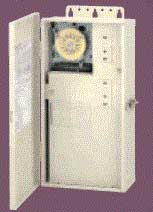
I am a big fan of sub panels at the pool equipment. They aren't expensive and give you more options. They make a special pool sub with built in timer (s) and spaces for the light GFCI and X10 modules for remote light switching.
It was turned down because the ground wasn't insulated all the way to the service.
Around here, if they don't install a pool equipment sub panel, they generally use a 240v switch in a wp box for a disconnect.
I am a big fan of sub panels at the pool equipment. They aren't expensive and give you more options. They make a special pool sub with built in timer (s) and spaces for the light GFCI and X10 modules for remote light switching.
Last edited by a moderator:
I guess my plan would be to draw it up and list what I am doing (how I have done permits in the past) and submit it with the permit application and see if anything comes of it.
If I used a pool sub panel at the equipment could I remove the sub panel in the garage and replace it with a junction box? I figure I only have #8 and a 40a breaker so there be much else I could run off of it any way.
Do you have any more info on the pool panels? The remote light switching is attractive.
Thanks
If I used a pool sub panel at the equipment could I remove the sub panel in the garage and replace it with a junction box? I figure I only have #8 and a 40a breaker so there be much else I could run off of it any way.
Do you have any more info on the pool panels? The remote light switching is attractive.
Thanks
Alectrician
DIY Senior Member
- Messages
- 688
- Reaction score
- 0
- Points
- 0
If I used a pool sub panel at the equipment could I remove the sub panel in the garage and replace it with a junction box?
This you cannot do. You would be feeding your pool equip with NM (no insulated ground). If you come from the garage sub, some inspectors would consider it good enough to take the insulated ground from that point instead of to the service.
Google intermatic pool timers http://www.inyopools.com/Products/02400001004796.htm?CS_010=4796&CS_003=905765
Last edited by a moderator:
I understand and will leave well enough alone and hope the inspectors lets it go. If he does question it I will plead my case with the 2005 code.
As for for the feed to the outside. Can I run 1 220v 4 wire feed to the disconnect and then split a 110v for the light circuit and a 220v for the pump? Or would it be better to take out 2 seperate feeds from the sub 1 for the light and 1 for the pump? And if I did that would I need a disconnect for the light circuit and what could I use, would the on/off switch work? The pump, I would use either a pool panel or a a/c type disconnect. Thanks again
As for for the feed to the outside. Can I run 1 220v 4 wire feed to the disconnect and then split a 110v for the light circuit and a 220v for the pump? Or would it be better to take out 2 seperate feeds from the sub 1 for the light and 1 for the pump? And if I did that would I need a disconnect for the light circuit and what could I use, would the on/off switch work? The pump, I would use either a pool panel or a a/c type disconnect. Thanks again
Alectrician
DIY Senior Member
- Messages
- 688
- Reaction score
- 0
- Points
- 0
Skip the AC disconnect idea.
A 6 or 8 space panel is under $30 and breakers are $4 a pole. Run your 4 wire, 30 or 50 amp feed to the equipment location and you will have 120v, 240v means of disconnect taken care of.
A 6 or 8 space panel is under $30 and breakers are $4 a pole. Run your 4 wire, 30 or 50 amp feed to the equipment location and you will have 120v, 240v means of disconnect taken care of.
JWelectric
Electrical Contractor/Instructor
I would check with the inspections department first as some inspectors believe this to mean that there can be only one remote panel (subpanel) between the pump motor and the service disconnect
680.25 Feeders.
These provisions shall apply to any feeder on the supply side of panelboards supplying branch circuits for pool equipment covered in Part II of this article and on the load side of the service equipment or the source of a separately derived system.
Also these feeders will need to comply with Article 225. This would mean that the pool panel will require a disconnect that is service rated complete with grounding electrodes.
680.25 Feeders.
These provisions shall apply to any feeder on the supply side of panelboards supplying branch circuits for pool equipment covered in Part II of this article and on the load side of the service equipment or the source of a separately derived system.
Also these feeders will need to comply with Article 225. This would mean that the pool panel will require a disconnect that is service rated complete with grounding electrodes.
Alectrician
DIY Senior Member
- Messages
- 688
- Reaction score
- 0
- Points
- 0
Install a outdoor rated breaker panel fed from the sub panel in the garage at the pool pad. Then the breakers will serve as the disconnects.
Correct.
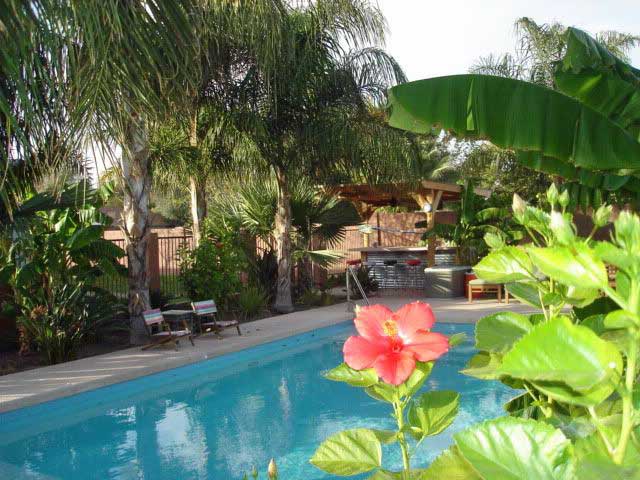
Here is my pool panel. It's kind of ugly but it's hidden behind the bar. GFCI and pool light switch are mounted on the side. It also gives me a 120V source for irrigation timer, landscape lights, cabana lights/fan/receps.
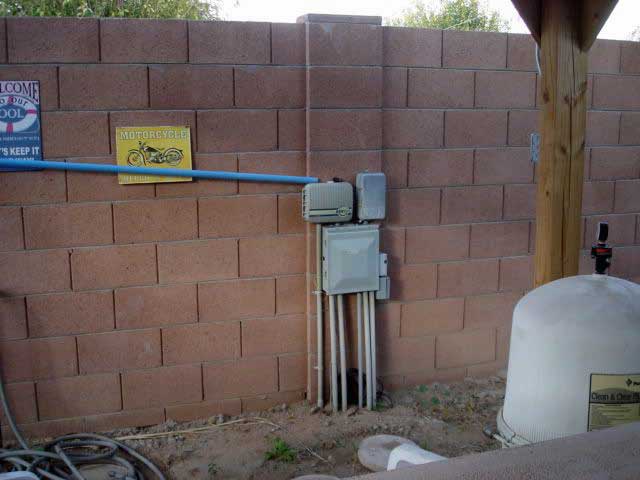
Like I said, it's ugly, but hidden.
Last edited by a moderator:
Similar threads

- Replies
- 16
- Views
- 6K

- Replies
- 11
- Views
- 3K


- Replies
- 4
- Views
- 2K

- Replies
- 54
- Views
- 21K