View Full Version : Septic System questions
JAR8832
11-29-2008, 06:11 PM
Our house is 35 years old and still has its original septic system. The soil in the area of the leach bed is gravel and drainage has never been a problem. However, the system has backed up twice in the past 10 years. Each time we had the tank pumped, and the line from the tank to the distribution box snaked, which cleared up the problem each time. The snake he used each time was a manual snake that he simply pushed back and forth until the effluent started flowing again.
After the first backup, we started having the tank pumped every 2 years instead of 4-5 years. The last backup was 3 years ago, at which time we decided to have the tank pumped every 18 months. There have been no problems since.
The most recent pumping was a few weeks ago, and I had the chance to talk with the licensed plumber (restricted sewer) who did the pumping about the issues we've had. He explained that the concrete tank is still in good condition and the leech bed *seems* good based on (1) visually examining the vent pipe at the end of the bed, (2) being able to detect suction from the vent pipe when he put his pumping tube into the opening leading to the pipe out of the tank, and (3) the fact we have never had any sewer smell from the vent pipe. He suggested the following:
1. Replace the 4" cast iron pipe between the tank and the distribution box with 4" PVC. This is the pipe that has clogged twice. He's not sure how long it is, but guesses 10 to 20 feet.
2. Replace the U-shaped baffle (which is still in good condition) with a PVC Tee Baffle. He explained this would reduce the amount of solids leaving the tank.
He offered to do this for $300 plus pumping the tank again if we have the line exposed and accessible. I asked if it would be worth hiring someone to send a camera into the leech bed, and he said it would not be worth it, because it's a safe bet that underground cast iron this old is probably rusting closed and causing the blockages.
Does this seem to be a reasonable investment for a 35 year old system based on his assessment?
leejosepho
11-29-2008, 06:41 PM
Each time we had the tank pumped, and the line from the tank to the distribution box snaked, which cleared up the problem each time. The snake he used each time was a manual snake that he simply pushed back and forth until the effluent started flowing again.
If those clogs amounted to buildups of rust from the cast pipe, then yes, have that pipe replaced ... and if your septic tank is doing its job, there should be nothing else coming out that could cause a clog.
After the first backup, we started having the tank pumped every 2 years instead of 4-5 years. The last backup was 3 years ago, at which time we decided to have the tank pumped every 18 months. There have been no problems since.
All of that pumping plus the plumber's suggestion of a new baffle makes me suspicious about solids coming *out* of your tank. Opinions vary greatly about how often a septic tank should be pumped, but a tank only truly needs pumped if or when the sludge in the bottom builds up to the point of being drawn into the outlet plumbing ... and in my own experience-driven opinion, you should have one of these filters in the new outlet tee you ought to have:
http://www.gag-simtech.com/new_files/Page566.htm
Opinions about filters also vary greatly, but the hard fact here is that one of those inexpensive filters unfailingly serves like a parakeet in a coal mine: While also assuring no solids get through to your drain field, it will "croak" (clog) and let you know when to have your tank pumped to get rid of excessive sludge. The veteran septic man who just recently pumped my own tanks said it is time to pump when the filter needs cleaned -- replacement is *never* necessary -- after only six months.
... the licensed plumber (restricted sewer) who did the pumping ... explained that the concrete tank is still in good condition and the leech bed *seems* good based on (1) visually examining the vent pipe at the end of the bed, (2) being able to detect suction from the vent pipe when he put his pumping tube into the opening leading to the pipe out of the tank, and (3) the fact we have never had any sewer smell from the vent pipe.
He definitely knows more than I, but that sounds right to me.
He suggested the following ...
He offered to do this for $300 plus pumping the tank again if we have the line exposed and accessible ...
Does this seem to be a reasonable investment for a 35 year old system based on his assessment?
Yes, absolutely!
JAR8832
11-30-2008, 07:02 PM
Thanks for the reply. He is not sure that the clogs were caused by rust, that was only his educated guess based on the age of the cast iron and the fact the system didn't back up again shortly after pushing the clogs into the leech field.
The effluent filter looks like an intriguing idea. Do they really need to be cleaned in as little as 6 months? That would really suck, especially if I forgot to do it and another backup occurred. Is the particular filter you linked to something you would specifically recommend? There seem to be different designs being promoted by different companies.
Thanks for your help.
Redwood
11-30-2008, 07:06 PM
I have seen filters clogged in as little as 6 months from a cleaning.
leejosepho
12-01-2008, 04:55 PM
The effluent filter looks like an intriguing idea. Do they really need to be cleaned in as little as 6 months? That would really suck, especially if I forgot to do it and another backup occurred. Is the particular filter you linked to something you would specifically recommend? There seem to be different designs being promoted by different companies.
The one I use from that link is the yellow one that simply slips down into the outlet tee and hangs there. Since installing one in each of my two tanks a couple of years ago, I have been in the habit of pulling them and rinsing them off twice each year ... but neither had never actually been clogged until just a few weeks ago, and that was because of a sludge buildup possibly caused by some other factors in one of my tanks.
Even if your septic tank already has risers and easy-access lids, the idea of taking a few minutes every six months or so to check and possibly hose-rinse a nasty-smelling "bottle-brush" filter -- Pull it out very slowly! -- might not sound very intriguing. However, the alternative is to either pump unnecessarily in order to assure no solids get out into your drain field or else to simply wait for the drain field to fill with solids and quit working.
As an alternative to a regular schedule for checking a filter, a high-level alarm could be installed to let you know if/when a filter begins to clog and the tank begins to become overfull, but I can much more easily afford about 15 minutes of my own time (per tank and sans parts or any other expense) twice a year.
JAR8832
12-01-2008, 08:08 PM
Are there any ways to predict how long a filter may last between cleanings? The tank is 1000 gallons. There's just 2 of us here, and according to the water softener we only use about 600 gallons of water per week pretty consistantly. Thanks again
leejosepho
12-02-2008, 03:38 AM
Are there any ways to predict how long a filter may last between cleanings?
Here is what the manufacturer has to say about that:
Service intervals will vary depending upon many factors such as water usage, soap usage, garbage disposals, etc. The filter should be serviced at least every three years. For maximum protection it should be replaced about every 50,000 gallons of effluent. For average residential applications this correlates to about 1 year of service. Because the water usage and configurations of systems vary quite a bit from area to area and even in the same area depending upon when a system was installed, it is recommended that the filter be inspected annually.
In my own experience, however, there is no need for scheduled replacement. For me, these filters easily rinse clean and mostly remain bright yellow.
JAR8832
12-02-2008, 12:45 PM
Thanks for pointing that out...not sure how I missed that. LOL I'm sold on the filter but won't be able to move forward with replacing the pipe and baffle until the soil thaws in spring.
Anyways, while studying effluent filters I stumbled onto another issue...a lint filter for the laundry washer. Here is a link to one for $130, "Filtrol 160":
http://www.filtrol160.com
Any opinions on such a device? Is laundry lint really such a big contributor to leach field failure, espcially for a system that has already lasted 35 years? I appreciate all the great help so far.
leejosepho
12-02-2008, 05:06 PM
Here is a laundry filter that might need emptied more often, but it does cost much less:
http://www.repairclinic.com/SmartSearch/SSPartDetail.aspx?PartID=541811&PPStack=1
The one my wife and I have here at home is similar to the high-dollar one you found, but it came from an auction for about $30.00.
A field system that is still doing its job after 35 years was obviously designed well initially, but that does not mean it will last forever. In my own opinion, and to avoid trouble or even replacement for as long as possible, I believe every effort should be made to let nothing other than clear effluent water into a drain field. My own septic and gray water have separate fields, and I even have one of those bottle-brush filters to catch hair and whatever else from our tub drains.
If you ever have trouble with your own field system, you might be able to at least partially revive it by installing a second field and using a diverter valve to let it remain dormant for a year or two ... then switch from one to the other every year after that and after/if the biomat dries out and shrivel-shrinks a bit.
JAR8832
12-15-2008, 12:20 PM
I opted to get the $130 lint filter, and after 4 loads of laundry it seems to work as advertised. I don't know if it is over priced, but if you think of it as insurance for the septic field and believe that lint is a big threat to it, it's probably worth it.
Getting back to the septic effluent filter, I see they also sell a 6" diameter bristle filter. Would the larger diameter increase the amount of time between cleanings? Any downsides to using a larger diameter? Since we don't have a T-Baffle yet, it would be just as easy to install a 4x6 tee instead of a 4x4 tee.
Redwood
12-15-2008, 01:09 PM
If a 4" line exits the tank you use a 4" tee and a 4" filter.
leejosepho
12-15-2008, 05:42 PM
Getting back to the septic effluent filter, I see they also sell a 6" diameter bristle filter. Would the larger diameter increase the amount of time between cleanings? Any downsides to using a larger diameter? Since we don't have a T-Baffle yet, it would be just as easy to install a 4x6 tee instead of a 4x4 tee.
I had never though of that, but yes, a 6" tee with a 4" hub for the outlet would more than double the service area of the filter.
JAR8832
04-20-2009, 07:36 AM
I was able to start this project last week and got the concrete distribution box exposed. I was dismayed to find that while the cover was in good condition, the side walls are crumbling, and the whole box will have to be replaced. The cast iron inlet line, as expected, is almost completely blocked with rust and other rock-hard stuff and only allows a small trickle of water into the DB. Also, the individual lines to the leach field are all at different elevations, so that the line on the right receives nearly all of the effluent. The good news is that there weren't any tree roots in the DB and the outlet lines look to be in good condition. I haven't been able to get in touch with the guy who will be performing the repairs, so I'm just wondering what folks would suggest as a replacement - another concrete DB or plastic? The current one measures 28" in diameter and 21" deep.
leejosepho
04-20-2009, 06:27 PM
I was able to start this project last week and got the concrete distribution box exposed. I was dismayed to find that while the cover was in good condition, the side walls are crumbling, and the whole box will have to be replaced ... wondering what folks would suggest as a replacement - another concrete DB or plastic? The current one measures 28" in diameter and 21" deep.
A local code might specify one or the other, but either should do just fine. I would probably use a piece of 24"-round, double-wall, plastic pipe that is ribbed on the outside and smooth on the inside. Then, one 28" concrete lid can serve as a base and the other can go on top.
The cast iron inlet line, as expected, is almost completely blocked with rust and other rock-hard stuff and only allows a small trickle of water into the DB.
A small trickle is very typical unless a bathtub or washing machine is presently dumping into the septic tank ... and if the tank and the D-box are fairly close together, replacing that line should not be very difficult.
Also, the individual lines to the leach field are all at different elevations, so that the line on the right receives nearly all of the effluent.
There is nothing terribly bad about that -- mine are the same -- and that can actually be a good thing. If just one of your lines is presently handling most or all of your load, that likely means it is in good condition and the other only has to serve as an overflow of sorts. Also, it is good for leach lines to be dormant for periods of time to dry out and "recover" a bit, so that means your second line is quite possibly in very good condition. As an experiment to see, plug the first line and let it rest for a few weeks while the other line does all the work. And since you are going to be getting a new D-box anyway, you might consider a diverter valve so you can switch lines every four or eight months (to give each line a taste of all seasons).
JAR8832
04-24-2009, 08:44 PM
Thanks for the reply. I discussed the situation with the master plumber who will be doing the work, and without seeing it first hand suggested placing a piece of large diameter sewer pip vertically inside the current DB, cutting holes for the inlet and outlet lines to pass through. He is concerned about digging up the old DB because it is technically part of the leach field. Hopefully he will stop out next week and clarify his approach, at which time I'll report back.
The inlet pipe is in the process of clogging with rust again. From the looks of it, it would be completely blocked within a year. I tried to open it up a little, but the stuff inside is rock hard. At least I know all of the digging was worth while...
Plugging the lowest outlet to test the other outlets sounds like a good idea. How would you suggest doing so? The outlet pipes are 4" corrugated flexible tubing. I'm not too keen on getting up close and personal with the effluent...
leejosepho
04-24-2009, 08:57 PM
Thanks for the reply. I discussed the situation with the master plumber who will be doing the work, and without seeing it first hand suggested placing a piece of large diameter sewer pip vertically inside the current DB, cutting holes for the inlet and outlet lines to pass through.
Sure, and that is the piece of corrugated plastic I would use.
Plugging the lowest outlet to test the other outlets sounds like a good idea. How would you suggest doing so? The outlet pipes are 4" corrugated flexible tubing. I'm not too keen on getting up close and personal with the effluent...
Wearing latex gloves, being careful not to splash and washing afterward is more than I do -- I just wash afterward -- when doing something with my own system, but you will have to decide about that.
I would probably find a couple of inexpensive, foam footballs at least an inch or two bigger than the insides of the lines for temporarily blocking them.
JAR8832
05-09-2009, 12:49 PM
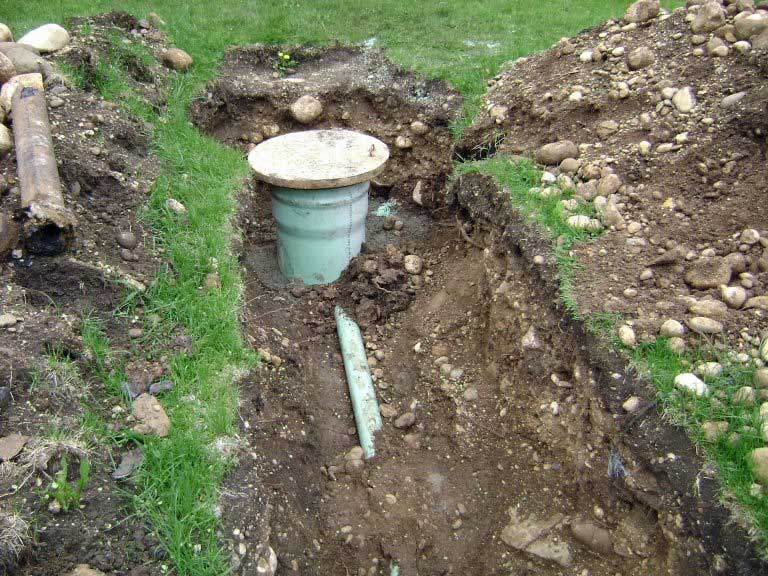
We finally got this project taken care of. His approach was just as you suggested, inserting a 19" sewer pipe into the old distribution box and making it long enough to bring it close to the surface for future service. We filled the space caused by the difference in diameter with concrete.
http://i134.photobucket.com/albums/q82/bleech2/DSC00692.jpg
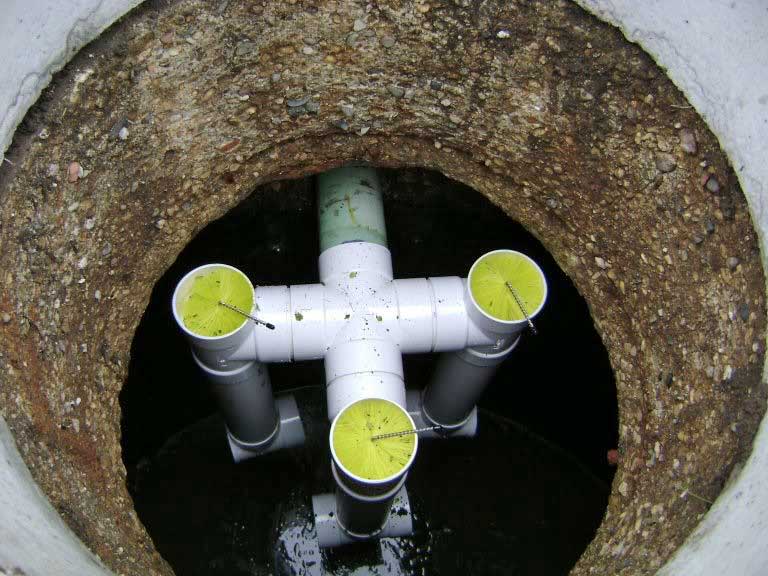
I also built a manifold so that I could use 3 of the Simtech filters in the septic tank. He'd never seen this before, but agreed to install it for me. I can't see why it won't work.
http://i134.photobucket.com/albums/q82/bleech2/DSC00696.jpg
Redwood
05-09-2009, 01:24 PM
I like the idea of multiple filters!
leejosepho
05-10-2009, 08:01 AM
Even with three filters, you should still take a look at them and probably rinse them off at least once each year. That company makes a maintenance sleeve that slips down inside the tee to stop the flow before the filter is pulled, but you could easily make your own with a piece of thin-wall pipe and for a lot less money.
Overall, nice job!
JAR8832
05-12-2009, 09:52 PM
Thanks. I made a sleeve like the one on the Simtech website and it works really slick. I plan on cleaning the filters just before the snow flies so I can get a sense of how fast they clog up.
One thing that concerns me is that the filters extend so far down that there's only 2 feet of space between the bottom of the filter and the bottom of the tank. This translates to about 450 gallons of sludge capacity based on the size of my tank. I have no idea how fast the sludge builds up so that will be another variable to watch out for.
JAR8832
11-14-2009, 01:14 PM
I cleaned my filters for the first time today, 6 months after installation. The filters for the most part were still clean, and pretty much evenly used. There was grey stuff coating the bristles which washed off pretty easily.
What concerned me was a ring of solid-looking grease-like material, about 1/2" to 1" thick, that covered (as best I could tell) the entire cross sectional area right at the water surface of each filter. It took quite a bit of effort to clean this material off. Unfortunately, I didn't get any pictures.
Is this the usual mode of failure with these types of filters? Does anyone with experience with the Simtech filters know how thick this "ring" has to get to cause an actual blockage?
leejosepho
11-15-2009, 05:21 AM
... a ring of solid-looking grease-like material, about 1/2" to 1" thick, that covered (as best I could tell) the entire cross sectional area right at the water surface of each filter ...
That sounds to me like grease, and I have never had such a ring on my filters. Do you cook with a lot of Crisco? Either way, grease needs to be removed from pans and dishes before they go into the sink.
Is this the usual mode of failure with these types of filters? Does anyone with experience with the Simtech filters know how thick this "ring" has to get to cause an actual blockage?
In order to "fail" as you are meaning that, the entire top of the filter covering the diameter of the outlet must do its job well enough to not let any water through.
One thing that concerns me is that the filters extend so far down that there's only 2 feet of space between the bottom of the filter and the bottom of the tank. This translates to about 450 gallons of sludge capacity based on the size of my tank. I have no idea how fast the sludge builds up so that will be another variable to watch out for.
Over enough time, that *could* be a place where your outlet becomes blocked by sludge saturating the lower ends of your filters. If that begins to happen, you will likely see some indication of it on the ends of your filters when you check and clean them.
Your filters have been protecting your drain field, and now they have let you know you need to do something about keeping grease out of your septic system ...
Nice work, eh?!
JAR8832
11-15-2009, 07:28 AM
Thanks for the reply, I'm not sure what to make of the "ring" now. We do use some grease for cooking but are always sure to wipe out the pans before washing. The inlet to the tank still has the orginal U-shaped fiberglass baffle, the bottom of which isn't quite as low as the bottom of the new outlet T-baffle so I'm not sure how grease is able to migrate into the outlet. But at the same time I don't know what else could make it past all of the filter bristles all the way to the top of the filter.
I should probably add too that we only use about 600 gallons of water per week and the tank is 1000 gallons.
JAR8832
11-17-2009, 04:45 PM
I didn't tell quite the whole story of my filter cleaning experience. I actually dropped one of them in and wasn't able to retrieve it until today (talk about fun!). There was still a piece of the "ring" I was talking about attached to it, so I took a picture. It seemed to be a little thinner than the ones found on the other two filters. Does this look like grease? The top of the filter is just to the right of the picture.
http://i134.photobucket.com/albums/q82/bleech2/DSC01295.jpg
leejosepho
11-18-2009, 04:18 AM
Strange. Maybe one of the experts here will know what that is ...
JAR8832
11-11-2010, 11:25 AM
Today I cleaned my septic filters for the first time since last November. All 3 were about equally "soiled", and none of them had the black disk at the very top of the exit point that I found last year; this time it was a very thin multicolored flexible disk that washed away easily. I noticed however that the general exit region was much darker in color than the rest of the filter and seemed to permanently stain the filter color. Does this look pretty normal for these kinds of filters when dirty?
http://i134.photobucket.com/albums/q82/bleech2/DSC01868.jpg
leejosepho
11-12-2010, 06:26 AM
Considering the fact of sewage discharge being called "black water", I would say they look just fine! I moved a few months ago and have not seen mine in a while, but I think they were only slightly lighter (indicating only a difference in fresh-water supplies).
Since you have three fingers going out into your drain field (as I recall), you might consider blocking them off one-at-a-time in a 6-month rotation. Along with the filters keeping the chunks out, that should help keep your drain field working well for a long time. Just be sure any foam ball or whatever else you might use if you do that absolutely cannot slip on down the line and plug it permanently.
ballvalve
11-12-2010, 11:00 AM
Installed many a system, engineered, pumped, static, switched. Maintain many. Finishing one today.
Lee said the inordiniate elevations of the leach field inlet lines might be okay. That is not good advice unless you have a set of engineered plans with a "switching" distribution box spec'd in. That entire fake D box has to GO, [okay on edit I see a reasonable quick solution]
But I would have had a real D box set in a base of concrete installed, or a huge bed of compacted gravel. Nice cast d box here is only $40 with a lid. Quite smaller than that mess you have [ had] now, and square.
Real D boxes come with adjustable 4" solid drain pipe entrance caps [spin adjust] . Or you may adjust inflow with careful trimming of the inlet nipples with notches. You should convert that junk flex pipe OUTSIDE the box and bring solid nipples inside, and make sure all lines are fed EXACTLY the same. Do careful observation and an adjustment after a few frosts.
I believe you can exclude the lint and sediment as an issue, unless you have a garbage disposer. If you have a split chamber tank, and a correctly set "T" shaped outlet line, and no disposer, I find after repeated tests that a 1200 to 1500 gallon tank can go 5 to even 10 years before sediment starts to get deep on the bottom. If you have the money and LOTS of kids, every three years is overkill but safe.
After 35 years of perhaps everything hitting one line, that field can be totally bio-slimed to a point where nothing will percolate properly, especially in wisconsin. The installers were obviously not pro's.
VERY RARE to need a filter unless you are pumping into a pressure sand bed filter with small distribution lines, with a short standard leach field on outfeed. Filters on standard systems are not needed or wanted by our septic inspector, and he really watches the D box, even checks them for level. Bad d boxes kill systems. Mine all have easy access risers and lids for quick and do-able inspection.
You are on the outside anyway for septic systems at 35 years.... so say some engineers.
I do like your multiple filter set up - good idea, but it might be a few decades late. And who wants another chore mucking in the Sh*&^ every few months. Enough trouble comes my way without having to pay for and install it.
Sorry for the hard line, but eventually you might need to muck out and re-gravel that over-used field. And you probably know this, but master plumbers in [at the least] California dont know a whit about septic. They give special licenses for that.
Good photos and information here altogether...
On edit - saw you are using only 600 gallons a week. If the installers used that junk pipe and that fake "D" box, without leveling the pipes, Sherlock says they also cheated on trench depth, length and gravel.
JAR8832
11-12-2010, 02:59 PM
Thanks for the replies. They do things here a lot differently than California. All septics installed in Wisconsin after 1986 are required to be pumped every other year (regardless of number of occupants), and within the past 10 years they now require filters in all new systems.
That said, our system (1000 gal, single tank NOT split) has never given us problems except for the rusted-shut line that fed the D-Box which was replaced last year. This includes a period in the 1980's when 4 adults and 3 kids lived in the house and the tank wasn't pumped for at least 8 years. The lowest drain field line coincidently has an inspection pipe and small chamber at the end of it, which has never shown the slightest evidence of moisture reaching the end of the line (which is why I haven't tried blocking it off yet). Our septic guy (20+ year MPRS) said this type of system (shoddy materials and all) was common in this area during that era and many continue to work fine with the right soil conditions, which I guess we have.
ballvalve
11-13-2010, 11:03 AM
The county or state requires the absurd 2 year pumping? They must not have an enforcement system, if they ALSO require filters. I know Wisconsin well, and a lot of guys on septic are not letting the Gov' into their yards.
With good soil, an old buick buried just right can last 35 years as a decent septic system. Got a few around here.
liplumber
12-22-2010, 09:13 PM
It's pretty tough to determine how long the filters will last without cleaning/replacing them. A cesspool service suffolk county (http://plumbriteplumber.com/) that I use told me the same thing that basically everyone here is saying. You can never really be sure.
JAR8832
09-21-2011, 12:01 PM
It's been over two years since we had our septic repaired (and last pumped), and I've decided to open the access hatch to the distribution box and see how things are going. I was (very carefully) able to take some pictures of the three corrugated pipes that leave the distribution box and carry the effluent to the leech field, and I'm wondering if there is any usefulness of these pictures in predicting how extensive the bio mat may be? Considering these pipes are 37 years old, they look practically brand new. Granted, this only shows the first few feet of the pipes, but wouldn't they tend show the most buildup if there was an impending bio mat problem?
http://i134.photobucket.com/albums/q82/bleech2/leachfield2.jpg
http://i134.photobucket.com/albums/q82/bleech2/leachfield1.jpg
http://i134.photobucket.com/albums/q82/bleech2/leachfield3.jpg
leejosepho
09-22-2011, 06:25 AM
... I'm wondering if there is any usefulness of these pictures in predicting how extensive the bio mat may be?
... wouldn't they tend show the most buildup if there was an impending bio mat problem?
Not really, but you might try looking for a high-water mark inside your distribution box to see whether they have ever been completely full (backed up). Biomat typically happens when salt hits clay soil and causes hardpan, or else when tanks are not pumped regularly and solids begin flowing out into the field. With your system being that old and still working well, I would guess you just need to keep taking good care by pumping your tank every couple of years.