I have a contractor moving the plumbing from one wall to another in our laundry room so we can build a laundry closet for our new stackable washer/dryer. When I inspected the plumbing I noticed some things I hadn't ever seen before and wanted to make sure they would work. First of all, the drain (which will serve both the washer (standpipe) and a sink next to it) contains a p-trap below floor level a few feet from the standpipe - This will be the only ptrap for the washer standpipe and will also serve as the ptrap for the sink (altough the sink may have another trap under the cabinent). I've never seen a p-trap this far from a fixture before - is this OK? My other question is in regards to the vent - a vent was installed after the before mentioned p-trap (as a vertical branch off the drain by the sink). I've never heard of a vent being installed after a p-trap. Is this work ok? There is another vent for the bathroom 7 feet away so do I even need a vent here? Thanks, Trevor

You are using an out of date browser. It may not display this or other websites correctly.
You should upgrade or use an alternative browser.
You should upgrade or use an alternative browser.
P-Trap/Vent question for new washing machine
- Thread starter tkram01
- Start date

hj
Master Plumber
- Messages
- 33,613
- Reaction score
- 1,057
- Points
- 113
- Location
- Cave Creek, Arizona
- Website
- www.terrylove.com
drain
Are you sure you have a plumber and not a handyman? We cannot see what you are describing, of course, but if we are reading it correctly the trap should not be more than 24" below the top of the riser pipe and the layout should be "P" trap, vent, and then drain. although where the "P" trap connects could have the drain going down and the vent rising from that point. The sink drain should connect to the vertical drain/vent pipe above the washer trap, but no to the riser where the washer hose will connect.
Are you sure you have a plumber and not a handyman? We cannot see what you are describing, of course, but if we are reading it correctly the trap should not be more than 24" below the top of the riser pipe and the layout should be "P" trap, vent, and then drain. although where the "P" trap connects could have the drain going down and the vent rising from that point. The sink drain should connect to the vertical drain/vent pipe above the washer trap, but no to the riser where the washer hose will connect.

Sponsor
Paid Advertisement

Master Plumber Mark
Sensitivity trainer and plumber of mens souls
that looks rough
is he tieing in some sort of lavatory off that elbow going up the wall
or is that the vent???
whatever it is meant to be ,
if he puts a p trap on it it will certanly gurgle.
.when the laundry lets out.
maybe he is just putting in one trap to catch
whatever is up the line from it...
cleaning out that line in the future
might be a tad hard to do too through that extra long trap.
--------------------------------------------------------------------------
he should have come up between the two fixtures and installed a cross tee or wye then installed a separate trap for the laundry and an arm out for the
other fixture.... then ran the vent up and back over
--------------------------------------------------------------------------
I guess in theory what is there will work, I have seen worse,
but I wouldent claim it as mine either
is he tieing in some sort of lavatory off that elbow going up the wall
or is that the vent???
whatever it is meant to be ,
if he puts a p trap on it it will certanly gurgle.
.when the laundry lets out.
maybe he is just putting in one trap to catch
whatever is up the line from it...
cleaning out that line in the future
might be a tad hard to do too through that extra long trap.
--------------------------------------------------------------------------
he should have come up between the two fixtures and installed a cross tee or wye then installed a separate trap for the laundry and an arm out for the
other fixture.... then ran the vent up and back over
--------------------------------------------------------------------------
I guess in theory what is there will work, I have seen worse,
but I wouldent claim it as mine either
Last edited:

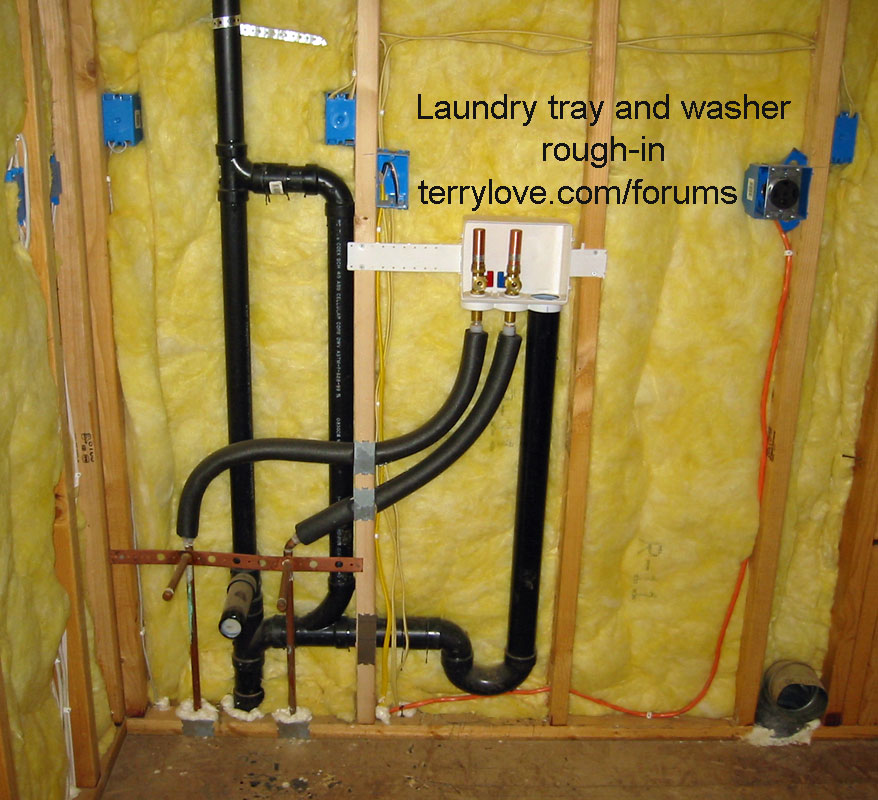
The correct way to have a laundry tray and washer plumbing.
It should look closer to this.
Notice the p-trap for the washer.
The pipe for the laundry tray facing out will get a p-trap after the wallboard is up.
Last edited:
hj
Master Plumber
- Messages
- 33,613
- Reaction score
- 1,057
- Points
- 113
- Location
- Cave Creek, Arizona
- Website
- www.terrylove.com
pipes
I suppose there is something correct about the installation, but beats me what it could be. No inspector would ever approve it and there may be a vent on the trap somewhere, but the picture does not show it.
I suppose there is something correct about the installation, but beats me what it could be. No inspector would ever approve it and there may be a vent on the trap somewhere, but the picture does not show it.
Master Plumber Mark
Sensitivity trainer and plumber of mens souls
its okee dokey
it looks a lot better this way...
the copper is a little sloppy but thats just a matter
of opinion,, and it doesent need hammer arresters if the
code doesent require them.....
they are no big deal --
they were code here for a while, now they are not..
the drain and vent look to be ok now...
the only thing I see in the picture is their is not
too much left of that one stud.... he has chopped it up
pretty good ... as long as is it is not a supporting
wall it will be ok....
did he whine , moan and complain very much when you
asked him to improve his work???
it looks a lot better this way...
the copper is a little sloppy but thats just a matter
of opinion,, and it doesent need hammer arresters if the
code doesent require them.....
they are no big deal --
they were code here for a while, now they are not..
the drain and vent look to be ok now...
the only thing I see in the picture is their is not
too much left of that one stud.... he has chopped it up
pretty good ... as long as is it is not a supporting
wall it will be ok....
did he whine , moan and complain very much when you
asked him to improve his work???
Last edited:
Well your handyman is getting a lesson I guess.
The vents can be tied together at 6" above the flood level of the highest fixture. The picture looks lower than that.
When waste drops into a horizontal line, you use a wye fitting or combination fitting, basicly a wye and 45 together. The santee on it's back is wrong.
When dropping from vertical to horizontal, you use a long turn 90, not a medium bend 90. The medium 90 below the sink drain is wrong.
If the home has a PRV in line, or a check valve at the meter, then you would need hammer arrestors on the washer. That is included in the current UPC code and the proposed UPC code that will come out next.
On a good note, it does look much better than before.
The vents can be tied together at 6" above the flood level of the highest fixture. The picture looks lower than that.
When waste drops into a horizontal line, you use a wye fitting or combination fitting, basicly a wye and 45 together. The santee on it's back is wrong.
When dropping from vertical to horizontal, you use a long turn 90, not a medium bend 90. The medium 90 below the sink drain is wrong.
If the home has a PRV in line, or a check valve at the meter, then you would need hammer arrestors on the washer. That is included in the current UPC code and the proposed UPC code that will come out next.
On a good note, it does look much better than before.
Master Plumber Mark
Sensitivity trainer and plumber of mens souls
give the guy a break terry
now come on Terry, he is close enough on the flood rim
issue here.... he is at least 2-or more inches above that box.....
better no start cutting hairs here or
the guy might start packing up all his tools
and walking off the job..
at least he did do it over...
now come on Terry, he is close enough on the flood rim
issue here.... he is at least 2-or more inches above that box.....
better no start cutting hairs here or
the guy might start packing up all his tools
and walking off the job..
at least he did do it over...
hj
Master Plumber
- Messages
- 33,613
- Reaction score
- 1,057
- Points
- 113
- Location
- Cave Creek, Arizona
- Website
- www.terrylove.com
pipes
I guess one quesstion might be what happened to the "P" trao under the floor. I do not see any signs that the floor was opened and it was removed, unless there was access to it under the floor.
I guess one quesstion might be what happened to the "P" trao under the floor. I do not see any signs that the floor was opened and it was removed, unless there was access to it under the floor.
Master Plumber Mark,
I don't want to discourage him either.
However, it does come back to bite you when the next homeowner takes a look at that picture and under it, they're told, it's all good.
It's not all good.
I would prefer that they know the right way, so they don't get turned down by the inspecter if they copy off this site.
I would love it if they copied off this site and the inspector thought they were pretty smart.
When I was in Belieze for vacation, there was no "real plumbing".
Everything was copied from the building next door and none of it right.
Oh, and you know the rest. "DON'T DRINK THE WATER"
There was Internet everywhere though, so if they want to see it right, it's going to be on this board. They won't see it anywhere else.
In a small or big way, we could be improving the health of the world this way.
I don't want to discourage him either.
However, it does come back to bite you when the next homeowner takes a look at that picture and under it, they're told, it's all good.
It's not all good.
I would prefer that they know the right way, so they don't get turned down by the inspecter if they copy off this site.
I would love it if they copied off this site and the inspector thought they were pretty smart.
When I was in Belieze for vacation, there was no "real plumbing".
Everything was copied from the building next door and none of it right.
Oh, and you know the rest. "DON'T DRINK THE WATER"
There was Internet everywhere though, so if they want to see it right, it's going to be on this board. They won't see it anywhere else.
In a small or big way, we could be improving the health of the world this way.
hj
Master Plumber
- Messages
- 33,613
- Reaction score
- 1,057
- Points
- 113
- Location
- Cave Creek, Arizona
- Website
- www.terrylove.com
trap
Since the new one is vented, you will not notice any immediate problem, although it could create enough resistance to cause the washer pipe to overflow, but after a time, that trap could create a stoppage, and there will probably not be any way in creation it will be able to be snaked with that trap there. It must be removed.
Since the new one is vented, you will not notice any immediate problem, although it could create enough resistance to cause the washer pipe to overflow, but after a time, that trap could create a stoppage, and there will probably not be any way in creation it will be able to be snaked with that trap there. It must be removed.
Hardman
In the Trades
adding to trap
what would adding 4" of pipe to the trap between the street-L and the trap on the waste side? A plumber told me the other day he routinely does this several times a week - even in new construction - to compensate for the new washing machines high discharge. Will doing this cause problems or is he on to something?
what would adding 4" of pipe to the trap between the street-L and the trap on the waste side? A plumber told me the other day he routinely does this several times a week - even in new construction - to compensate for the new washing machines high discharge. Will doing this cause problems or is he on to something?
hj
Master Plumber
- Messages
- 33,613
- Reaction score
- 1,057
- Points
- 113
- Location
- Cave Creek, Arizona
- Website
- www.terrylove.com
trap
It would create a deep seal trap and induce resistance. If anything you want to reduce resistance so you try to use the least pipe and fittings possible, not more.
It would create a deep seal trap and induce resistance. If anything you want to reduce resistance so you try to use the least pipe and fittings possible, not more.

Terry Love
Plumber
You can't dump the washer over the laundry tray.
The laundry tray will need it's own vent.
The laundry tray will need it's own vent.
No, diagram one show the washer being dumped down the laundry tray vent.
You need to move the tee for the washer "below" the tee for the laundry tray.
The washer comes in "below" the laundry tray.
You need to move the tee for the washer "below" the tee for the laundry tray.
The washer comes in "below" the laundry tray.
Similar threads

- Replies
- 8
- Views
- 3K
- Replies
- 0
- Views
- 2K
- Replies
- 1
- Views
- 928


- Replies
- 3
- Views
- 481