
Pressure Issue causing my PVR to leak

samslmmr

New Member
Messages
4
Reaction score
0
Points
0
I have multiple threads here, but I figured I would rehash my problem to see if I am missing something.

About 4 to 6 weeks ago my hot water tank started leaking from the PVR - not a little leak, but a constant drizzle. If I turned any water on in the house the tank would stop leaking. The hot water tank is probably 15 years old.

My first thought was that it was a bad PVR, so I went to Home Depot and bought a new one. I installed it without any problems except that it didnt solve the leaking issue.

I then did some research and talked to several friends of mine and they mentioned a thermal expansion tank. I went and bought one and installed it but it didnt resolve the leaking PVR issue.

I have a water pressure gauge. If I let the water run for a little bit and then check the gauge, the pressure is roughly 60 PSI. If I leave the water off until the pressure relief valve starts leaking, it spikes upwards of 100 PSI. I also have a Pressure Regulator or whatever they are called.

The only thing I have not done to this point is call the water company, but im not sure they will be able to do anything.

What am I missing? I am not a plumber by any means (though I was pretty stoked to learn how to sweat my pipes) so any help is greatly appreciated.
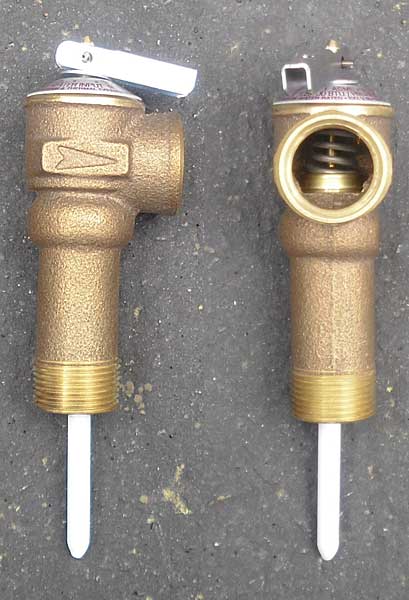
tp_2.jpg

T&P Valve looking at two sides.
 
Last edited by a moderator:
If the pressure creeps up during the time that the water heater is "heating", in other words after drawing down some hot water from a tap....then that is an expansion issue. But if if creeps up after just running a cold tap, then that is a failed pressure regulator valve on the house.


The TP on the water heater has a design spec of 150 PSI, but it is common for them to begin weeping at any pressure over 100 or so.
 
Well, in an effort to keep the hot water tank from running all day long, I turn off the cold water supply to the tank until we need it (showers, dishwasher, etc). Once I do this, the hot water tank stops leaking.


When I checked the pipes this morning ( before I used any water ) the pressure was upto 100. Once I started running some water (hot or cold), it dropped to 60.

Is a pressure regulator valve something that is complicated to install? I know where my current one is and it looks old. I am fine with sweating pipes now ... is this something as simple as buying a new pressure regulator and putting it in place of the current one? Or is it more on the advanced side?
 
First let's clear up some terms. You used the term "PRV" as a device on the water heater. That device is called a T/P or temperature/pressure valve. It is designed to trip to relieve excess temperature or pressure in the tank. A PRV is a Pressure Regulator Valve. This is a device installed in the main water supply line, usually shortly after the line enters the house. It is used to limit and regulate the water pressure for the whole house. Sometimes city water mains carry too much pressure and that can be harmful to appliances in the home. Now to your problem. When water heats, it expands. If the home does not have a PRV, this expansion is just absorbed by the city water main. However, when a PRV is added to the supply line, this creates what is called a "closed system". The PRV has built into it a check valve that prevents the expansion from getting to the city main. The result of this is the pressure rises in the water heater and when it reaches 150 psi, the T/P valve trips to protect the heater from blowing up...literally! So your T/P is doing what it is supposed to do. To deal with the closed system problem, one needs to install a thermal expansion tank between the PRV and the water heater. These tanks are charged with air pressure set to the same pressure as the PRV. Installation of the expansion tank is simple enough if you can sweat copper. Same with a PRV, but if you already have one that has just failed, it may be that you can get a new one that would just replace the old one and not require sweating. You also need a pressure gauge to adjust the PRV and expansion tank pressures.
 
One more quick note. Your water heater is quite old, but it is still functioning and should not be blamed for the problem you're having. A new heater would do the same thing.
 
First let's clear up some terms. You used the term "PRV" as a device on the water heater. That device is called a T/P or temperature/pressure valve. It is designed to trip to relieve excess temperature or pressure in the tank. A PRV is a Pressure Regulator Valve. This is a device installed in the main water supply line, usually shortly after the line enters the house. It is used to limit and regulate the water pressure for the whole house. Sometimes city water mains carry too much pressure and that can be harmful to appliances in the home. Now to your problem. When water heats, it expands. If the home does not have a PRV, this expansion is just absorbed by the city water main. However, when a PRV is added to the supply line, this creates what is called a "closed system". The PRV has built into it a check valve that prevents the expansion from getting to the city main. The result of this is the pressure rises in the water heater and when it reaches 150 psi, the T/P valve trips to protect the heater from blowing up...literally! So your T/P is doing what it is supposed to do. To deal with the closed system problem, one needs to install a thermal expansion tank between the PRV and the water heater. These tanks are charged with air pressure set to the same pressure as the PRV. Installation of the expansion tank is simple enough if you can sweat copper. Same with a PRV, but if you already have one that has just failed, it may be that you can get a new one that would just replace the old one and not require sweating. You also need a pressure gauge to adjust the PRV and expansion tank pressures.

I just installed a thermal expansion tank last night and it did not resolve the issue.
 
The spring in a T&P valve can get weaker as it ages, plus, if it gets mineral deposits on it, it may never fully seal again. Did you replace this? With a WH that old, you're on borrowed time.

Did you set the static air pressure on the expansion tank to your nominal water pressure? They typically come set to 40#, which won't be enough based on your normal pressure. You need something like a bicycle pump, and it needs to be set without water pressure so you need to shut off the main, and open a valve to relieve water pressure so you can adjust it, if required.
 
The spring in a T&P valve can get weaker as it ages, plus, if it gets mineral deposits on it, it may never fully seal again. Did you replace this? With a WH that old, you're on borrowed time.

Did you set the static air pressure on the expansion tank to your nominal water pressure? They typically come set to 40#, which won't be enough based on your normal pressure. You need something like a bicycle pump, and it needs to be set without water pressure so you need to shut off the main, and open a valve to relieve water pressure so you can adjust it, if required.

Yes, the first thing I changed was the T&P - I mistakenly called this a PVR in my OP.

I also set the expansion tank to the same pressure that I had when the water was flowing ( roughly 60 PSI)
 
If after all you have replaced you are still having the same problem you need to replace ,if you have one, or install new, if you don't have one, a PRV.

After installing the PRV you need to set it at or 1-2 #s lower than the pressure in the expansion tank.
 
A little time spent with a pressure gauge and applying some logic to the troubleshooting could have saved a lot of unneccessary work.
 
Back
Top