PDA

View Full Version : DWV Help


hammer
08-11-2008, 02:00 PM
I am in the middle of remodeling the upstairs bath in my 100+ year old victorian house. My original plan was to not mess with the plumbing to much, but as usually happens in a remodel, plans have changed midway though. A couple of nights ago, as I was relaxing after a hard day of thinking about the project, I heard a loud snap :eek:. Turns out the soil stack (old cast iron) cracked all the way from the basement (about 4 feet off the cement) to the middle of the first floor :mad:. When cutting out the cracked piece to replace it... snap. There goes another section above it, right up to the second floor bath. So, I pulled up the sub floor in the second floor bath to see what the plumbing looked like, and found what I've (somewhat poorly) sketched below. It's not pretty. The biggest issue is that the horizontal section of the 4" vent/stack actually pitches back towards the vent quite a bit (maybe 1/2" in a foot). I figure it must have settled over the years, and probably was putting a lot of stress of the lower part of the stack.

So, anyway, I figure now is the time to fix it... Any thoughts on the best was to rerun the drains. It's somewhat hard to see in the pic, but the toilet (WC) is on the west wall (the drain runs all the way across the bath floor), the horizontal part of the stack is near the north wall, the bath is against the east wall. Neither the bath or the sink have their own vents. I am open to ripping it all out, and even moving the toilet to the north wall, and putting the sink on the west wall (in the pic, north is up).

Any help is much appreciated... Thanks!

nhmaster
08-12-2008, 05:32 PM
And I assume since it's an old house, the laterals to the tub and lav are probably galvy? And there's not a vent in sight either.?

Big can o worms opened here I suspect. Further Information needed please.

hammer
08-13-2008, 04:09 AM
Thanks for responding... The branch lines to the lav and bath are 2" copper. Actually, the minor plumbing change I had made before I ripped up the whole subfloor was to just move the lav drain (originally an S-Trap into the floor) into the wall using a P-Trap into a pedistal sink... However, in the last few days I have been learning all I can about DWV, and think moving the drain into the wall just made another S-Trap, since there is no vent off the top of the lav drain.

No vents in site, except the 4" CI stack vent.

So, now that I have a somewhat better idea of how a DWV system should work, maybe I can be more specific. I have attached a pic of the bath layout as it is now.

Can all 3 fixtures in the bath (WC, Lav and Bath) be stack vented? I had read somewhere that only the highest fixture on the stack can be stack vented, but it went on to say it's ok to have the WC stack vented using a T, and have the bath come in a side inlet on the T.

What are my options for running the WC into the stack when the transition from stack to vent is all horizontal in the floor?

Also, now that I will be redoing all this, we have the option (I think) of swaping the location of the WC and sink, which we may well want to do. In that case, the WC would site about a 18" to the right of the stack coming up from the first floor.


Thanks...

hammer
08-13-2008, 04:13 AM
Actually, the lav drain meets the bath drain like below, not in the wrong direction!

Master Plumber 101
08-13-2008, 05:30 AM
Send another pic. of exact layout where everything is going to go.

hammer
08-13-2008, 05:52 AM
I am open to either of these layouts. Note that I do plan on building some type of cabinet in the top left corner. The boxed out vent will be hidden in that. One option that recently occurred to me is if the cabinet is wide enough, it could potentially go over the stack from first floor, and actually allow me to run the stack straight up through to the attic, avoiding the horizontal section under the floor altogether. That may crowd the WC or Lav (whichever ends up by the bath) though... have to check the dimensions.

hj
08-13-2008, 06:43 AM
There are too many unknowns for us to be able to advise you. Because of the various ways the building could have been construced only someone at the house can advise as to the best way to install the piping and keep it legal.

hammer
08-13-2008, 08:03 AM
I understand. Well, I can handle all the framing issues that might arise, having been a carpenter for quite some time. I am not worried about that. But I am interested in the theory behind the DWV, so any general info related to this situation would be helpful.

Whatever I end up with, I will be sketching out and getting a permit/inspection to do the work, but I want to at least have a good idea of what I can do before I head up to get the permit.

Thanks.

Master Plumber 101
08-13-2008, 09:03 AM
Mr. Hammer,

You probably need to install a new stack other than what you have. The 4" main vent that you see upstairs is also most likely attached to the rest of your fixtures vent systems. If you have dry vents connecting below it is not wise to dump a fixture drain above that.You can also replace that exsisting 4" to 3" if your local code permits.Your new stack for the bathroom may also be 3" if your local or national code permits. I'm from Wisconsin, so we are on a state code vs national.Since your a carpenter you probably can locate the new stack anywhere and box out below.

nhmaster
08-14-2008, 06:33 AM
Here's a general rule. S traps are illegal because they are prone to siphonage. That aside, anytime waste goes down (from a fixture) it must be vented. The trap to vent distances are listed in the code book. All drains up to 3" must be sloped 1/4 ipf.

Master Plumber 101
08-14-2008, 06:40 AM
I have a documented case of IDGAF disorder that makes typing, spelling and rememberings difficult

hammer
08-14-2008, 09:20 AM
Very good... ok, so here's one thing (one of many, that is) I am unclear on. On a stack vented fixture, where the trap arm is not longer then the distances listed in the code book, why doesn't it siphon? Why would a long trap arm siphon and a short one not?

nhmaster
08-14-2008, 12:04 PM
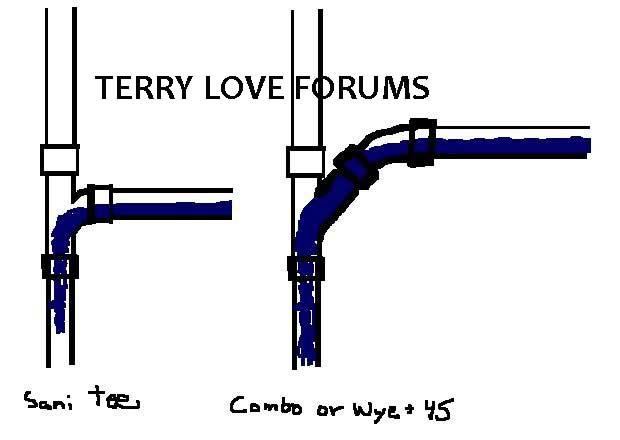
It's not the length of the trap arm that causes it to siphon, it's the way the trap is configured, which is why a vertical sanitary tee should be used instead of a vertical why because the wye puts the trap weir above the air vent. If I had my IPC book with me I could show you the diagram but alas I do not.

hammer
08-14-2008, 12:41 PM
ahhh... ok. So the max distance of the arm accounts for the fact that, assuming a 1/4" drop per foot, the inside top of the drain pipe (trap arm) going into the stack will not be lower then the inside bottom of the trap arm at the trap. For the siphon effect to take place, the outlet of the siphon tube must be lower then the input of the siphon tube. So right, a wye at the stack would drop the outlet way down and allow for the siphoning effect.

nhmaster
08-14-2008, 05:38 PM
That's It !

Redwood
08-14-2008, 06:31 PM
This poorly done sketch should give you a visual on the tee vs. wye on the vertical and its effect on venting...

http://i44.photobucket.com/albums/f2/Redwood39/ventingsaniteevswye45orcombo.jpg

nhmaster
08-15-2008, 06:11 AM
This poorly done sketch should give you a visual on the tee vs. wye on the vertical and its effect on venting...

http://i44.photobucket.com/albums/f2/Redwood39/ventingsaniteevswye45orcombo.jpg

That's nice. I have a working model set up in the classroom of that same effect. Along with a drum trap showing the same thing.