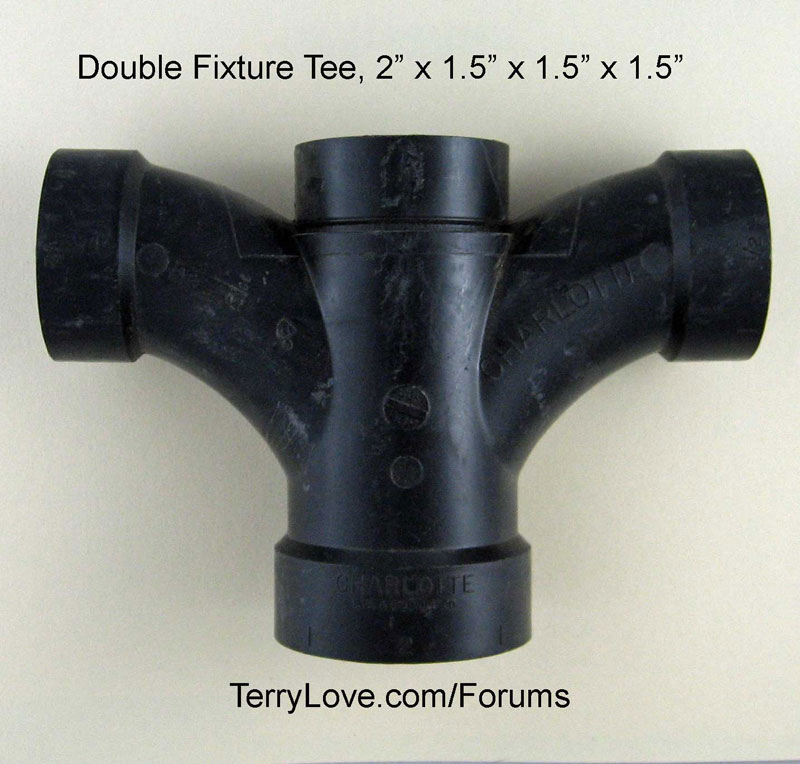
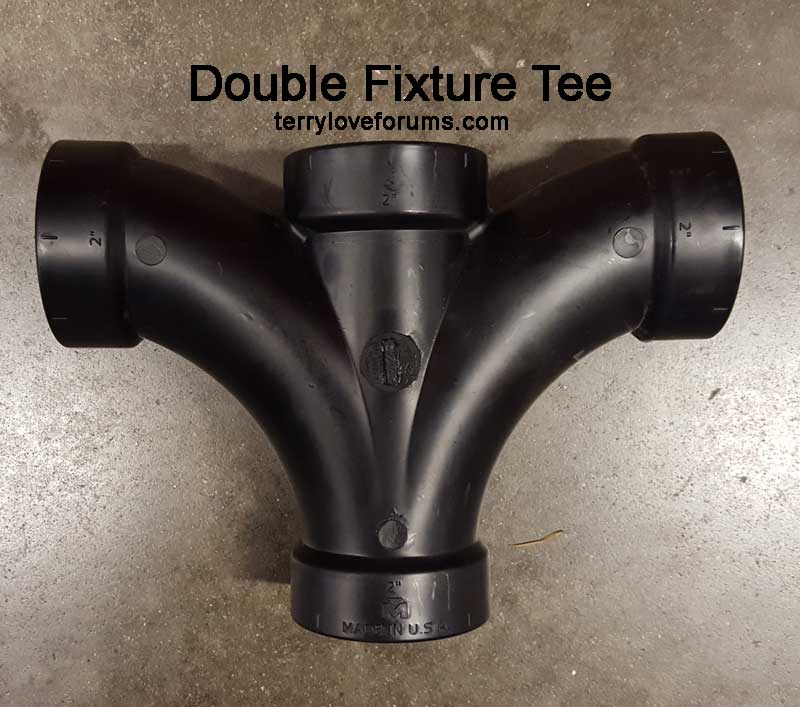
Double fixture tee or double sanitary tee?

If you are doing back to back toilets, it needs to be at least the double fixture fitting.
And even with that, the waste from one toilet will cross over into the other arm, forcing the water up in the bowl, and then leaving it with less water.

I becoming a big, I'm not a fan of any kind of cross for todays toilets.

double_lav_rough_1.jpg


Last edited:
Thanks Terry - see OP though - these are two sinks on a double vanity.

Another question - do these fittings have the slight drain angle built into the fitting?
 
Last edited by a moderator:
fitting

The double fixture fitting is the only one approved for back to back installations although it is possible a cross could slip by an inattentive inspector. The hubs have enough "slop" in them that they do not need built in pitch. You can install the pipe with the proper pitch, reverse pitch, or 'excessive' pitch just by holding the pipe at the desired angle as it cures.

abs_fixture_cross.jpg
 
Last edited by a moderator:
Here's a pic

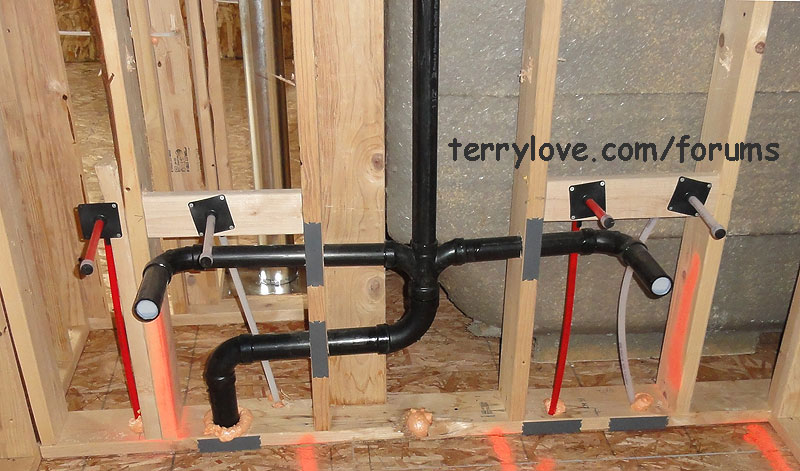
The pic below of double lav install (I believe it's from one of Terry's jobs) shows the correct configuration using a double fixture fitting. For the ABS fittings, Google "plumbing supply" and go with the famous one.
 

Attachments

  • lav_rough_double_b.jpg
    lav_rough_double_b.jpg
    82.4 KB · Views: 24,495
picture

The only addition to the picture, unless it is dropping directly into a main line would be a cleanout tee beneath the fixture fitting. Although a snake will drop down the stack, removing a trap to clean the line is not a proper cleanout method in this area.
 
Thanks all - I do already have an existing cleanout beneath the existing (single tee) fixture. I'm planning to cut above and below the existing single tee, & add my double tee.

When adding a section of dwv pipe back in this vertical way, what's the best way to get couplings squeezed in there? In other words - if I come back with pipe to fit the exact length that I cut out, there won't be room to get couplings in where I need. I was thinking that I glue the bottom joint (between the tee and cleanout), and then on the top joint (above the tee), I use a rubber coupling? What do you all think?
 
Sam - Just for the sake of explanation - why don't you use the type you pictured in the lower picture?
 
And just to review - it's only when I'm doing a back-to-back installation (i.e. two different rooms) where I need a double fixture tee, right? Same room, two sinks = double sanitary. Correct?
 
Sam - Just for the sake of explanation - why don't you use the type you pictured in the lower picture?

My 50 cent explanation: the steel band in upper pic reinforces the coupling making for a connection that won't offset or separate. The coupling in the lower pic relies on the soil backfill to reinforce the coupling.

Also, look closely at the coupling in the first pic - notice the stop for the pipe in the center and the ridges at either end to seal the joined pipes. The coupling in the second pic does not have these features.
 
Last edited:
The IPC will let you use the double san tee in the configuration that you want to use it for, HOWEVER if you have to snake the drain you'r gonna have troubles because the snake is going to pass straight through and not go down. We can not use double san tee fittings for back to back blow out type fixtures. I would follow Terry's advice and go with a double fixture Tee.
 
code

The IPC is a cost driven code, and since a double fixture fitting costs more than a cross, the cross will be allowed even if it does cause operational problems later.

double-fixture-tee.jpg
 
Last edited by a moderator:
I don't know it it was allowed by the CA plumbing code at the time my condo buildings were built ( 1985 ) but I assume we have double san tees on the back to back closets, because on two occasions in the last several years, plumbers called in by homeowners have pulled the guy's toilet and run a cable down, which promptly came up inside the adjacent apartment and beat the toilet to death!
 
toilets

It can happen with a back to back fitting also if the cable is very stiff. It will hit the slope of the other side and then make the gradual turn to go upwards.
 
The IPC is a cost driven code, and since a double fixture fitting costs more than a cross, the cross will be allowed even if it does cause operational problems later.

Never heard it called that, but I like it. I prefer to think of it as a manufacturers code. Or conversly the Idiotic Plumbing Code.

Hell, now I'm all stirred up again and feel like having a screeming contest with the state board members again. They're gonna get a restraining order on me pretty soon.:D
 
If you are doing back to back toilets, it needs to be at least the double fixture fitting.
And even with that, the waste from one toilet will cross over into the other arm, forcing the water up in the bowl, and then leaving it with less water.

I becoming a big, I'm not a fan of any kind of cross for todays toilets.


So what are you in favour for then Terry for horizontal to vertical applications like a back to back toilet installations? A double wye? Or do you only prefer to use a double wye if a double fixture fitting is not available?
 
A lot of time a double wye and 1/8 bend take up too much space, especially in residential work. A double fixture fitting is a whole lot more compace. They are fairly common, though the box stores probably won't have them. If the fixtures are not blow out tye, you can still use a san tee by the IPC and UPC but again, they make cleaning a little more difficult. To be honest I usually try to use std fittings and offset the drains so that a regular wye ir san tee woll work.
 
Back
Top