PDA

View Full Version : What is the name of the tool??


chestnuts
07-19-2008, 02:07 PM
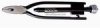
An buddy of mine is an electrican and had most of his tools handed down to him. He has a tool that will twist 2+ wires together, but he has never known the exact name of the tool. You put the wires in one end and then spin the handle to twist the wires together before you put on a wire nut. Anyone know what the name of this tool is or what company makes one??

Thank You,

Mikey
07-19-2008, 02:12 PM
I've got 4 or 5 tools like that that are used to twist safety wire -- used in aircraft systems to prevent threaded things from becoming unthreaded things. They are called ... umm ... "safety wire twisters." I don't think they would work for electrical-wiring-sized wire.

4955

hj
07-19-2008, 02:17 PM
KLEIN TOOLS - Klein Connection Basic Search (http://www.kleinconnection.com/webapp/wcs/stores/servlet/BasicSearchView?storeId=10001&langId=-1&catalogId=10001&catGroupId=&searchTerm=wire+twister&resultCatEntryType=3&pageSize=5&beginIndex=20&sType=SimpleSearch&searchTermScope=3&searchMFPartNumber=)
These are listed for aviation use so I would assume that means for insulated wires, not rebar tie wire.

Bob NH
07-19-2008, 03:04 PM
As Mikey said, they are for safety wire.

http://www.whizwheels.com/Tips/safetywiring.html

Stainless steel wire is threaded through holes in the nuts or bolt heads and oriented in a way that prevents any fastener from un-screwing due to vibration as it might in missile, aircraft, or machine operations.

The pliers are used to make it easy to twist the wires.

Igor
07-19-2008, 03:14 PM
KLEIN TOOLS - Klein Connection Basic Search (http://www.kleinconnection.com/webapp/wcs/stores/servlet/BasicSearchView?storeId=10001&langId=-1&catalogId=10001&catGroupId=&searchTerm=wire+twister&resultCatEntryType=3&pageSize=5&beginIndex=20&sType=SimpleSearch&searchTermScope=3&searchMFPartNumber=)
These are listed for aviation use so I would assume that means for insulated wires, not rebar tie wire.

No, those are for stainless steel safety wire. The safety wire is run through holes drilled in nuts and bolts to keep them from vibrating loose.

I don't know of anything like the OP describes that is currently on the market, but there is a patent (http://www.patentstorm.us/patents/5379809/description.html) for a wire-twisting device.

jimbo
07-19-2008, 03:15 PM
rebar ties are twisted with a simple tool which is a hook and a spinning wooden handle.

http://www.hardwareandtools.com/invt/1482256?ref=gbase

chestnuts
07-19-2008, 05:35 PM
Finally found what I was looking for on an auction site :rolleyes: ....

Igor
07-19-2008, 06:30 PM
That "Nut Twister" looks like it's meant to twist the wire nut, not twist the wires before installing the nut. There are other tools out there that will do the same thing; some Ideal screwdrivers have a wire nut wrench in the handle, and you can get wire nut bits for a cordless drill.

Speedy Petey
07-21-2008, 04:15 AM
I am curious as to why we need extra tools for this very basic stuff.

I am all for more tools, but a tool to twist wire before putting on a wire nut?????? :rolleyes: It's called a lineman's pliers.

hj
07-21-2008, 06:53 AM
Some people have too much empty space in their tool boxes and want all the specialized tools they can find. A lot of times all you need is the multipurpose hammer/screwdriver and a screwdriver/chisel, possibly a pliers/hammer, and you can accomplish a lot.

Redwood
07-21-2008, 07:36 AM
Build it and they'll buy it!

Here we have the hammer/pliers!

http://www.hooverfence.com/tools/pliers-2t-1900.jpg

chestnuts
07-23-2008, 07:48 PM
The reason a specialty tool is needed is because I am trying to twist 4 wires together. The reason I am doing that?? Because of the idiots that wired my garage before I bought my house. I had an outlet quit working. When I went to replace the outlet I found one hot into the outlet itself, then 3 hot wires from the the back of the outlet to 3 light switches. This ended up buring up the outlet, so I am told. So, now what I am trying to do is bring the hot into the outlet box, then jumper to the outlet and the other 3 switches. To do this, I have to twist 3-4 wires together. I watched my buddy twist nuts on 4 wires quickly when we remodeled my kitchen. So, I was looking for a "PROFESSIONAL" way to accomplish this.

Now, what is SO wrong with that????? :confused:

Mikey
07-24-2008, 03:59 AM
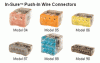
While you can twist 4 wires together, with or without special tools, they now make push-in junction gizmos that are a heck of a lot easier to use and take less space in the box. Downside is they're a one-way trip -- you can't change your mind after the junction(s) are made. Made by Ideal and others, they're available in big-box stores and trade outlets. Come in several sizes:

4999

Wrex
07-24-2008, 05:20 PM
Oooh pretty colors :D.

They look nice but they aren't as compact as 4 wires and a wire nut. This is very important when space is at a premium.

I've personally never been sold on the "clip in" design I still use the screw on fasteners on recepticles.

On a related note recently I just installed a GFCI outdoors and it had a wonderful compromise. You insert the wire through the hole in the rear then tighten the screw on the side the screw pulls a fastening plate tight onto the wire "biting in" and holding it in place.

Now thats a good idea I want to see that on ordinary non-GFCI recepticles.

Whats the big deal about twisting 4 wires together?

As long as you have linesmans pliers and not thin nose pliers you should be able to do it fine.

Furd
07-25-2008, 12:39 AM
I just installed a GFCI outdoors and it had a wonderful compromise. You insert the wire through the hole in the rear then tighten the screw on the side the screw pulls a fastening plate tight onto the wire "biting in" and holding it in place.

Now thats a good idea I want to see that on ordinary non-GFCI recepticles.

They're called "back-wired" receptacles and are commonly available. Look for "specification grade" on the box. They cost more than the cheap ones but they are better made all around.

Mikey
07-25-2008, 04:10 AM
They look nice but they aren't as compact as 4 wires and a wire nut.
The wire nuts you're using must be a lot smaller than the ones I'm using...

Wrex
07-25-2008, 07:55 PM
They're called "back-wired" receptacles and are commonly available.

Ah specification grade so thats what that mean't on the package.

I never quite trusted the old "click in" mechanism but now that its fastened down with a screw I feel much more comfortable using them.


The wire nuts you're using must be a lot smaller than the ones I'm using...

I was just going by the picture without looking at actual dimensions from the pics. Not a good practice.

These push in connectors remind me of butt connectors introduced for phone lines years back. The phone line butt connectors all worked fine when installed but years later they introduced all kinds of problems.

The real question is what is their longevity?

A release for the wires would have been a good idea. If someone wanted to run another line into the box they would have to cut off all of the wires. If this happened too many times you would end up with short wires that don't reach.

I am naturally suspicious of new products until they have been proven in the field.

tjbaudio
07-25-2008, 09:15 PM
Speck grade is the only kind I use any more. I still check the outlet in the box to make sure they are the kind I like! I just dont trust the big box stores! And I have used them to join 4 wires together and they work nice. NOW if they would only make the ground wire like that! I know I know probably some NEC or UL rule.

Mikey
07-26-2008, 03:45 PM
The real question is what is their longevity?
Good question. These looked too much like "backstabbed" receptacles for me, but these are good for 12AWG, are really quick to install, and do save a lot of space. The clincher was when a bunch of Halo can lights I bought came with these things already pushed on to the fixture pigtails. I love them.

A release for the wires would have been a good idea. If someone wanted to run another line into the box they would have to cut off all of the wires. If this happened too many times you would end up with short wires that don't reach.
That probably would have made them more expensive, and perhaps added an uncertainty that UL wouldn't have liked. Unless I'm certain of a box's final configuration, I use these thingies with an extra hole or two for later mods.

I am naturally suspicious of new products until they have been proven in the field.
Me too. I'll let you know if I have any problems.

Tundra
07-27-2008, 01:36 AM
Build it and they'll buy it!

Here we have the hammer/pliers!

http://www.hooverfence.com/tools/pliers-2t-1900.jpg


If you do any work on barbed wire fences you will appreciatte these to say the least!!! Just ask a good ole' farm boy :D

Tundra

pudge565
07-27-2008, 07:55 PM
I will have to look on another forum for the thread I am looking for it pictured a wire twister with like 8 holes that goes on a drill you put the wires in certain holes and it will twis em right for you. but by the time you get em in the hole and all that you could have been done with your linemans.