View Full Version : my pex heating roject
Dave_in_Troy
05-22-2008, 09:28 PM
Hi Guys,
I’m not a plumber so I hope you can give me some advice.
Right now I own a house that’s about 75 years old, a 2 story center hall colonial. It currently has a convection flow steam system installed. I think the furnace is the original one. It’s an old coal-fired monster and someone pulled out the coal grates and stuffed in an oil gun. I have 10 Aero steam/water radiators, each with one 1.25” feed/return pipe and a pressure relief valve.
My problem is that the oil bill to keep this dinosaur running is killing me, the upstairs is too hot, the downstairs is too cold, I don’t think the old steam trunking system can be zoned and some of the cast iron fittings on the furnace itself are rusting. I think I need to put this thing out of my misery.
My overall plan is to rip out the entire existing system including the feeds to the radiators (but not the radiators themselves), the furnace and the oil tank. I want to bring in a natural gas line from the feeder line across the street and put in a new gas furnace.
I want to have 3 zones, one for upstairs, one downstairs and one for an indirect hot water tank.
For the distribution piping to the radiators I am thinking of running 1” pex trunks and ¾” pex feed/returns to each radiator i.e. not home-running all the lines to a manifold. No trunk would support more than 3 radiators. Hopefully using pex will allow me to avoid putting joints in the walls or ceilings and minimize the amount of sheetrock I have to hack up to get the piping in. Also, copper is crazy expensive these days and I am not a pro at sweating copper joints. I want to run ¾ pex for better flow to the radiators (1/2 is too small once you account for the fittings I think).
I am thinking of using the Watts fittings and either the Watts SS cinch rings or the standard brass crimp rings (which is better?). Also, I would have to find a source for the oxygen-barrier pex pipe (any good source?).
For the radiators themselves I have a bit of a problem. The side of the radiator that is currently hooked up to the steam system should be ok, I think I can break the union and reduce down to ¾ pex. The other end has been sealed with the factory plug since they were new and after 75 years of steam they WILL NOT move. The cast material the plug is made of won’t hold enough pressure to break the rusted in seal, the metal just deforms. My plan is to drill through the face of the plug and tap it for ½” NTP, from there I can attach ¾ pex fitting. I tried this on a spare radiator that I removed last year and it seems to work, although I haven’t pressure tested it yet. Then I would have to drill and tap for the air bleeder valves and plug the hole where the steam pressure relief valve was attached.
I would have to pay someone to install the furnace unit itself along with the water heater tank, circulation pumps, expansion tank, connect to existing water lines, run the gas line and due any necessary system tuning. I would do all the plumbing for the trunk lines and up to the radiators (I just can’t afford 85$/hour for that many hours).
OK, that’s the plan. Please tell me what’s wrong with it.
Thanks for your help.
David
rmelo99
05-22-2008, 10:05 PM
I went through a similar project as you.
I have a 3 story colonial (100yrs old) was all one zone.
Now I'm at 8 zones all with circ pumps. I did it all with Wirsbo/Uponor pex with oxy barrier. HePeX. I bought the pipe from pexsupply.com
I did all mine with 1/2" pex. I also thought about doing larger but since i was breaking it down into so many small zones the smaller pipe was enough.
My third floor has stand up cast iron rads, the second has cast iron baseboard, and the first floor is a mix of cast iron baseboard and recessed cast iron rads.
I'll post more info up in the morning, got to get some sleep now.
patrick88
05-23-2008, 08:55 AM
I have seen a lot of steam Rad's leak when filled with water. I would rethink keeping the Rad's. I have gotten many flood calls caused by a steam Rad leaking because the boiler was over filled.
You can remove the union and the brass piece so you can bush it down with little effort. The other end might be a bit harder.
I think you would find it simpler to goto baseboard or replace your rads.
jadnashua
05-23-2008, 09:05 AM
BTW, when heating water, it's called a boiler, not a furnace. A furnace is used to heat air in a residential situation.
I know it would add to the costs, but probably not to the labor...I'd chuck those old radiators, get some nice flat panel, unobtrusive new ones, and maybe even relocate them if the old positions aren't great. You'll have one huge rust mess once you circulate water through those old radiators that will take awhile to clear out, if you ever do.
The size of the pex you run would depend on the amount of heat you need to supply. Uphonor stuff has a good rep. Depending on the controls you choose, you may not need to buy their expansion tool as some of the fittings use o-rings and compression.
poorplmbr
05-24-2008, 04:51 PM
Just be extra careful when using the "o"ring/compression,or "QS",type fittings from Uponor.....the o-ring can get pinched really easy and if the PEX isn't cut square and fully inserted into the QS fitting you WILL have a leak...take it from experience!!!!
75 years ago? You could have 3 column steam radiators which cannot be converted to hot water. I am not sure how you plan to pipe these radiators because you cannot loop from one to the other using the size pipe you indicate. And tapping the radiator with 1/2" ips and then increasing to 3/4" is also counterproductive. $85.00 per hour is expensive, until after you have done the entire system and it doesn't work right and you have to pay that to have it done over, which is the way it appears you are heading.
rmelo99
05-27-2008, 09:29 PM
My system was a bit different as I already had a hot water circulating system except it was all on one big loop.
I didn't change out my boiler but it is on the list.
I did pipe the system with enough valves to make working on it, draining, purging, or swapping out components like circulators, expansion tank and the boiler itself without having to drain down the whole system.
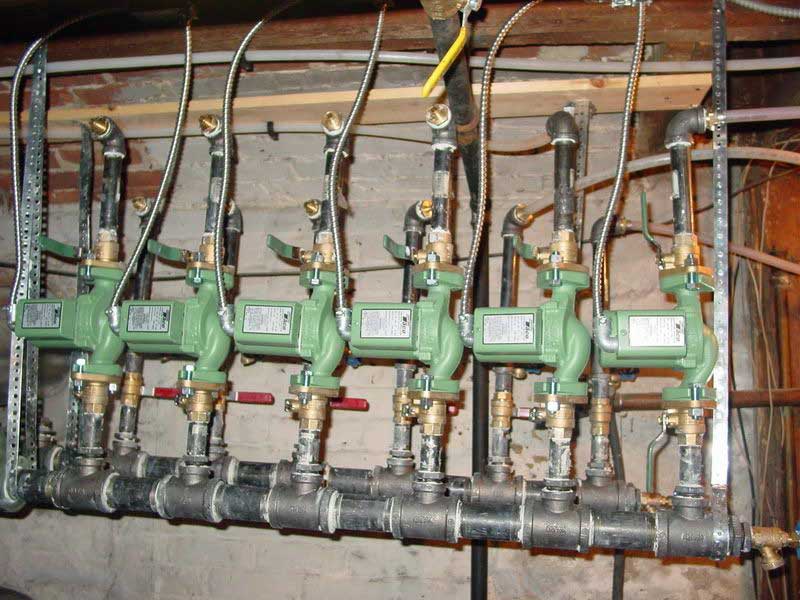
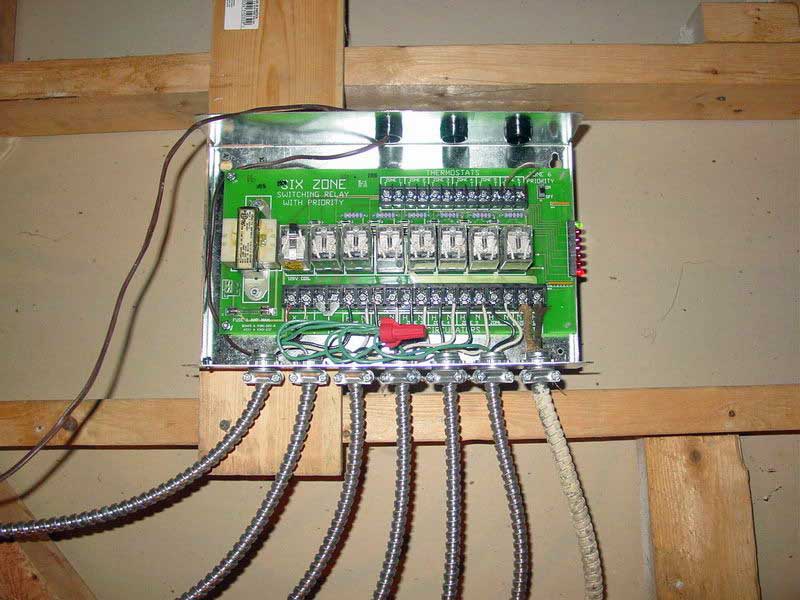
I also did not want to deal with the complexity of zone valves in combination with circulators, so I zoned my entire system with circulators. I used a Taco zone controller so I can just wire a thermostat to each zone and then to it's circulator.
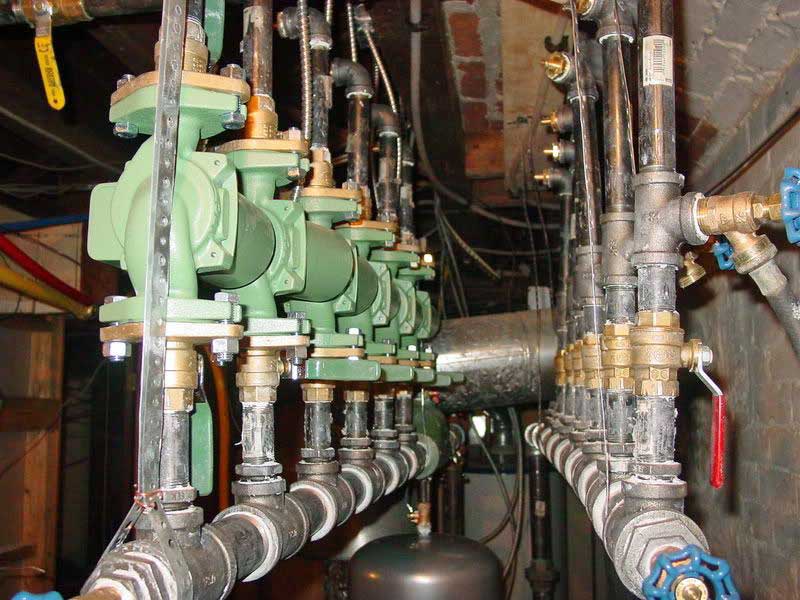
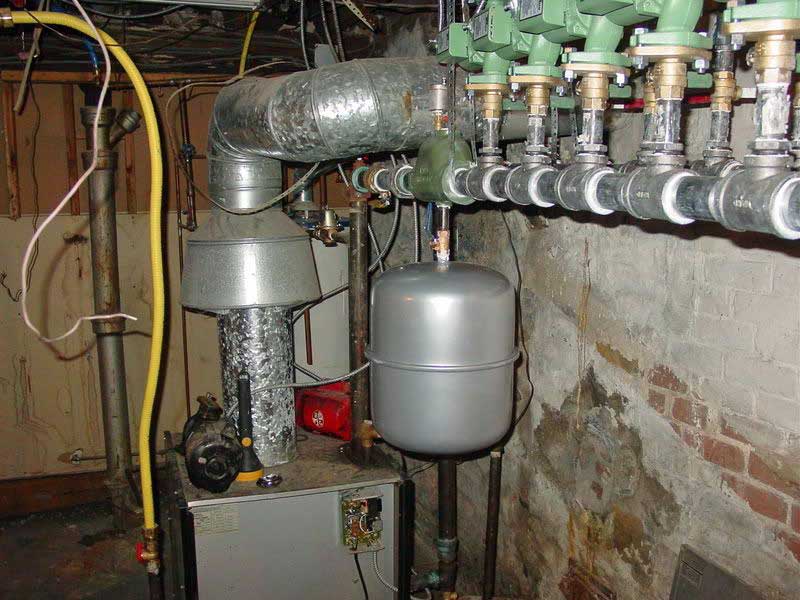
here are some pics. these are first round. more circs have been added since and I cleaned up the pex runs above to make it look cleaner. (as much as possible with pex)
http://i138.photobucket.com/albums/q276/rmelo99/Boiler%20Brooklawn/DSC02912.jpg
http://i138.photobucket.com/albums/q276/rmelo99/Boiler%20Brooklawn/DSC02928.jpg
http://i138.photobucket.com/albums/q276/rmelo99/Boiler%20Brooklawn/DSC02907.jpg
http://i138.photobucket.com/albums/q276/rmelo99/Boiler%20Brooklawn/DSC02914.jpg
Bill Arden
05-28-2008, 01:41 PM
here are some pics. these are first round. more circs have been added since and I cleaned up the pex runs above to make it look cleaner. (as much as possible with pex)
It looks like you are using cast iron pumps with non barrier pex.
I had to change to a brass/bronze pump since it kept rusting regardless of how much of the "protector" I added. Note: everything else in my system was PEX, copper, or stainless.
cattledog
05-28-2008, 03:27 PM
Dave-
Another issue with keeping the original steam radiators is matching the heat delivered by the lower temperature hot water to the heat load of the house. As others have advised, you may be better off replacing the radiators with something properly sized for your heat loss when using hot water. In fact, if you oversize the radiation, you can run lower temperature water and possibly consider a modulating/condensing boiler with outdoor reset and achieve a large energy efficiency gain.
rmelo99
05-29-2008, 08:34 PM
It looks like you are using cast iron pumps with non barrier pex.
I had to change to a brass/bronze pump since it kept rusting regardless of how much of the "protector" I added. Note: everything else in my system was PEX, copper, or stainless.
Sorry, that is incorrect, my pex is Wirsbo HePex, it has an oxygen barrier. It isn't the aluminum type of pex, but does have an oxy barrier and can be used with cast iron, other wise I'd have more problems than my pumps all my rads are cast iron.
jkorver
06-18-2010, 03:31 PM
I know this is an old thread, but hopefully someone is still around.
I am wandering if there is any corrosion due to dissimilar metals.
I am hooking up cast iron radiators and I ran pex to each one, then I want to change to iron pipe before I come through the wall or the floor. However, I can only find brass fittings to make the PEX crimp connection. Then, if I connect brass to iron pipe, I probably should use a dielectric union.
Does anyone know a better way, or a way around this? I just don't want my plastic pipe exposed in a 90 year old house...tacky!
Wally Hays
06-18-2010, 04:31 PM
brass to steel pipe is the correct way there will be no dielectric issues
ALL the gas CSST manufacturers state that their material is NOT to be used as a "flexible connector" connected to the appliance.
Wally Hays
06-19-2010, 04:53 PM
Yea but who reads directions these days :)
rmelo99
06-19-2010, 09:17 PM
ALL the gas CSST manufacturers state that their material is NOT to be used as a "flexible connector" connected to the appliance.
Was this misposted? I don't see any mention of GAS piping or CSST or flexible connectors in this thread. Just pex / iron pipe and brass for hydronic heating.
To answer the question yes you can do brass to iron pipe, not an issue. Perfectly fine.
Redwood
06-20-2010, 07:55 AM
Was this misposted? I don't see any mention of GAS piping or CSST or flexible connectors in this thread. Just pex / iron pipe and brass for hydronic heating.
To answer the question yes you can do brass to iron pipe, not an issue. Perfectly fine.
I believe this picture brought the comment about CSST...
http://i138.photobucket.com/albums/q276/rmelo99/Boiler%20Brooklawn/DSC02928.jpg
rmelo99
06-20-2010, 08:04 AM
Gotcha! Didn't even realize the CSST being referred to was the CSST in my picture!
To clarify if it isn't visible there is Black pipe below that shutoff valve and that is what goes into the boiler. Same setup exists on the NatGas HW Heater behind in the pic. This was done by a licensed plumber and inspected when we bought the house. The house was winterized. When they unwinterized it for our inspection they had a gas leak that couldn't be located. A plumber ran new gas lines all CSST from the meter to the 2 gas appliances. The city inspections were done right after we closed on the house. So as far as the Building department is concerned my setup is ok in their books.
I have read about flexible or CSST connectors passing through the metal appliance jacket. But like I said about the last part of the appliance connection is actually black pipe.
Wally Hays
06-20-2010, 08:29 AM
Six zones, cast iron radiators, no bypass, no tempered return. I see a new boiler in the near future. Who does this stuff and why?
rmelo99
06-20-2010, 08:38 AM
Six zones, cast iron radiators, no bypass, no tempered return. I see a new boiler in the near future. Who does this stuff and why?
If you're refering to mine there is a tempered return in place now. Not shown in those old pics but it is a bypass in place to protect the boiler from cold return temps.
ballvalve
06-20-2010, 11:29 AM
I would sell that house and buy one with in floor pex heating and plastic manifolds. Leave that threaded time bomb for someone else.
Wally Hays
06-20-2010, 03:03 PM
It's definitely one for the archives :)
rmelo99
06-20-2010, 04:36 PM
I would sell that house and buy one with in floor pex heating and plastic manifolds. Leave that threaded time bomb for someone else.
Everyone is entitled to their own opinion. The house is 110 years old. I removed the majority of the ORIGINAL Black pipe for the purposes of zoning and creating a more efficient way to heat a 4000sq ft house. The original piping was in PERFECTworking order for 100+ years. I think that has to say something for the "time bomb". I did choose to reuses the cast-iron baseboard radiators etc...
I am the type of person to be open minded to new things, that is one of the reasons I chose to use PEX in my house. While I am happy that I did so, all of the recent "PEX" related recalls etc has me a bit worried. I can't say that I have seen any widespread failures of the millions of homes that use the old school piping methods.
I'd never trade my 110yr old house for a new construction house if you paid me! Would I like in floor heating throughout? Yes, it would be nice.
Here in CT there is almost no "SLAB" built houses(we have basements) which makes for not the most ideal setup for in-floor heating. I know there are various ways to do it.
As a DIY'er that relies on the internet for help/research and information I wouldn't want to run across your post that makes it seam like what I've done is bad or wrong.
There is always more than one way that things can get done. Given the constraints of working in an existing house(3 stories), retrofiting an in-floor pex heating system isn't the feasible, cost effective, or even the most efficient way to heat this house.
ballvalve
06-20-2010, 05:14 PM
Nothing personal, I like to save old houses too.
What would scare me is all those joints in the basement with modern "pipe" imported from Indonesia [?] Its really crap, and the quality control on thickness and metallurgy, not to mention thread specs are pitiful. If you used schedule 80 USA pipe and fittings, maybe it would come close to the old stuff you pulled out. One bad piece of chinese "quality" in that manifold will ruin your month.
Sure everyone puts galv pipe into brass valves, but it never comes out down the line.
Question for the expert plumbers: could he have used ductile iron "sprinkler" pipe? that stuff seems to have great quality and domestic mfgr.
It seems you could have saved a bunch of money by using the cast iron circulator flanges.
And would it not be easier to use one or two larger pumps and adjust zones using valves?
rmelo99
06-20-2010, 06:05 PM
I'll answer a couple of questions about my "manifold". When I first undertook this project I was not able to locate "pre-made" boiler manifolds. Now that I know they exist it is much easier and having done it again I would prob go that way. It was not fun building that thing.
http://www.pexsupply.com/HydroPEX-2X1HEADER-8-2-Boiler-Header-with-1-Outlets-8-Branches (FYI Those may be made in China)
Regarding the quality of the material. All of my Black Pipe Fittings are WARD and stamped USA. http://www.wardmfg.com/WardAbout.aspx
The TACO Freedom Flanges on the other hand is a different story. I did already have one fail. That being said I don't know how much more can be done to ensure quality is there.
I chose to zone with circulators after much research. It did/does cost me more, upfront and running costs. But I was able to design my zones such that a very common TACO007 pump curve was able to perform across the board. I am able to keep a shelf spare of that pump. The zoning with pumps makes for a much simpler plumbing layout and electronics layout. When there is a problem it is easy to troubleshoot where the problem is. In addition if one pump ever goes down I only lose one zone the rest of the house keeps running. With the isolation valves @ each pump I can replace a pump with the entire system running and not having to purge water/air from any zones.
Wally Hays
06-20-2010, 07:36 PM
Ductile would be expensive, hard to get and overkill. Zone valves, circulators, not much difference price wise these days though zonevalves would be much much less expensive to operate ( electricity cost ) The other issue with running that many pumps is the massive change in system pressures when one or several pumps cut in along with a huge swing in the delta t. which you would also get with zone valves unless you go with a variable speed pump ( wilo, grundfos or taco ) Either way though the entire system should have been piped primary secondary to keep temperature swings within design and to lessen pressure differential within the system. Of course, while I'm into it the biggest thing here is all the money spent on circulators, valves and controls and they are all hooked up to a gas boiler with atmospheric burners with a real effiaciency ( not AFUE which is a joke ) of around 70% on a good day. On the upside though, with a new high efficiency boiler with reset and a little bit of piping it could be a pretty efficient system. I have a 200 year old house with CI radiators that are all piped back to multi port manifolds with variable speed pumping. outdoor reset and a Buderus GB125. cut my oil use by 1/2
rmelo99
06-20-2010, 07:41 PM
The old oversized boiler was outfitted with an IntelliCon HW+ to boost it's effeciency till it was replaced. Recently it was replaced with a Viessman Gas Boiler with some pretty cool controls. The next step when funding permits is a HI Eff Modulating/Condensing Type boiler.
The Viessman was pratically free from a trade school that used it for HVAC classes. Only had a few hours of runtime on it.
DkraM
10-04-2010, 04:13 PM
Ductile would be expensive, hard to get and overkill. Zone valves, circulators, not much difference price wise these days though zonevalves would be much much less expensive to operate ( electricity cost ) The other issue with running that many pumps is the massive change in system pressures when one or several pumps cut in along with a huge swing in the delta t. which you would also get with zone valves unless you go with a variable speed pump ( wilo, grundfos or taco ) Either way though the entire system should have been piped primary secondary to keep temperature swings within design and to lessen pressure differential within the system. Of course, while I'm into it the biggest thing here is all the money spent on circulators, valves and controls and they are all hooked up to a gas boiler with atmospheric burners with a real effiaciency ( not AFUE which is a joke ) of around 70% on a good day. On the upside though, with a new high efficiency boiler with reset and a little bit of piping it could be a pretty efficient system. I have a 200 year old house with CI radiators that are all piped back to multi port manifolds with variable speed pumping. outdoor reset and a Buderus GB125. cut my oil use by 1/2
Wally, I am new here and am attempting something similar to what has been described: 120 year old 2 story, 2000 sq/ft house with 11 CI radiators. I have just completed a new basement floor (sewer and sump pump too) and added PEX in the basement floor. The old iron radiator piping which was at 4 feet above floor level had to come down. The boiler was replaced about 12 years ago with a Weil McL- 195,000 btu Nat. gas model and a single circulator pump. I don't have complaints about how the system worked and now I want to use PEX to replace what pipe has been removed. I suppose the easy way would be to home run 1/2" tube to a 12 port manifold and simply hook everything to that single pump. I would appreciate any ideas you have about efficiency options and possibly creating two zones (upstairs bedrooms and main floor) which could be timer controlled to keep the main floor cooler at night. In the past we found that our house didn't respond too well to a 65 degree set back at night because it would take 3 or more hours of continuous firing to get the house back to 72 degrees. (although admittedly this might change because of the reduction in pipe water volume). I would think a simple timer and single zone valve for the main floor radiators would be OK?
I'll need to plumb in the new basement floor heat in the winter with some type of lower temperature control. I'd like to hear your ideas on how best to set that up.
Thanks