Need help replacing valves

sdjerry

New Member
Messages
24
Reaction score
0
Points
1
Location
San Antonio, TX.
Hi everyone, I hope someone can give me some assistance. I want to replace the hot & cold water valves under my bathroom sink. I then plan to replace the old supply lines with new braided steel one's. I have included a picture of one of the valves. They are compression style.

My problem though is I don't know how to safely remove the old valves so I can replace them. So I have some questions.

1.) I have made one attempt after turning the water off to the whole house, but the nut on the copper pipe just turns and turns, no progress is made. I think it's because they are so old and corroded as you can see. How can I get them off?

2.) There are two water valves at my house, one on the street, and one next to my house. The one on my street also turns off the neighbors water because it's a duplex, so I'd rather not turn that one off unless I absolutely have to. However, I notice when turning off the valve next to my house that I still get a little bit of water coming out of faucets even after a while. How can I get the water off completely as it should be?

I'll just leave at it this for now so I don't overwhelm anyone, I appreciate all responses.
 

Attachments

  • MVC-008S.JPG
    MVC-008S.JPG
    40.9 KB · Views: 447
You definitely should replace the valve that shuts off only your 1/2 of the duplex. You probably want a plumber for that job as it won't be fun if things go wrong and your neighbor is going without water too...

To do these shut offs under your sink you could shut of the valve that isolates your side only then open a hosebibb to divert the leaking water while you work.

To remove the shut off you need one wrench to hold the shut off valve still while you turnthe nut to unscrew it from the valve. It is a compression fitting. Now the fun part...

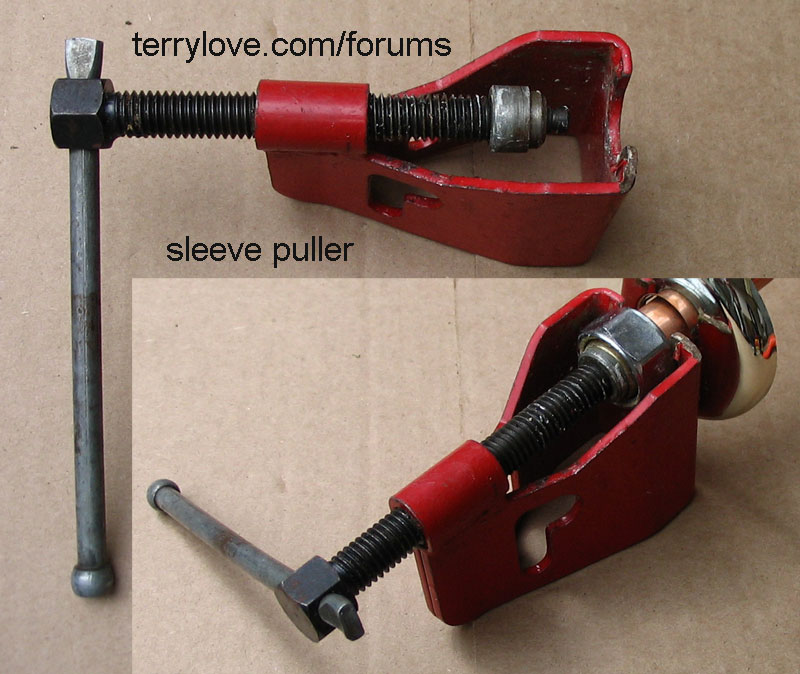
Hopefully the new compression angle stop valve has the same threads so you may reuse the nut and ferrule that is on the pipe. If it is not you will need a ferrule puller to remove it so you can install the new one...

You may just want to have a plumber do this for you at the same time the other valve is being replaced.
 
You've got enough copper sticking out on one side to just hacksaw the valve off it looks like. Not so on the other. Measure the inside depth of the valve you choose and see if you have enough length if you just cut it off to allow a new one to fit. Keep in mind you need enough length to allow the nut to turn freely while you've got the valve bottomed out on the pipe.

sleeve_puller_1.jpg
 
Last edited by a moderator:
Thanks for the responses so far.

I'd really like to do this myself and not call a plumber unless I have to, not sure I could spare that kind of cash right now. At the same time though I understand that I've never done this before and so there are risks involved. I'm weighing my options at this point, the majority of people are telling me just to do it myself as it's not as complicated as it looks, but I respect the opinions of people here as you guys know more than me when it comes to plumbing.

Redwood, in order to change that valve outside of my house I would have to turn the main valve off on the street wouldn't I?

Is that a pretty easy job?
 
You really need to get rid of those stops and those flex supplies.

I would pull the stops off, they will be hard, but they will unscrew.

with those type, you will probably not be able to use the old nut and farrell, some you can, but if I remember correctly, those type threads do not match up.

I would pull the old farrell and nut, solder on mip's and use IPS stops, 1/4 turns.

As far as being able isolate your unit from the others, this should be first and formost on your priority list, it is very important to be able to turn your unit off, especially if you have other one piece supplies and stops in your unit.
 
There is absolutely no way the nuts could "turn and turn and turn" without loosening the valve.

Maybe the valve is loose for all I know, but nothing happened in terms of the valve coming off. Why would I make it up?

I came here for help, I have no reason to make things up.
 
Are you using two wrenches, as you need to do? One to turn the nut and the other to "hold back" on the valve body to keep it from rotating.
 
Are you using two wrenches, as you need to do? One to turn the nut and the other to "hold back" on the valve body to keep it from rotating.


That's what I was not doing, and that's why it kept turning as I was only turning the nut on the copper pipe. That was bad advice from someone else though, but I've never done this before so it's partly my fault to. There is some corrosion on these valves, the picture doesn't do that part justice.

And so I'm wondering if it's going to be difficult getting it loose.

Appreciate all the replies so far.
 
Even though there are hard water deposits, it may not be that hard to loosen the nuts.
 
We didn't quite understand your comments, because if you are holding the valve body with one wrench, it would be almost unheard of for the nut to turn and not come loose. They just don't do that. Now if you turn the nut and allow the valve body to turn with it , then of course nothing comes loose.

The bad news here is that these water lines are FAMOUS for snapping off or pin-holing if you even just LOOK at them. Since you have done that, it is quite imperative to "gitt'r done"

Turn off the house valve, open all the hose bibbs and all the cold taps, and if the drip is minimal, you can proceed. Get a LOT of towels and small pails ready to deal the water under the sink, and if it gets out of hand, be ready to shut off the curb valve.


For at least the closer valve in the picture, you could definitely cut with a fine tooth hacksaw carefully right behind the nut. After, carefull debur the inside of the pipe and take emery cloth to the outside burrs, as well. Put on a new chrome escutcheon, then the new valve. Ensure you hold the valve bottomed out onto the pipe as you tighten the nut. Hand tight on the nut, then one turn with a wrench and you will be close. If the valve feels like it would move if you twist if, increase in 1/2 turn increments until it is quite snug.

In terms of loosening the nuts, a soak in white vinegar or PB Blaster will help. A 12" channellock and 12" crescent should do it.

Many of use use a light coat of 3-in-one oil, or a light brushing of White teflon paste, on the new ferrule and threads. Not mandatory, but we just like it. Use NO teflon tape on this job.
 
nut

The reason I said it was impossible for it to turn without loosening was because your picture implies that the lines are still connected to the faucet, and if so the valve could not turn around on the tubing, and the nut would have to separate from the valve. Now if your picture is inaccurate and the lines have been disconnected from the faucet, then the valve could rotated if someone were to try to remove it with a single wrench, but we would not have that information.
 
I will now say that I think you are all misguided (edited).

As a DIYer I would not even attempt this until I knew the house supply could be turned completely off. And this guy definitely is a DIYer!

The main shut-off needs to be fixed first and by a qualified plumber. Then he can play with these til his heart's content.

The main shut off is your only line of defence and really, therefore, the only thing you absolutely must use a plumber for.
 
Last edited:
I will now say that I think you are all idiots.

As a DIYer I would not even attempt this until I knew the house supply could be turned completely off. And this guy definitely is a DIYer!

The main shut-off needs to be fixed first and by a qualified plumber. Then he can play with these til his heart's content.

The main shut off is your only line of defence and really, therefore, the only thing you absolutely must use a plumber for.


Hey Ian, don't call me an idiot.

why don't you read the bottom of my post before you start typing:confused:
 
You really need to get rid of those stops and those flex supplies.

I would pull the stops off, they will be hard, but they will unscrew.

with those type, you will probably not be able to use the old nut and farrell, some you can, but if I remember correctly, those type threads do not match up.

I would pull the old farrell and nut, solder on mip's and use IPS stops, 1/4 turns.

As far as being able isolate your unit from the others, this should be first and formost on your priority list, it is very important to be able to turn your unit off, especially if you have other one piece supplies and stops in your unit.


Hey Ian, over here......:p
 
Apologies, that was a bit harsh of me. But a pro, like you, can work with running water. A DIYer cannot.

A recipe for disaster is being discussed here, without doing first things first.

He's going to be sitting up all night filling buckets waiting for the plumber to arrive.
 
Last edited:
pro

Even a pro cannot, and would not, try to replace those valves with water running, but a minor leakage can be dealt with. If we tried to post every caveat when someone asked a question we would be spending hours typing, and needlessly if the person already knew what was being added. I will expect that the person knows what should be done up to the point where he asks the question. If not, then he shouldn't be doing the work, or should ask specific questions about what he should, or should not, do.
 
Ok so I have a better idea of what steps to take here.

Just to clarify the amount of water still coming out of some faucets with the valve turned off is minimal, but I agree that the goal is to have no water coming out at all for peace of mind.

The main valve out at the street works great, it just turns the water off to both my house and next door since this is a duplex home. I have attached a picture of the valve outside of my house, it turns off the water to my house only, I notice that the only hose bibb I have outside of my house continues to run water normally though even if this is turned off, so I don't know if that's normal, or is that hose bibb tied to the main valve only. You tell me.

So where I'm going with this is I would like to take care of this outside valve first, as no water should be coming out if this is turned off. Is this something to replace myself or should I just have a plumber replace the valve for me?

Also would water in the water heater be responsible for the small bits of water that still come out even after this valve is turned off? Some of the water I collected in a cup felt warm, so just a thought.
 

Attachments

  • MVC-009S.JPG
    MVC-009S.JPG
    40 KB · Views: 433
Ho hum...
To do these shut offs under your sink you could shut of the valve that isolates your side only then open a hosebibb to divert the leaking water while you work.

The fact that your hosebibb seems to be on the other side of this valve could be a problem though... What have you got for faucets at lower levels that may work to divert the flow?

Just don't turn off that old gate valve too hard... It will break off and not reopen.
 
Last edited:
Also would water in the water heater be responsible for the small bits of water that still come out even after this valve is turned off? Some of the water I collected in a cup felt warm, so just a thought.

To some extent, if you open cold AND hot taps, then the siphon action of the taps can siphon hot out of the tank. There is a small anitsiphonhole about 3" down the dip tube, so this should stop, but I generally only leave hot taps open while doing this sort of job.

Your main valve is a gate valve, and almost always they leak when old. It is soldered in place, but you could replace it with a SharkBite valve. The only requirement would be that you have some horizontal "slack" in th pipe where you would cut that in.

If you decide to tackle the valve, that completely solves the dripping problem inside....cut out the valve first!
 
Back
Top