
Installing Angle Stop Valve Compression Type

Bjferri

DoD Army
Messages
150
Reaction score
1
Points
0
Location
Maryland
I read somewhere that you should use teflon tape on the pipe end before tightening the compression fitting...this doesn't sound right and I wanted to check here first.

The other question. If I hand tighten compression fitting first, how much of a turn with pliers afterwards so I don't overtighten?

Thanks.
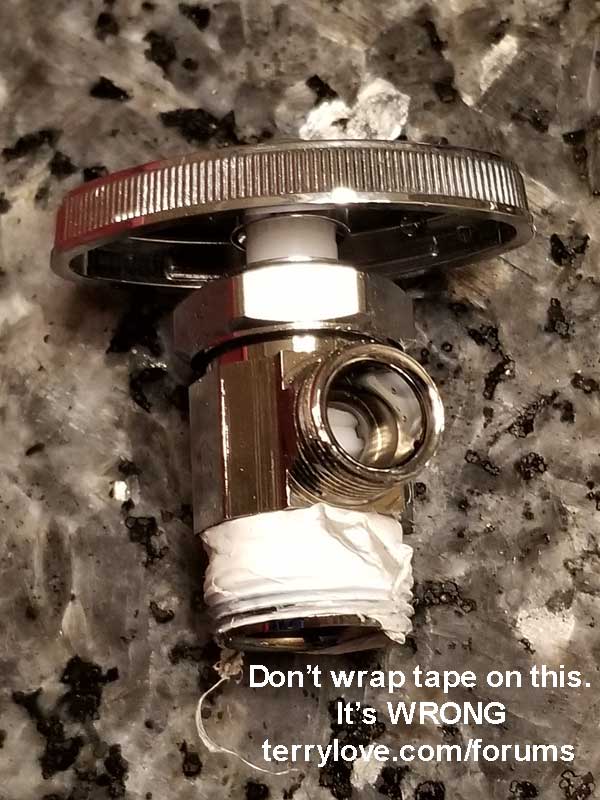
anglestop-taped.jpg


I removed this leaking stop
Terry Love
 
Last edited by a moderator:
teflon tape on pipe

As far as I know, you should never use anything under a compression ferrule except clean pipe, if that is your question. The other thing recommended on compression fittings is a little oil on the threads doing the compressing so that it doesn't gall the threads during the tightening operation.
 
I would never use teflon.

I have used a little dope to help lube up the connection before.

I have done it many more times without anything and have been just fine.

Tape is a no-no though.
 
It's a little hard to give a definite example such as hand tight, then 1/2-turn...each one and the pipe associated with it is a little different. You should not be able to easily turn the valve once it is installed on the pipe. Easiest for a DIY'er is probably try it, and if it leaks, give it another 1/8-turn and try again, then maybe one more 1/8th.
 
compression

IF you put tape on the tubing, you will not get the compression ring onto the pipe. I never use anything on the threads. I slide the fitting onto the tubing just the way it comes out of its package or off the shelf. Hand tight and a 1/4 turn will never be adequate. I tighten them until I know they are tight enough and that often means almost as tight as they will go with a 15/16 open end wrench.

anglestop-taped.jpg


I removed this leaking stop. Terry Love

index.php


And this replacement on 9/29/2021

index.php
 
Last edited by a moderator:
Thanks for all this feedback. I couldn't have done this complete bathroom redo from bare studs, i.e., plumbing, electrical, etc. without this forumn.

Many thanks!
 
Before I went on these forums I had a pesky compression fitting at the back of my fridge that would leak. The pipe was securely clamped so movement wasn't my issue.

I wasn't losing a considerable amount of water but no leak is a good leak.

I tried the compression fitting bare and slowly tightened it in hope that it would stop. I eventually ended up causing the ferrule to deform so I had to cut the pipe and try again.

The second time around I wrapped the FERRULE on the tubing with 3 turns of teflon tape and tried again. Not a single leak.

I think it was the movement of the fridge that irratated the fitting causing the weeping.

Wrapping the pipe itself won't do anything and as HJ said you won't get the ferrule on there.

Also wrapping the threads with anything won't help. The seal is between the ferrule and the seat and the ferrule and the pipe. The threads don't seal anything.

You will commonly have a leak in one of two places between the ferrule and the pipe or between the ferrule and the seat. Both must be water tight to make a good seal.

The teflon tape helps with the latter sealing out any minor leaks between the ferrule and the seat and also acts as a type of lube so that the nut doesn't bind up against the ferrule which can make it more difficult to turn.
 
Last edited:
Confession - I tighten them hand-tight, plus just a little bit, half a turn or so... then turn on the water just a little bit... then tighten until it stops leaking.

It's amateurish, I know, but hey - I am an amateur at plumbing. And this way, I never have to worry about over-tightening; works for me...
 
You will commonly have a leak in one of two places between the ferrule and the pipe or between the ferrule and the seat. Both must be water tight to make a good seal.

The teflon tape helps with the latter sealing out any minor leaks between the ferrule and the seat and also acts as a type of lube so that the nut doesn't bind up against the ferrule which can make it more difficult to turn.

If I understand this when you wrap the ferrule with tape, the tape then gets pitted between the ferrule and the seat ( by seat are you referring to the threaded part of the stop valve? ) forming a seal?
 
valve

Starting hand tight and then progressing from there with the water turned on will someday find you with a valve in your hand, or on the floor, and water gushing out of the copper tube where it blew off. Or one that is no longer fully inserted onto the tubing, but you have now secured it at that point.
 
Knowledge gained and not shared is knowledge wasted.

But if you do not share it no one else is going to take credit for the idea.

Ha ha keeps the world goin' a round :D.

If I understand this when you wrap the ferrule with tape, the tape then gets pitted between the ferrule and the seat ( by seat are you referring to the threaded part of the stop valve? ) forming a seal?

By seat I am referring to the recess in the valve where the ferrule resides when the joint is assembled and where it is crushed when you tighten the nut.

The tape helps to seal any minor leaks that can occur between the seat and the ferrule.

If you can make the union dry without any tape and it doesn't leak good job. However if you have a minor weeping leak that won't stop with tightening then the tape is a way to stop it.

This is why I prefer either sweat or threaded joints on supply valves. In my mind the only place compression fittings have is on piping 3/8" and smaller.

Also stay away from those all-in-one ferrule already installed in the nut packages.

You can't separate the ferrule from the nut and because of this can't use teflon tape on them if need be buy the nut and the ferrule separately.
 
Last edited:
Gotch! Thanks...

If I totally screw this up - how do I get the ferrule off and try again?

I've only sweated pipes (more comfortable with) so this is all new stuff for me...
 
Well that depends if you deform the ferrule and it bites into the pipe from overtightening and it leaks your only choice is to cut the pipe and start again.

However if you didn't reach that point there are tools to pull the ferrule off but your best bet is to cut and start with a clean slate.
 
Last edited:
Back
Top