How long does it take a 1/2" copper pipe to freeze?

Lithnights

Member
Messages
150
Reaction score
0
Points
16
Location
PA
I'm wondering if there are any calculations one can use to figure out how long it would take a run of 1/2" copper pipe to freeze at a given temperature? Assume each end of that exposed run is in an insulated area.

e.g. assume you have a 8 foot section of 1/2" pipe exposed to the weather at 32 degrees, how long would it take to freeze? 20 minutes? 2 hours? 6 hours?

or assume it's exposed at 20 degrees or say 10 degrees, how long?

Any ideas?

Thanks!
 
Actually water does not freeze at 32ºF. Ice will melt at 32ºF. The point here is if you have a piece of ice below 32ºF it will be solid. If you heat the piece of ice slowly it turns into liquid water at 32F.

Going in the other direction, that is, cooling liquid water or water vapor, things are more complicated. Both liquid water and water vapor can be cooled to temperatures lower than 32ºF without immediately forming solid ice. Sometimes in carefully controlled conditions for quite a long time. The reason for this is for liquid water, or water vapor, to form ice crystals, there must be a site for the formation of the ice to begin. When that does, ice formation is very rapid. These non-equilibrium conditions are said to be supercooled.
 
It takes 1BTu to change 1# of water one degree while liquid, but the heat of fusion to change liquid water to ice requires about 316BTU, and once frozen, instead of being colder, it will still be at 32-degrees F. (BTW, if I remember, it takes something like 540BTU to go from 212 liquid to steam - that's why steam is so dangerous, it contains a huge amount of heat.) Now, water can have a different freezing temp depending on how pure it is. The heat of fusion why ice can stay ice for so long in your drink.

How conductive the pipe is (you can look up that for copper) and how much air movement will determine how fast heat can be removed from the pipe and therefore the water. Plus, the conduction of the copper will allow heat to migrate into the open area, slowing the heat loss as heat is gained from either end. You'd also need to know the temperature of the water at either end, and if there was a little slope, you'd set up a convective loop to exchange some of that heated water with the colder stuff. This is not a trivial question.
 
while not easy, the fact that there is heat at the ends can be ignored, because that helps - the fact that the pipe has insulating value (or conductive value) can be ignored because that helps (either to maintain pressure, or insulate) - it would error on the safe side by overstating how fast it cools

put in 31f as your freezing point, and you are close enough.

it must come down to volume(area) of water in the cross section, initial temp of water, temp of outside air (consider it is a perfect absorber of heat)

the differential between the outside air and the water -> 0 over time, and the rate of change is proportional to the temp difference inside vs outside, so the rate changes with time as a logrithm.

i posed it to yahoo answers in the physics section, asked for a simplistic answer -

just to be cute, consider the water was moving, it would lose heat at the same rate, so the length (distance) and flow rate would determine time of exposure - so same formula....just make the initial temp one end or the primary, and calculate the final temp the other (just in case you have formulae for coils and heat exchangers - set the secondary coil input to your outside temp, and the output temp to the same (i think that makes it an infinate absorber) use the water-to-air exchange coefficient.

i'll let you know what i find. been 25 years since i took the class - i didn't like it then either. i'd rather to that LCR circuit calculation!
 
If you just want a basic rule of thumb? It generally takes 2-3 days of sub-20 degree weather to cause damage in an empty, unheated house. At least that's what I'm told by plumbers who work in vacation communities nearby. Obviously, your mileage may vary.
 
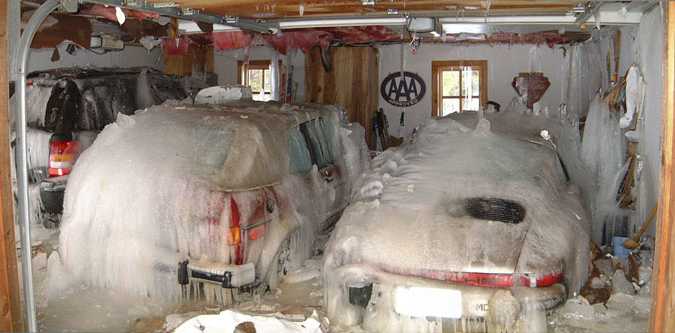
Frozen.jpg


Anyone want to guess how long this one took? :D
 
What does 165 F fluid do to glass if it is 0 F when it hits the windsheld?
 
Back
Top