
You are using an out of date browser. It may not display this or other websites correctly.
You should upgrade or use an alternative browser.
You should upgrade or use an alternative browser.
Back to Back sink DWV fitting
- Thread starter PJL57
- Start date


Basement_Lurker
One who lurks
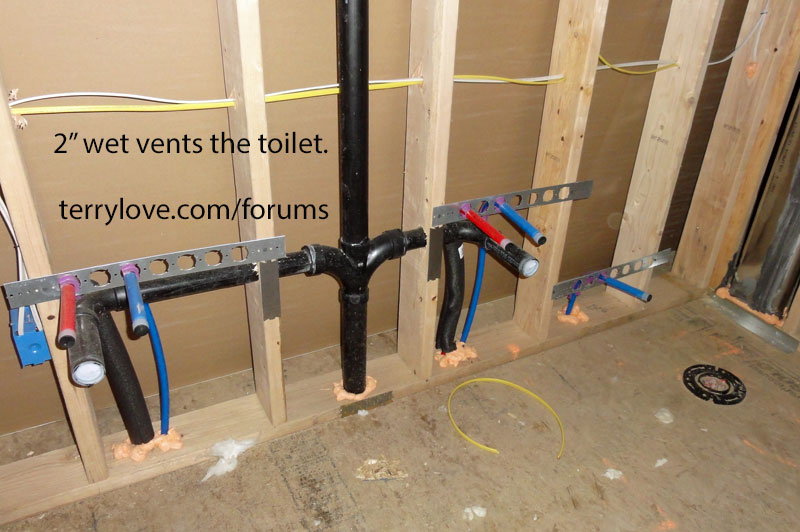
A double fixture fitting would do the trick.

Sponsor
Paid Advertisement

Construct30
New Member
Doubles back to back sinkd are not allowed every where, check your code. The double fixture fitting is better as far as I'm concerned for back to back, but once again for venting reasons not allowed by every inspector.
Last edited by a moderator:

GrumpyPlumber
Licensed Grump
If available, an "Owl eye", or "Frog eye" fitting is better...it's a double tee-wye with both inlets facing the same way, but they take more room.
You can stack fittings as long as the lower is vented seperately & connected to 6" above the flood level of the highest fixture (usually the lav in a bathroom which means 40+ inches above finish floor will cover it)
You can stack fittings as long as the lower is vented seperately & connected to 6" above the flood level of the highest fixture (usually the lav in a bathroom which means 40+ inches above finish floor will cover it)
Construct30
New Member
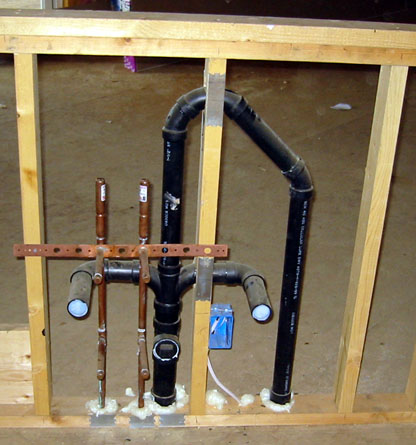
This is Terry's picture of a rough in for an island sink, why would it not work back to back if you just turned one and ran out the top with the vent stack?
Last edited by a moderator:

davefoc
New Member
This is the exact question I spent some time trying to get an answer to.
My copy of plumbing codecheck says back to back sanitary tees are required by the UPC.
But the UPC actually says:
Back to back fixtures may be served by a single vertical drainage pipe if approved double fixture fittings are used. . . UPC 704.2
So does that mean back to back sanitary tees are now precluded?
As a practical matter it seems to me they should be. Snakes tend to pass right through them from one fixture to the next instead of down the drain.
And if a double fixture fittings are used does that mean the length of the trap arm should be reduced from what it is if a sanitary tee is used because the weir is higher (I think)?
I wrote to the author of the code check who very nicely returned my email. Unfortunately his answer didn't really go to my questions and he didn't respond to a follow up email.
My copy of plumbing codecheck says back to back sanitary tees are required by the UPC.
But the UPC actually says:
Back to back fixtures may be served by a single vertical drainage pipe if approved double fixture fittings are used. . . UPC 704.2
So does that mean back to back sanitary tees are now precluded?
As a practical matter it seems to me they should be. Snakes tend to pass right through them from one fixture to the next instead of down the drain.
And if a double fixture fittings are used does that mean the length of the trap arm should be reduced from what it is if a sanitary tee is used because the weir is higher (I think)?
I wrote to the author of the code check who very nicely returned my email. Unfortunately his answer didn't really go to my questions and he didn't respond to a follow up email.

hj
Master Plumber
- Messages
- 33,613
- Reaction score
- 1,057
- Points
- 113
- Location
- Cave Creek, Arizona
- Website
- www.terrylove.com
tee
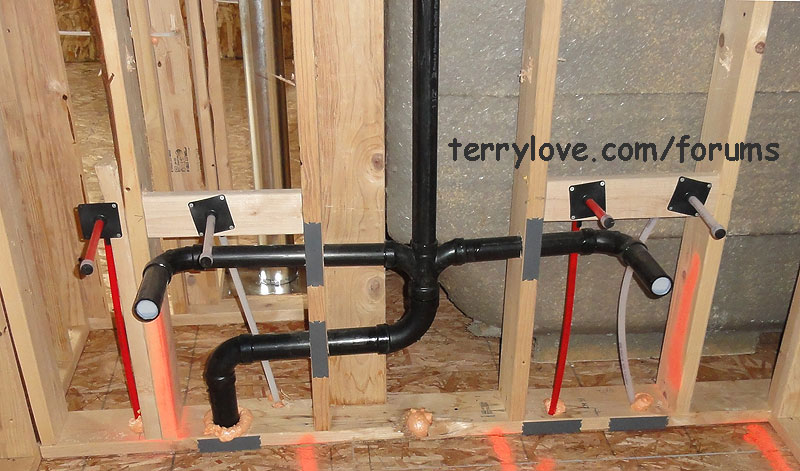
A "back to back" sanitary tee is a sanitary cross and is seldom approved. The back to back fixture fitting shown in a previous picture and Terry's island vent is the approved fitting, and is the one specified in the first paragraph of the code section cited. Sanitary crosses, double "Y"s, and double combination Y-1/8 bends are all prohibited but for different reasons. And an "owl eye" fitting would only work if both sinks were on the same side of the wall, or if it were turned sideways with elbows for the sink connections, neither of which seems like a very sensible solution. Stacked tees can be used but then it makes one connection a lot lower than the other one.
A "back to back" sanitary tee is a sanitary cross and is seldom approved. The back to back fixture fitting shown in a previous picture and Terry's island vent is the approved fitting, and is the one specified in the first paragraph of the code section cited. Sanitary crosses, double "Y"s, and double combination Y-1/8 bends are all prohibited but for different reasons. And an "owl eye" fitting would only work if both sinks were on the same side of the wall, or if it were turned sideways with elbows for the sink connections, neither of which seems like a very sensible solution. Stacked tees can be used but then it makes one connection a lot lower than the other one.
Last edited:
davefoc
New Member
Thanks hj. Your answer was clear.
I was confused because standard hardware stores seem to only carry back to back sanitary tees and yet it doesn't seem like these are code compliant in the most likely way that they would be used. And in addition, the codecheck book seems to be incorrect with regards to back to back sanitary tees.
Do you know the history of the back to back fixture fitting? The building I maintain was built in 1929 and back to back sanitary tees were used throughout. Did the back to back fixture fitting come along later to correct problems with the back to back sanitary tees? Why have the back to back sanitary tees stayed in production?
I was confused because standard hardware stores seem to only carry back to back sanitary tees and yet it doesn't seem like these are code compliant in the most likely way that they would be used. And in addition, the codecheck book seems to be incorrect with regards to back to back sanitary tees.
Do you know the history of the back to back fixture fitting? The building I maintain was built in 1929 and back to back sanitary tees were used throughout. Did the back to back fixture fitting come along later to correct problems with the back to back sanitary tees? Why have the back to back sanitary tees stayed in production?
Construct30
New Member
So what is the double fixture fitting? Something between a tee and wye? What about the distance from the trap on it? Should it always be close like the island roughin and can it be turned in the wall back to back or should it stay the way it is in the picture with 90's?
I don't have much call for this and have usually stacked the tee's, but this works much better.
Maybe a stupid question, but why do they make a double tee? Always seemed usless to me if you want t stay legal. Is there a legal use that you can think of or just for venting once and a while?
I don't have much call for this and have usually stacked the tee's, but this works much better.
Maybe a stupid question, but why do they make a double tee? Always seemed usless to me if you want t stay legal. Is there a legal use that you can think of or just for venting once and a while?
hj
Master Plumber
- Messages
- 33,613
- Reaction score
- 1,057
- Points
- 113
- Location
- Cave Creek, Arizona
- Website
- www.terrylove.com
tee
It is not a double tee, it is a cross, and it has application for vent systems.
It is not a double tee, it is a cross, and it has application for vent systems.
Construct30
New Member
It is not a double tee, it is a cross, and it has application for vent systems.
I do know what stuff is called, but unfortunately my hillbilly up bringing lets me use local terms for stuff even though it may be wrong.
The old plumber at the supply house calls stuff what he wants and if you don't like it then get the _________ out of his space. I guess I feel the same at times.
I guess I should start going to box stores and reading boxes.

TMB9862
New Member
- Messages
- 206
- Reaction score
- 0
- Points
- 0
I know it's a tiny image but that's what I've always seen used, a threaded cross tee. I've never seen a back to back in plastic so I don't know what that fitting looks like. I've seen a bunch of these fittings get approved though.
And why can't I link to any sites with the word "plumbing" or "plumber" in the URL?
The same reason you can't link back to terrylove from those sites.
And why can't I link to any sites with the word "plumbing" or "plumber" in the URL?
The same reason you can't link back to terrylove from those sites.
Last edited by a moderator:
hj
Master Plumber
- Messages
- 33,613
- Reaction score
- 1,057
- Points
- 113
- Location
- Cave Creek, Arizona
- Website
- www.terrylove.com
fitting
Look at Terry's drain picture up above and you will see what a plastic back to back fitting looks like. It is similar to a double combination Y-1/8 bend, but modified to comply with the back to back limitations.
Look at Terry's drain picture up above and you will see what a plastic back to back fitting looks like. It is similar to a double combination Y-1/8 bend, but modified to comply with the back to back limitations.

Dav
New Member
If you use two TEE's instead of a DOUBLE FIXTURE FITTING, you create a vertical wet vent section which has some extra sizing constraints (UPC 908). Also, I have seen "inspector's guidelines" in one jurisdiction which require that the two fixtures have the same level for use of a DOUBLE FIXTURE FITTING (so a kitchen sink and lav might not work for someone demanding this). However, UPC does NOT seem to require this.
Anyone else see this "same level" requirement?
Anyone else see this "same level" requirement?
Last edited:

SacCity
In the Trades
I think that using two stacked tee would be better.
Remember that there are two different type sinks so the ideal would be to have the lav above the laundry. Laundry is going to need a two inch line anyway so that takes care of the size issue.
Just need to make sure that the wet vent between the two tee's is 2 inch min.
Michael
Remember that there are two different type sinks so the ideal would be to have the lav above the laundry. Laundry is going to need a two inch line anyway so that takes care of the size issue.
Just need to make sure that the wet vent between the two tee's is 2 inch min.
Michael

TheOverThinker
Member
I have seen "inspector's guidelines" in one jurisdiction which require that the two fixtures have the same level for use of a DOUBLE FIXTURE FITTING (so a kitchen sink and lav might not work for someone demanding this). However, UPC does NOT seem to require this.
Anyone else see this "same level" requirement?
I see "UPC 704.2 Two fixtures set back-to back, or side-by-side within distance allowed between a trap and its vent may be served by a single vertical drainage pipe provided that each fixture wastes separately into an approved double-fixture fitting having inlet opening at the same level."
It only talks about the level of the waste being equal, not the fixtures.
Similar threads
- Replies
- 8
- Views
- 560
- Replies
- 0
- Views
- 139
- Replies
- 1
- Views
- 509
- Replies
- 0
- Views
- 467
- Replies
- 0
- Views
- 4K