PDA

View Full Version : Is kester 60/40 solder ok to use


backwaterdogs
01-01-2008, 11:45 AM
Hello,

I am about to sweat some joints in a small job I have (shower valve) and have an old roll of solder I got w/ some other stuff at auction.

The solder is Kester brand and 60/40 ( assume 60% lead), w/ Nosput flux. Core says 66 and diameter is .080.

Not sure what the core number implies....but given that this will only be on a shower...will this solder be good for leak free joints?

Thanks very much!

Wet_Boots
01-01-2008, 11:55 AM
Save it for a Radio Shack kit. That's electronics solder. You use your lead-free solder for that shower valve.

backwaterdogs
01-01-2008, 12:05 PM
will do, thanks very much!!!

hj
01-01-2008, 01:39 PM
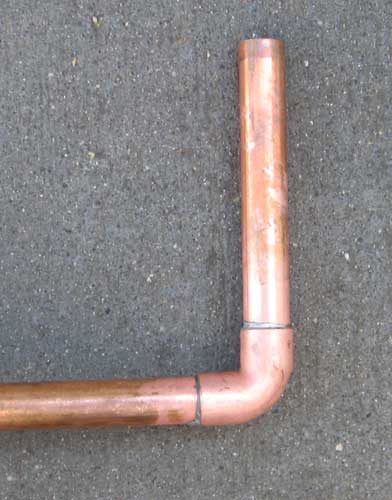
You cannot use core solder for sweat joints if you do not want leaks. The second thing is that you need lead free solder to make Ralph Nader and California happy.

http://www.terrylove.com/images/copper_90.jpg
Soldered with No-Lead Solder

GrumpyPlumber
01-01-2008, 01:50 PM
NEVER, EVER use leaded solder on your potable water.
In one word...backflow.

Just to put it in perspective...there is a theory that use of lead cookware & water containment was partially responsible for the fall of the Roman empire...no joke.
(though I'm sure there will be a few to come)

backwaterdogs
01-01-2008, 02:00 PM
Wow....I am sure glad I asked....was just about to save myself a trip to the hardware store and use what I had on had.

I didn't realize the lead could get through the rest of the house from the shower valve...via backwashing.

Thanks very much!

Redwood
01-01-2008, 03:02 PM
You will also need flux and plumbers cloth to properly prepare the joint for sweating... What is this small project you are doing on the shower? Have you ever sweat pipe before and do you have any idea how its done... I strongly recomend that you learn before shutting off the water and trying it for the first time.

GrumpyPlumber
01-01-2008, 03:11 PM
You will also need flux and plumbers cloth to properly prepare the joint for sweating... What is this small project you are doing on the shower? Have you ever sweat pipe before and do you have any idea how its done... I strongly recomend that you learn before shutting off the water and trying it for the first time.

LOL...ya think?

Redwood
01-01-2008, 03:28 PM
LOL I don't have any idea what makes me think that...

Its probably a little project like taking out a Delta 1700 that is dripping and installing a 3 handle glacier bay unit in its place...

Gawd, I see a train wreck happening!

Herk
01-01-2008, 07:50 PM
Gawd, I see a train wreck happening!

Buy 'em books and buy 'em books and all they do is eat the covers . . .

Bob NH
01-01-2008, 08:35 PM
When you make that trip to the hardware store, or HD, get some Oatey No. 95 or No. 5 self-tinning flux. It will probably save you at least one leaking joint.

hj
01-02-2008, 06:47 AM
I didn't realize the lead could get through the rest of the house from the shower valve...via backwashing.

Actually it probably wouldn't because your solder joint would expose a minimal amount of the solder to the water, asssuming you did a real good joint. If you did a bad one, no solder would be exposed to the water. In addition, after a very short time a patina would develop which would encase any exposed solder and isolate it from the water. You would have a better chance of getting lead into your water from the brass valves, and even then I have never heard of any valve failing because it lost its metal.

jimbo
01-02-2008, 07:05 AM
I don't remember at the time they shifted from lead solder.....were there actually any tests that showed significant lead leaching into the water from the pipes.....or was it just that there was a possibility, so let's get the lead out??????

Bob NH
01-02-2008, 11:19 AM
Lead is illegal in potable water systems, including showers. That doesn't mean that you will ever have a real problem.

Lead may be a problem with water running out of the kitchen faucet if you drink the water first thing in the morning, and with new pipes, without letting any run down the drain. They test for lead by taking a "first flow sample" and base the requirement on the assumption that your children will drink water with high lead content from birth. It is as much as political thing as anything else.

Lead from a normal installation is virtually undetectable but the EPA hasn't much else to do so they make no-lead-solder rules assuming that the worst case condition applies to every drop of water that comes out of a faucet, and every drop that your baby drinks is coming from that faucet.

alternety
01-02-2008, 12:50 PM
Just for a bit of further insight. The world is on an anti-lead crusade. Europe passed a set of regulations prohibiting lead (and other things) from electronics. Thus the world is switching so they don't have to make two sets of everything (w/wo lead). China (particularly the toy makers) seem to have solved this by just using lead for everything.

Unfortunately electronic no lead solder is sort of like banning the green treated wood and later finding out that the replacement brown treated wood eats steel (e.g., the lag bolts that hold the deck on the house). Solder without lead creates little tiny whiskers of metal that are big enough to short things out at the scale of modern circuit spacing. There are some other issues but that is the one with the most bite.

One of the things that happens to some old electronics is they wind up in a stream in China and leach lots of nasties. Stopping this is good.

interalian
01-02-2008, 12:59 PM
Just for a bit of further insight. The world is on an anti-lead crusade. Europe passed a set of regulations prohibiting lead (and other things) from electronics. Thus the world is switching so they don't have to make two sets of everything (w/wo lead). China (particularly the toy makers) seem to have solved this by just using lead for everything.

Unfortunately electronic no lead solder is sort of like banning the green treated wood and later finding out that the replacement brown treated wood eats steel (e.g., the lag bolts that hold the deck on the house). Solder without lead creates little tiny whiskers of metal that are big enough to short things out at the scale of modern circuit spacing. There are some other issues but that is the one with the most bite.

One of the things that happens to some old electronics is they wind up in a stream in China and leach lots of nasties. Stopping this is good.


Tell me about it. The company I work for is an electronics manufacturer and we went RoHS-6 compliant last year at great expense. Several US states are going down the same path as Europe (Cali for one). We do surface mount fine-pitch (TQFP, TSSOP, BGA, leadless flat-pack etc) as well as through-hole soldering on a mid-large scale. What fun.

GrumpyPlumber
01-02-2008, 08:09 PM
I don't remember at the time they shifted from lead solder.....were there actually any tests that showed significant lead leaching into the water from the pipes.....or was it just that there was a possibility, so let's get the lead out??????

Yes, you can go into an old house that still has lead solder and the water test will show it.

As for back flow, if it weren't an issue we wouldn't be concerned with air gaps/anti siphons/vacuum breakers on tub spouts, kitchen sprayers or hose bibs if it weren't an issue.
I said something above about the Romans, I wasn't kidding, here's an EPA website quote, with a link to the page that explains it below:
"The Romans were aware that lead could cause serious health problems, even madness and death. However, they were so fond of its diverse uses that they minimized the hazards it posed. Romans of yesteryear, like Americans of today, equated limited exposure to lead with limited risk. What they did not realize was that their everyday low-level exposure to the metal rendered them vulnerable to chronic lead poisoning, even while it spared them the full horrors of acute lead poisoning."
http://www.epa.gov/history/topics/perspect/lead.htm

mikept
04-01-2008, 01:47 PM
http://en.wikipedia.org/wiki/Lead_acetate#Historical_use

The romans didnt have sweet and low they used lead as a synthetic sweetener.

Ian Gills
04-02-2008, 02:10 PM
But for the old-timers, what was it like to solder with lead solder?

Was it any better? The flow? the joint?

Let's leave aside the poisoning issue for the moment.

jadnashua
04-02-2008, 02:54 PM
Lead melts at a lower temperature, so shorter time with the torch to heat things up, and potentially more opportunity for it to flow where you don't want it to, or the joint to fall apart before it solidified.

Ian Gills
04-02-2008, 03:40 PM
and potentially more opportunity for it to flow where you don't want it to

lol, I did some fantastic soldering over the weekend with my lead free solder, but a bit dropped and solidified on my finger.

It bloody hurt! Didn't leave a burn though.

I'm gonna be more careful this weekend when I do some more.

Redwood
04-03-2008, 06:37 AM
It makes no difference to me whether it is lead or, lead free solder. There is not a substantial difference to me. Now brazing is a substantial difference!

Gravity is an important force to keep in mind while sweating a pipe! Its not fun to catch molten solder with your bare hands.:(

Wet_Boots
04-03-2008, 12:38 PM
lol, I did some fantastic soldering over the weekend with my lead free solder, but a bit dropped and solidified on my finger.

It bloody hurt! Didn't leave a burn though.

I'm gonna be more careful this weekend when I do some more.Look up "wiped joint" and see what kind of fun your ancestors had with solder.

hj
04-03-2008, 01:41 PM
If you were to check the water coming into your building for lead, you would probably find that that is where the lead is entering the water, not after it gets into your house. If the lead in your faucets could leach out, it would leave "holes" in the brass and it would leak.

Ian Gills
04-03-2008, 01:45 PM
That's it. I am going to bring back wiped joints.

Will lead-free solder be OK for this? I assume I just melt it, pour it onto the joint, and then wipe the joint with a cloth so as to shape the joint as required.

Can you see any problems? And can I do it with copper pipe, or should I repipe with lead? And should I flux the outside of the joint first?

And why don't we use brass pipes any more? I have brass pipe, coming just after my meter. Its difficult to solder but more sturdy than copper?

Herk
04-03-2008, 04:08 PM
So many questions . . .

I used 50-50 lead-bearing solder for many years. it was far easier to work with than the newer lead-free solder. It had a larger "window" that allowed you to wipe the joint with gloves or rag and make it look neat. The lead-free solder is either very liquid or very solid.

Similarly, wiping a lead joint requires wiping solder, and it has a longer window. The technique involves pouring the molten solder over the joint (after preparation) until it warms the lead enough for the solder to meld with the lead, but not so warm that the lead melts - a real possibility. It took a goodly amount of coordination and skill, and the old masters of the art could wipe some complex and difficult joints.

I know little about lead for water pipes since I've never actually seen it done where I worked, so I do not know the method of joining them. The lead wiping is for drainage lines.

One of the questions on one of my state plumbing tests was: "How do you support lead pipes?" And the correct answer is, "continuously, with wood strips." However, none of the lead pipes I've ever seen were supported that way, or at all, except by their connections or the floor joists they were hung on. That may be because at the time the joints were being made, there were no codes nor inspections in this state.

Ian Gills
04-04-2008, 03:52 PM
Thanks Herk. Fascinating.

Now who can tell me if brass pipes are good or bad?

I prefer soldering brass fittings. The solder seems to flow better.

jadnashua
04-04-2008, 07:01 PM
Brass is more stable than copper.