Striped screws on toilet flange

mnpsacks

New Member
Messages
2
Reaction score
0
Points
0
Put in a new tile floor and new toilet. It started to leak so we replaced the wax ring and when screwing the toilet down the threads striped on the toilet flange. Is there a fix short of tearing out the new tile floor and replacing the flange. Please help!.
 
There are no threads to strip on a toilet flange. The bolt just pulled through. You have to pull the toilet again and see if the flange needs repairing. There are all sorts of ways of repairing a damaged flange short of replacing it. It might just be that the bolt wasn't set in the flange properly to begin with. It needs to be turned sideways and then locked in position with a washer and nut.

Why not show us a pic?
 
mnpsacks said:
and when screwing the toilet down the threads striped on the toilet flange.

Darn, all I get is checked ones. (Sorry, couldn't resist.)

Typically, a closet bolt is made from brass, has a large head that rests below a slit in the flange - whether a short slit on each side, or a longer slit that allows the bolt to be slid around to position. The bolts are not an integral part of the flange.

There are also plastic closet bolts which also have a large plastic head.

So, unless the flange itself is broken, it does not need to be replaced.

In some very old installations, bolts were actually threaded into holes in the cast iron flange. In a case like that, I'd drill the remainder of the bolt out with a smaller drill so as to not destroy the threads in the flange, use an easy-out to remove the remainder, and screw in a new brass bolt without the head.
 
Toilet flange

Thanks for responding. Yes, I misspoke. It's the bolts are coming through the flange when they are tightened. So we were thinking of putting washers on to distribute the stress on the flange. It is an upstairs bathroom and we have the ceiling off from the room underneath it. My husband says he can replace the flange but is afraid it might tear up the new tile. Any ideas!
 
In some very old installations, bolts were actually threaded into holes in the cast iron flange ...

Similar to that, there are studs you can get that slip through the flange and screw into the floor. One end of the stud will have threads like a lag screw, and the other end will have the usual threads for a nut. By using two nuts locked together on the upper end of the stud, you can use a wrench or socket to screw the studs into the floor ... then remove the nuts and set the toilet.
 
mnpsacks said:
Yes, I misspoke. It's the bolts are coming through the flange when they are tightened. So we were thinking of putting washers on to distribute the stress on the flange.

OK, if I'm understanding you correctly, the flange has either deteriorated or broken, and you need a way to keep the bolts in place. There are a couple of ways to do that. Recently, in a similar situation, I had to use large washers on the bolt head for the same reason. I cut one half-moon edge off the washer so it would sit closer to the pipe. There are also repair pieces that can be used for a broken flange. In my own home, I would think nothing of replacing the flange if necessary, but then, I'm a plumber.

401781.gif
 
What is the flange made of? There are some relatively easy repair possibilities!

Post a pic!
 
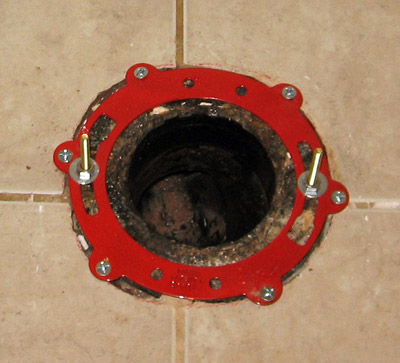
This was a tile floor with an unsecured flange. The wood below had given it up, and the screws no longer held.
What you can do, is add a flange repair ring, they have holes outside the normal edge that allow you to find wood that will hold a screw.

red_ring_03.jpg
 
Last edited:
This was a tile floor with an unsecured flange. The wood below had given it up, and the screws no longer held.
What you can do, is add a flange repair ring, they have holes outside the normal edge that allow you to find wood that will hold a screw.

red_ring_03.jpg

Hey! I see this thread is a few years old, but I'm hoping you might still be around and able to help me? I have a similar situation, but I'm dealing with a concrete floor :s Is there a way to fix it without ripping up the tile and chipping out the concrete to replace it?
 
The same technique can work...you just need to predrill the holes, and depending on the fastener you choose, either an insert, lead anchor, or a TapCon, and anchor the repair ring. A hammer drill helps when drilling into concrete, but is not essential, just makes it much more efficient.
 
Back
Top