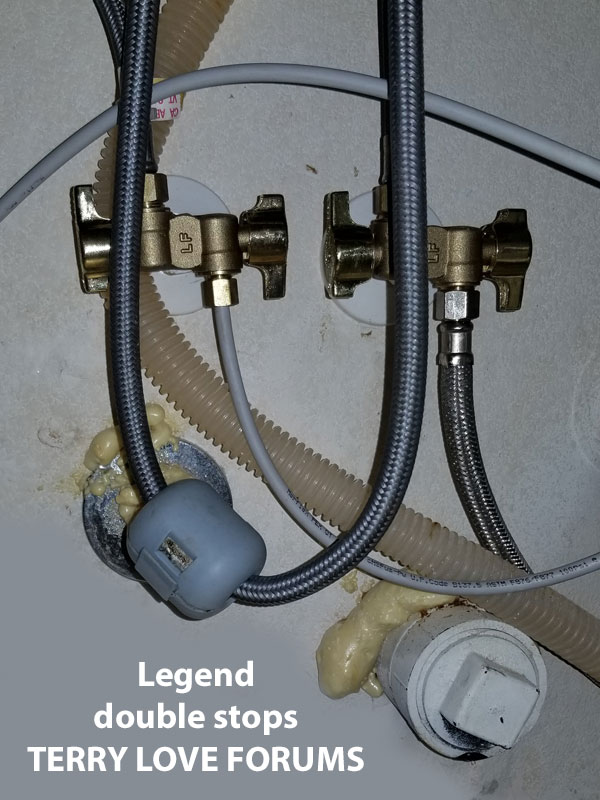
Multiple shutoffs under sink?

Bassman

DIY Member
Messages
94
Reaction score
0
Points
6
Location
Ventura, CA
It's been suggested to me to have two separate hot and cold shutoffs under the kitchen sink: one each for hot and cold sink, DW and water filter. Is this better than two valves with dual outlets? Thanks for any opinions.
Neil
 
If the DW developed a leak and needed time for repair or to order a part, having dual shutoffs would leave the sink still useable without having to block the DW line some other way.

legend-double-stops.jpg
 
Last edited by a moderator:
valves

It is "better" but can be a nuisance if by so doing the handles wind up in such a way as to make them difficult to operate. And I hate to try to operate valve handles that are "sideways" as most 2 handle/double valves are.
 
Since all of the uses connected under the sink are low-volume, then the use of Tees or dual outlet valves poses no problems. So far, I have not seen a ball-valve type dual valve, so this is one vote for putting in multiple valves. I would probably do this if replumbing my kitchen from scratch. I would put approriate tees inside the wall, and provide 4 separate sturdy stuboout, and use the brasscraft 1/4 turn ball valves. I would stub them a reasonable distance apart to allow for installation/maintenance.

This may be overkill, and may lead to a bigger tangle of supply lines under the sink. All in all, it is not an issue to lose a lot of sleep over.

 
When I had my kitchen remodeled, I had them put in 5 ball valves and a hammer arrestor: hot and cold for the sink faucet, one cold for a filter at the sink, one cold for the frig, and one hot for the DW.
 
hj said:
It is "better" but can be a nuisance if by so doing the handles wind up in such a way as to make them difficult to operate. And I hate to try to operate valve handles that are "sideways" as most 2 handle/double valves are.

A plumber buddy of mine said to put them at 16 and 20 inches which seems like plenty of separation for 1/4 turn valves.
 
I use two dual outlet angle stops to keep things tidy and it means fewer compression joints to leak. It also means no need for Tees. If the dishwasher leaks, or the icemaker fails I can live without the kithcen faucet for a while.

The only challenges are the price and how you position them. I bought my ball dual oultet angle stops from Lowes and they cost more than the single outlet versions.

Two compression joint ball angle stops thereby replaced my old set-up comprising three gate angle stops, a saddle valve and a Tee. There were six compression joints on the old-setup and one had started to leak.

Now if my original setup had sweated Ts on the hot and cold water supply I would have replaced with four seperate single outlet ball angle stops, but it all depends on what you are working with. I did not want to sweat in the confined space of my kitchen cabinet. Doing that would have made me Grumpy. As would installing ball valves instead of angle stops.
 
Last edited:
When I had mine done, I opted for soldered in valves...too much possibility of knocking things with compression fittings for me there...other places, no problem.
 
I would highly recommend having separate shutoffs for the DW and faucet. Consider that if your DW springs a leak and you need to replace it, it may be at least several days until you can buy and install/have installed a new one. I personally would find not having a kitchen faucet working to be a major inconvenience.

I too would vote for a sweated fitting if I were doing it from scratch. Not sure why folks are so skittish about soldering inside a cabinet.
 
My sink is in a corner cabinet, so there was actually a fair amount of room, the the plumber was small:) . The counters weren't on, either, so the light and claustrophobia was okay.
 
I always stub out four times.

2- hots
2- colds

Each with it's own compression shutoff.

Using a torch in a cabinet doesn't make sense to me.
It's much easier to replace compression shutoffs at a later date.
 
Do the shut offs have to be under the sink? In my case the valves could go right under the floor in the fairly low basement celing. It is also easy to get to, considering all the crap that gets stuffed under there by my other 1/2.:D
 
Terry said:
I always stub out four times.

2- hots
2- colds
Each with it's own compression shutoff.
Using a torch in a cabinet doesn't make sense to me.
It's much easier to replace compression shutoffs at a later date.

I have no walls in my kitchen at present, so I can solder to my heart's content. 4 shutoffs it is. I've uses compression shutoffs under sinks with no problems before too.
 
tjbaudio said:
Do the shut offs have to be under the sink? In my case the valves could go right under the floor in the fairly low basement celing. It is also easy to get to, considering all the crap that gets stuffed under there by my other 1/2.:D

Yes they should be at the fixture. If something ever happened would you want to go hunt for the valves, or just reach under and shut them off.
 
patrick88 said:
Yes they should be at the fixture. If something ever happened would you want to go hunt for the valves, or just reach under and shut them off.
That was my point about all the CRAP she puts under there! I guess I could put a valve in both places. One way or another it gets turned off!

At least she prefers Linux to Windows!
 
That was my point about all the CRAP she puts under there! I guess I could put a valve in both places. One way or another it gets turned off!

I would also put the ones in my basement just in case you need them I have valves in my basement for my kitchen sink. I have them at the sink also. It makes things easy for plumbing upgrades.

At least she prefers Linux to Windows!

You married a very smart women.
 
Back
Top