

You are using an out of date browser. It may not display this or other websites correctly.
You should upgrade or use an alternative browser.
You should upgrade or use an alternative browser.
new at this
- Thread starter davescobia
- Start date

Jimbo
Plumber
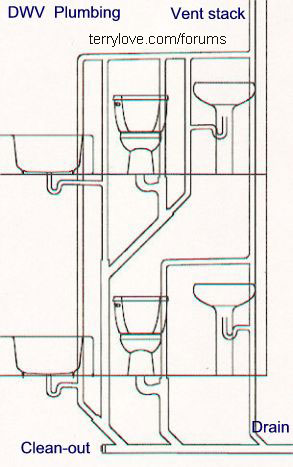
If this is the whole house, the vent will not pass. I don't know specifically if Florida is UPC or IPC. Under UPC assuming the home's main drain is 3" minimum, the the VTR need to be 3" , or a combination of 2 or more vents whose aggregate cross sectional area equals that of a 3" pipe.
If this is an addition, and there are other existing bets, you might be OK.
If this is an addition, and there are other existing bets, you might be OK.

Sponsor
Paid Advertisement

That's not plumbing.
Plumbing has vents to prevent siphoning of traps.
Plumbing has vents to prevent siphoning of traps.
davescobia
Plumber
this is an addition
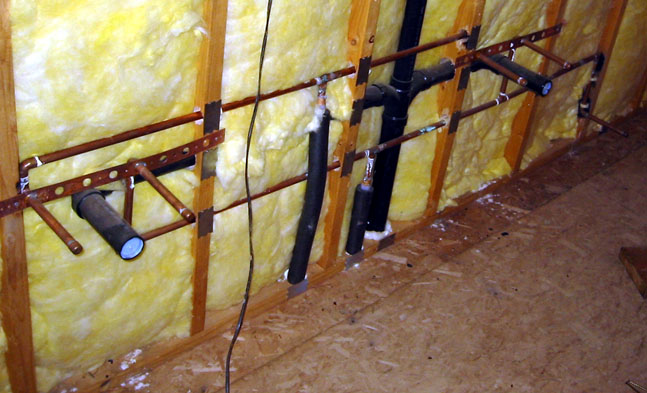
Double lav rough-in

FloridaOrange
Plumbing Designer
That is code compliant for a wetvent in Florida. However, I would tap the lavatory sinks separately into the stack. I would add a vent at the water closet to give me the warm fuzzies, but it is not required by code.
FYI, Florida no longer requires a 3" vtr, but it is a wise idea to have one.
FYI, Florida no longer requires a 3" vtr, but it is a wise idea to have one.

GrumpyPlumber
Licensed Grump
Fl-Orange,
I know you suggested adding a vent, but you mean to say FL code would allow the whole lower bath group to use the main stack as a vent even with additional plumbing going into it above?
I know you suggested adding a vent, but you mean to say FL code would allow the whole lower bath group to use the main stack as a vent even with additional plumbing going into it above?
FloridaOrange
Plumbing Designer
GrumpyPlumber said:Fl-Orange,
I know you suggested adding a vent, but you mean to say FL code would allow the whole lower bath group to use the main stack as a vent even with additional plumbing going into it above?
I don't see anything about plumbing going into it above unless you're talking about the lavs. I'm assuming, being in florida this is a separate branch for a house that sits slab on grade. Of course it would be wrong if it were picking up discharge from above into the vented line.
The prevailing thought is the lavatory stack would provide the vent and it's highly unlikely you'll be flush the toilet, and draining the lavs/shr and tub.
Like I said, I would add additional venting just to make myself feel better in case you have multiple fixtures used but it would help with the tub or shr when the toilet is being flushed. Which of course is a time limited event.

acjensen
New Member
if you're going to wet vent the bath group, doesn't everything being wet-vented HAVE to be above the WC?
GrumpyPlumber
Licensed Grump
FL-orange,
From what the diagram shows, the lavs are above the bath group, yes thats what I mean.
This thread could rapidly become a "Who's on first" skit between diagram interpretations and various codes.
In my state we cannot reduce stack size for starters, it would have to remain 3" all the way up.
Other states require that the 3" be broken into at least the same square volume in smaller vents.
We are only allowed to wet vent a single bath group and it has to be a minimum 2" with a seperate vent per bath group either vtr on it's own or tying in 6" over flood above the highest fixture in the house.
In other words, I think YOU are about the best candidate to answer this guys questions, You're Fla.
From what the diagram shows, the lavs are above the bath group, yes thats what I mean.
This thread could rapidly become a "Who's on first" skit between diagram interpretations and various codes.
In my state we cannot reduce stack size for starters, it would have to remain 3" all the way up.
Other states require that the 3" be broken into at least the same square volume in smaller vents.
We are only allowed to wet vent a single bath group and it has to be a minimum 2" with a seperate vent per bath group either vtr on it's own or tying in 6" over flood above the highest fixture in the house.
In other words, I think YOU are about the best candidate to answer this guys questions, You're Fla.

Cwhyu2
Consultant
We had the seme code as yours grumpy untill they switched B.O.C.A.
broke my wrist yestrday typing one handed.
broke my wrist yestrday typing one handed.
FloridaOrange
Plumbing Designer
acjensen said:if you're going to wet vent the bath group, doesn't everything being wet-vented HAVE to be above the WC?
Not since the adoption of the '01 code. I don't agree with that and avoid it as much as possible though, hencw my warm fuzzies comment,
FloridaOrange
Plumbing Designer
GrumpyPlumber said:FL-orange,
From what the diagram shows, the lavs are above the bath group, yes thats what I mean.
This thread could rapidly become a "Who's on first" skit between diagram interpretations and various codes.
In my state we cannot reduce stack size for starters, it would have to remain 3" all the way up.
Other states require that the 3" be broken into at least the same square volume in smaller vents.
We are only allowed to wet vent a single bath group and it has to be a minimum 2" with a seperate vent per bath group either vtr on it's own or tying in 6" over flood above the highest fixture in the house.
In other words, I think YOU are about the best candidate to answer this guys questions, You're Fla.
I'll give a better comment later. Like cwhuy2, I'm typing one handed as well, but my other hand is occupied by a 7 day old daughter.


Markts30
Commercial Plumber
I will hold off comments on this as it would not fly here but I don't know the Fla code...
GrumpyPlumber
Licensed Grump
markts30 said:I will hold off comments on this as it would not fly here but I don't know the Fla code...
Ditto...my code is far from that diagram.
Other variables - distance from traps to "wet vent" are unmentioned as well.
Personally, I wouldn't plumb a house that way, but I dunno Fla code.
FloridaOrange
Plumbing Designer
Correction, the vent would need to be a 3" vent due to fixture units. A typical bathroom can fall under Common Vent (basically wet vent) and Wet vent criteria. There is some difference of opinion regarding the code intent as the FPC is supposed to be based mostly on the IPC. The IPC allows the wc to flush past a shower and/or bathtub, the FPC says no, but it's been allowed in all jurisdictions I do work in such as Lee, Collier, Charlotte, Manatee and an occasion Palm Beach County. Most plans reviewers refer to the IPC for clarification. I carry the 2003 Intenational Plumbing Code Commentary for clarification, this book gives illustrated examples of most situations.
The distance from vent to trap is based on the Vertical wet vent (main line shown in the bathroom) being considered the vent. So, 1-1/2-2" drain is 6', 3" drain is 10', 4" drain is 12'.
I'm not trying to stir up the wet vent/no wet vent debate, just trying to give the OP my professional opinion in Florida based plumbing design. In Florida in many cases, we are restricted by slope which can prohibit venting all fixtures individuyally. I have to look at things from a purely code allowable standpoint.
The distance from vent to trap is based on the Vertical wet vent (main line shown in the bathroom) being considered the vent. So, 1-1/2-2" drain is 6', 3" drain is 10', 4" drain is 12'.
I'm not trying to stir up the wet vent/no wet vent debate, just trying to give the OP my professional opinion in Florida based plumbing design. In Florida in many cases, we are restricted by slope which can prohibit venting all fixtures individuyally. I have to look at things from a purely code allowable standpoint.
Cwhyu2
Consultant
I went B.o.C.A. wewbsite now ICC.Check it out.

hj
Master Plumber
- Messages
- 33,613
- Reaction score
- 1,057
- Points
- 113
- Location
- Cave Creek, Arizona
- Website
- www.terrylove.com
iso
The drawing is good, the plumbing is not. Even if that system would pass ANY plumbing code, it would still be a bad system, and I would not install it that way, even if the drawing were approved.
The drawing is good, the plumbing is not. Even if that system would pass ANY plumbing code, it would still be a bad system, and I would not install it that way, even if the drawing were approved.
FloridaOrange
Plumbing Designer
hj said:The drawing is good, the plumbing is not. Even if that system would pass ANY plumbing code, it would still be a bad system, and I would not install it that way, even if the drawing were approved.
Good thing you're not plumbing in Florida.

Frenchie
Jack of all trades
Terry said:That's not plumbing.
Plumbing has vents to prevent siphoning of traps.
...classic!
Similar threads
- Replies
- 3
- Views
- 532

- Replies
- 12
- Views
- 536

- Replies
- 3
- Views
- 3K

- Replies
- 3
- Views
- 481
- Replies
- 2
- Views
- 340
