Framing question

Bassman

DIY Member
Messages
94
Reaction score
0
Points
6
Location
Ventura, CA
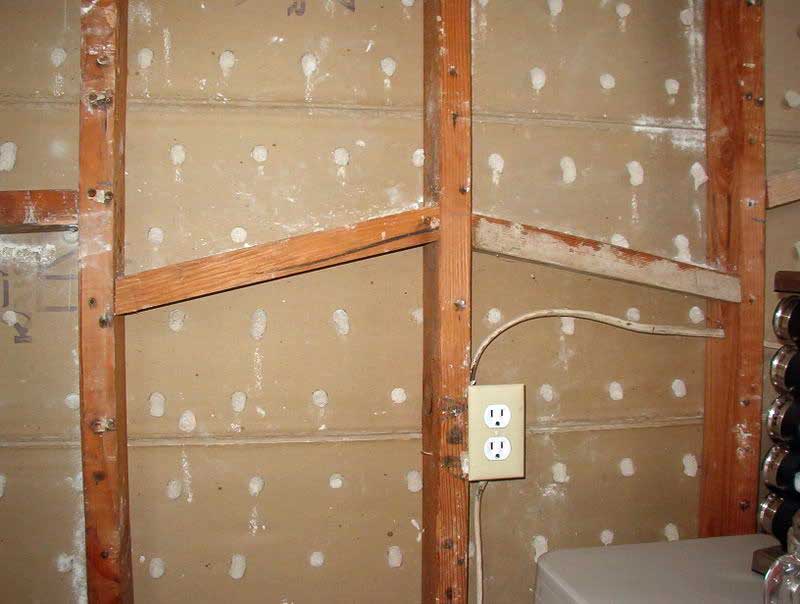
I just gutted my kitchen and want to know why some of the blocking between the studs is installed at an angle and not straight across? Like this |/|\| only not such a large angle, maybe 25-30 degrees or so. Is it easier to nail that way, or is it stronger? Thanks,
Neil
 
blocking

They cut all the blocks the same size, and oversize, then angled them however they fit. It was a lazy way to do it and would have caused a "real" framing carpenter to have a heart attack. Or as I asked a plumber one time, (who also happened to be the city plumbing inspector for a neighboring city), "Who installed that water heater?" And when he said, "I did.", I told him to redo it and do it right. At the time I was a third year apprentice.
 
leejosepho said:
If that blocking is at a fairly consistent height along the wall, that angling might have been done to widen the area where cabinetry could be attached.

It's about the height you'd expect a firebreak to be.
 
hj said:
They cut all the blocks the same size, and oversize, then angled them however they fit. It was a lazy way to do it and would have caused a "real" framing carpenter to have a heart attack. redo it and do it right.
Ah, that make perfect sense! No measuring and they will always fit SOMEWHERE.
Thanks
 
Bassman said:
Ah, that make perfect sense! No measuring and they will always fit SOMEWHERE.
Thanks

Are the blocks straight cut or angle cut on the ends?Straight cut=lazy/ hack framer...
 
Old Dog said:
Are the blocks straight cut or angle cut on the ends?Straight cut=lazy/ hack framer...

Angled. How is straight a lazier way to do it? Seems like you'd have to be dead on for all the straight pieces to line up. These houses in my area went up in a hurry, that's for certain.
 
blocking...

Have to see a picture of it but if they cut both ends on an angle they did it for a reason.As another poster said if they are straight cut and random length they were being lazy.A good inspector would of caught that during the framing stage.I have seen blocking done on angles in cabinet areas before.Are the 2x4's nailed on the edge or with the wide face out?Wide face out would indicate they wanted more area to fasten to.THey could of done it that way if they had to do a drywall repair for some reason and needed "dead wood" to fasten to.
Fire blocking normally is horizontal staggered every other stud bay the thickness of a 2x4 so they can be nailed.Some framers "toenail" them in keeping them even all the way across. Many years ago had a inspector in Ca. give me a hard time for doing it that way...
 
Here's a photo. Those outside studs aren't really bowed, it's the camera lens. So the correct way is to have them straight across and staggered so you can nail directly into the end?

bassman-01.jpg
 
Last edited by a moderator:
Bassman said:
Here's a photo ...

Whew! Somebody sure made a lot of extra effort to cut and fit those so nicely ... and I still wonder why.

Bassman said:
So the correct way is to have them straight across and staggered so you can nail directly into the end?

That would be my own preference in order to avoid toe-nailing.
 
fireblocking

Fireblocking can be anywhere as long as it makes a cavity 8' long or less. I usually put mine down low where I can reach it without a ladder, although some like it 8' high for some reason. One old time framer got all bent out of shape when the blocking was offset. He wanted it straight across, (but also 8' high).
 
Framing question...

Hey Bassman,
I was looking thru one of my old Audel carpentry books My dad gave me from the 1950's today...It shows that type of angled draft/fire stop in framing details.I quote from the book about bracing and firestopping:"Angle of bracing and intermediate firestopping between floor levels should not be less than 15 degrees nor more than 30 degrees from the horizontal."
Must of had an "old school" carpenter on your house...
 
Last edited:
Old Dog said:
Hey Bassman,
I was looking thru one of my old Audel carpentry books My dad gave me from the 1950's today...It shows that type of angled draft/fire stop in framing details.I quote from the book about bracing and firestopping:"Angle of bracing and intermediate firestopping between floor levels should not be less than 15 degrees nor more than 30 degrees from the horizontal."
Must of had an "old school" carpenter on your house...
Very interesting, I wish they gave a reason for the angle.
 
Too large of an angle, and it would tend to concentrate the flame, reducing the burn-through time.
 
Reasons...

I found a section that explains their reasons.From the Audel book:"It is more effective than the horizontal type since it forms a continuous truss and tends to keep the walls from sagging.Whenever possible , both outside and inside walls should be bridged alike.
Horizontal bridging is nailed between the studs and halfway between the sole and the plate.Such bridging not only stiffens the wall but will also help straighten the studs."
Horizontal bridging/blocking is a lot faster too!
BTW,that is fibre board wall sheathing in your picture...(gotta love these old books)
 
Old Dog said:
BTW,that is fibre board wall sheathing in your picture...(gotta love these old books)

I'm pretty sure it's made of gypsum. The locals call it button board. With that and the plaster, all my walls are an inch thick.
 
I stand corrected!It sure looks like an illustration in the book though...
 
Back
Top