View Full Version : New home on well, flow concerns...
bjjb99
08-15-2007, 05:44 PM
Greetings,
I'm nearing the end of having a new home built, and I have run into what I believe is a serious problem with the water flow rate inside the house. Coming from being on town water, I really don't have a good gauge of what being on a well is supposed to be like.
As you can tell by my join date, I'm absolutely new to this forum. Apologies if I stumble around with terminology.
Here are my symptoms:
I turn on the water to the tub in the master bathroom (the largest fixture in the house, as far as I can tell). Initially I get perhaps 4-5 gpm out of the fixture, but this rapidly diminishes over about 15 seconds to an average of around 2 gpm. Mind you, this is a big tub, and it's going to take about 40 minutes to fill at that rate. While the tub is running, I can turn on any other faucet in the house and I get _maybe_ 1 gallon every 5 minutes out of it... a trickle.
Here's what I know or have measured:
The well is 6 inches in diameter and 600 feet deep. The pump is set at 500 feet from the surface. The water comes up to within 30 feet of the surface (measured using a measuring tape and a plumb bob). The well recharges at between 3 and 5 gpm. I do not know the pump's horsepower rating. I believe the pipe running to the home is either 1 or 1.25 inches. The basement floor of the home is located a further 15 feet up a hill from the well.
The water enters the basement level of the home. The pressure tank is a Goulds Pump V140, used at 40-60 psi. It takes around 2.5 minutes to go from 60 psi to 40 psi when the master bath fixture is open, and it takes around 1.5 minutes to get back to 60 psi once the pump starts running.
The water passes through a single filter (make and model unknown, other than "low pressure drop, high flow") and then enters a manifold distribution system. From there, the water flows through 0.5 inch PEX for about 80 feet until it reaches the master bath tub fixture located one floor above (call it 12 feet up).
The home is 3 bedrooms, 2 baths, with an unfinished basement. Eventually the finished basement will add another bedroom and 1.5 baths, so I'd like to plan for that.
It would be nice to be able to run the master bath tub while the kitchen sink and either a washing machine or dishwasher are running. Heck, toss in a toilet flush or two as well. All the fixtures/appliances are on the floor above the pressure tank and manifold.
My builder actually told me "well, that's what you can sometimes expect when you're on a well". Based on your collective knowledge, is 2 gpm reasonable for a home on a well? Did I miss something? Is something undersized or underpowered?
I'm guessing from reading some of the posts here that going to a larger horsepower pump is not necessarily the solution, given the recharge rate of the well. Is this a case of "pump the water up into a storage tank, and use a booster pump from there to feed the home"?
Any thoughts would be appreciated...
BJJB
Gary Slusser
08-15-2007, 07:10 PM
Get rid of the filter. then see how the flow is. I think you may find a substantial improvement.
As to the tub, if there's an anti scald valve it will reduce flow.
leejosepho
08-16-2007, 03:38 AM
My builder actually told me "well, that's what you can sometimes expect when you're on a well".
... is 2 gpm reasonable for a home on a well?
Being on a well is *not* the problem. Even municipal systems have pumps drawing from wells.
I believe most fixtures are designed to deliver a limited 2gpm at a given pressure, so that number can be expected.
I suspect there is something wrong with your internal distribution system (house plumbing). Do a little testing with a 5-gallon pail and a garden hose connected at a spigot near your pressure tank to see what kind of flow you get "at the source" while the pump goes through its cycle. You should get something close to whatever your pump is supposed to produce. If not, your problem is there, and if that is okay, then you will have to figure out why the water is not flowing into the rest of the system properly.
bjjb99
08-16-2007, 05:25 AM
Gary: When I first noticed this issue, I did open the filter and check the cartridge. It looked a little discolored but didn't seem clogged. This evening, I'll use the bypass valves around the filter and see what kind of flow I get at the tub.
leejosepho: The fixture is rated at 18 gpm for a 40 psi input (see http://www.moen.com/shared/pdf/T920sp.pdf for the faucet, http://www.moen.com/shared/pdf/4997sp.pdf for the valve). Now I had no expectations of obtaining that level of flow from this fixture given that I was on a well that recharged at 3-5 gpm, but I certainly expected greater than 2 gpm.
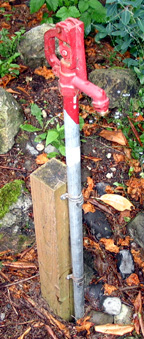
I have to apologize as I forgot to mention before that I have gone outside to the pump itself and used the spigot there (sorry, don't know the proper term for the blue handled spigot on a pipe sticking straight out of the ground), I got a blast of water at pretty high pressure, and then the flow decreases to around 6 gpm where it appears to stabilize. At the time, I thought I was getting 6gpm because I had a whole house full of water located above the height of this particular spigot. The spigot is located next to the well, 12 to 15 feet below the basement floor of the house.
So if the filter does not turn out to be the culprit, what is the next thing I should test? Does it make sense for me to just start working my way from the pump through the house, checking flow rates at each outlet as I go? That ought to help in identifying the location of any restriction, right? Once I've worked my way from the pump to the manifold, it's a straight run to each fixture... do I need to test the flow at each fixture throughout the house at that point?
Thanks for the help guys, I do appreciate it.
BJJB -- adding a 5-gallon pail to his list of stuff to buy for the house. ;)
Pumpman
08-16-2007, 07:23 AM
See if you can find out some info on the pump itself. It would help if we knew what the pump was doing from the get-go. If it's a Goulds, like your tank, I'll have the curves to tell what it should be doing. If it's another brand, someone here will be able to figure it out.
Ron
bjjb99
08-16-2007, 08:05 AM
Pumpman: I talked to my builder, and all he knows right now is that the pump is a Goulds Pump, rated at 7 gpm, 3-wire. He said he might have more information tomorrow after he talks with Goulds Technical Department.
BJJB
speedbump
08-16-2007, 12:18 PM
As you use water at a good clip, your going to notice the pressure deminishing as the level in the well goes down due to the low flow of the well itself. But you still have a good supply of water in that well being 6" to at least fill a tub without a great drop in pressure. I don't like the 1/2" plumbing, but I guess that's the sign of the times with everything else being water savers. I agree with Gary. Lose the filter. It's totally useless anyway and will only give you grief.
You did say "It takes around 2.5 minutes to go from 60 psi to 40 psi when the master bath fixture is open, and it takes around 1.5 minutes to get back to 60 psi once the pump starts running." This tells me the pump and well are doing fine and the restriction is somewhere in the house.
bob...
Gary Slusser
08-16-2007, 04:07 PM
The recovery rate of the well has nothing to do with this. Neither does the 7 gpm rating of the pump; the water being moved is from the static, or dynamic, water level in the well when the pump comes on. Drawing water through a faucet is not going to be a good test because the flow is 'regulated' by the size of the faucet, like the yard hydrant out in the yard. It probably is 3/4" at best.
The line from the pump to the pressure tank should be at least a 1".
You may have a leak in the drop pipe or a fitting anywhere from the pressure tank backwards to the pump's inlet but.... with the 90 seconds to refill the pressure tank, I would think there is no leak.
Since you only get 6 gpm at he hydrant, you must realize that until the pump comes on, the water flows from the pressure tank backwards to the hydrant. When the pump comes on, then you get water out of the well.
Looking at a filter is no way to gauge it's ability to allow water flow through it... A 15 psi pressure loss across a filter is the best way to determine when to replace a cartridge but... as long as your water is visibly clear, you don't need a filter.
All the builder needs to do is call the well or pump guy that put the pump in and find out what the hp is.
If you don't have a $2 at Wal-Mart 5 gal bucket, how did you come up with these gpm numbers?
Federal law requires all fixtures except tubs to meet water conversation requirements of no more than 2.5 gpm. It's been the law since about 1990 or 1991.
My guess is you either have a blocked filter cartridge or the filter's fittings are say 1/2", a stuck check valve or stop valve that is partially closed; like a gate valve. Or a water leak somewhere. Or the pump is running on 120 instead of 230 vac.
http://www.terrylove.com/images/yardhydrant_installed.jpg
bjjb99
08-17-2007, 06:56 AM
Whew, last night was a late night.
Okay, I went out to the house and took a lot of measurements. I think we have identified the immediate cause of low flow to the master bath tub as a horribly clogged filter cartridge. When I originally opened up the filter and just looked at it, it didn't look like it was clogged up, but when I bypassed the filter... wow, big difference. Here's the measurements I took:
Flow rate at well hydrant (through about 6 feet of hose as well): 7.8 gpm
Flow rate at pressure tank: 9.1 gpm
Flow rate at lower hose bibb (tapped off before the filter): 4.8 gpm
Flow rate at upper hose bibb (tapped off before filter, one floor up): 4.9 gpm
Flow rate at master bath tub (with old filter): 1.8 gpm
Flow rate at master bath tub (filter bypassed): 8.9 gpm
Flow rate at master bath tub (no cartridge in filter): 9.8 gpm
Flow rate at master bath tub (new 30 micron filter): 8.5 gpm
Flow rate at master bath tub (new 25 micron filter): 9.0 gpm
Measurements were taken by timing how long it takes to fill a 5 gallon bucket, after having let the water run long enough to cause the pump to start cycling. At least two measurements were taken at each location, with the above flow rates being the average. My flow rate measurements from previous posts were made using a 1/2 gallon milk jug, taking the average of at least 5 fills.
So the filter was the culprit. Right now I can fill the master bath tub in just over 10 minutes while also running a sink or two. I decided to try both filter cartridges, even though I didn't expect the 25 micron filter to perform any better than the 30 micron one in terms of clearing up the water... it didn't.
As for water clarity, it's not clear at all, much less visibly so. If I fill a 5 gallon bucket with water (even water through the new filter cartridge), I have a hard time seeing a coin at the bottom of the bucket. The water is a slightly yellower version of my hardwood floor color and murky. Seeing the drain at the bottom of the tub when I filled it was not easy. I plan to run the water for a while today when I'm out at the house to see if I can get the clarity to improve.
Sorry for all the questions, etc., but I have one more.
When the tub fixture is open all the way, the pressure gauge at the pressure tank drops from 60 psi to 40 psi , the pump turns on, and the pressure continues to drop down to around 25 psi, where it remains until the tub fixture is turned off. Then the pressure rises back to 60 psi and the pump switches off. Are there any concerns I should have regarding that 25 psi pressure and how much the pump is apparently working?
BJJB
[edit] minor cleanup of flow rate results
speedbump
08-17-2007, 07:29 AM
Now you should know the uselessness of an inline filter. The reason your pump drops below the turn on pressure of the pump is that your tub is using more water than the pump can handle at a greater pressure. Remember it's only a 7 gpm pump and the water level at the time has a lot to do with it's actual output. For instance a 7 gallon per minute pump with a 30' water level at 30 psi is doing around 10 -12 gallons per minute. The same pump with a 100 foot water level at 30 psi is doing only 6 gpm.
Since the inline filter isn't cleaning the water, why not get rid of it alltogether, run the water until clear and enjoy it. If the water won't clear, do a water analysis and post back.
bob...
Rancher
08-17-2007, 07:30 AM
When the tub fixture is open all the way, the pressure gauge at the pressure tank drops from 60 psi to 40 psi , the pump turns on, and the pressure continues to drop down to around 25 psi, where it remains until the tub fixture is turned off. Then the pressure rises back to 60 psi and the pump switches off. This is what you would expect with a 7GPM pump and a bath tub that is using 8-9 GPM. If you don't want it to go down to 25psi, then you need a bigger pump (more GPM).
Rancher
Gary Slusser
08-17-2007, 07:34 AM
There ya go! BTW, we can't see particulate matter less than 50-45 microns in size. Smaller the number the smaller the particle.
Since your water is not clear when drawn, you need real water treatment equipment, not a disposable cartridge filter. Run water for some time without letting the pump suck air, that may help it clear up.
Then get a water analysis for, hardness, iron, pH, Coliform bacteria and Nitrates and if possible manganese, sulfates and chlorides.
Is there any odor to the water as you spray cold water out of the yard hydrant or outside faucet into a bucket with your nose on the rim smelling for odor?
Now you've discovered another problem... the pressure should not be falling after the pump comes on. It should rise. This could be due to the hp of the pump or.... the water level falling in the well from all the water you used doing the flow testing. Either way, it's a pump sizing issue IMO.
Find out who installed the pump and call them to get all the info about the pump; hp, gpm, depth it is set at, drop pipe ID and type of material; PE, galvanized, sch 80 PVC etc..
Find out who drilled the well and get the depth, ID, static water level, depth of casing, any grouting and depth and any screening and how much any gravel pack, well recovery rate, and have them send you a copy of the well drilling record or get the number for the State records dept and call them for a copy.
Then let us know what you've found.
bjjb99
08-29-2007, 12:43 PM
Some updates since the last round of posts:
I'm still working the issue of getting the water professionally analyzed and also obtaining the well drilling record. Unfortunately, other more pressing matters have taken up my time recently, such as a builder who hasn't paid some of his subcontractors.
I ran the water for some time, as was suggested, and I found that it would generally start off turbid, then clear up for a while (not bottled water clear, but pretty clear nonetheless), then it would rapidly become very turbid again. At no point did I let water level get down near where the pump was set. The pump is at 500 feet, and the water level never dropped to more than 300 feet below ground level, as measured by timing return echoes from sharply tapping on the well cover.
I started thinking that maybe the water near the top of the well just contained a lot of residual suspended fine silt, which was not ever being pumped out since I never let the well pump draw the water all the way down to nearly the pump's depth. This silt was then being diluted a bit by incoming water, while the remainder was being forced back up to the static water level. The next time I'd turn on the water, I'd get some initial turbid water, then the diluted portion, followed by some of the turbid water that had been forced back to the top of the well... made sense to me, at least...
I decided that in order to keep from accidentally pumping the well dry, I'd pump water out of the well, through a series of cartridge filters to clean out the sediment, and then run the output back into the top of the well. That way, the turbid layer of water would slowly travel down to the pump, up through the filters, then back into the top of the well as less turbid water. Repeat this circuit a few times, and the well turbidity should go away, right?
Well, yes and no. First, the "yes" part. The filtration method I described worked and the water in the well was clear. I sure had some nasty looking cartridges by the end of the filtration, though... especially the cartridge sized for 5-15 micron particles.
Now the "no" part. While the filtering method did clean the sediment out of the well, as soon as I began pumping water out to simulate normal use, it started to become turbid again. I think I've got sediment coming into the well with the recovery water. I've read that pulling water out of a well faster than its recovery rate can cause turbulent water flow in the surrounding geology which then carries sediment into the well. I work with a geologist/geophysicist who apparently knows quite a bit about hydrologic transport and wells... he described basically the same thing that I had read, and mentioned that perhaps the well had not been fully "developed" (?)
... no idea if that makes any sense or not, as wells aren't my specialty. :)
It will be a while before I can get around to obtaining the well drilling record or the water analysis. I get to sort out a mess involving a builder not paying his subs first.
Just figured I'd post an update on the situation. Thanks for the help thus far, everyone. I really appreciate it.
BJJB
Gary Slusser
08-29-2007, 07:09 PM
Yes wells aren't developed today as they were when drillers had the opportunity to spend the time to do it. Now everyone wants to spend the least to get the well done so the driller is forced by competition to come in with the lowest price or go broke.
Disposable cartridge filters are not a good choice. And I think you need to take a sample of water into a water treatment dealer or lab, or buy a home test kit. You need iron, hardness, TDS, pH, Coliform bacteria, nitrates and if possible, manganese, sulfates and chlorides. I think you may find your problem may be iron.
Bob NH
08-29-2007, 08:06 PM
I'm the heretic engineer when it comes to filters.
I install water filtration systems for people who use surface water sources (lakes and ponds) for public water supplies. The systems have to meet the requirements of he EPA Surface Water Treatment Rule which requires removal of about 98 to 99 percent of 5 micron particles.
Rule #1 of filtration systems is that if you have filterable material in the water then you have to monitor the condition of the filter and change it when the pressure loss across the filter approaches end-of-life.
Some on this forum have asserted that homeowners can't be relied on to manage their filter system. If you consider yourself one of those, you should go no further in this posting.
You can't see a 5-micron particle with the naked eye, but you can see the effect of millions of them. That is called turbidity. That is what causes the apparent color that you see in your water.
All of my systems have the filter between the first pump and the first tank. Because surface water systems must be chlorinated with about 30 minutes contact time there are always two tanks and usually two pumps. One advantage of putting the filter before the tank is that the flow is more constant (the pump flow rate), rather than the variable demands of faucet, tub, shower, and flushing. The other advantage is that the pressure loss through the filter doesn't affect the pressure delivered from the pressure tank to the system.
If you put the filter between the pump and the pressure tank, then you MUST have a relief valve on the inlet side of the filter, and you must have pressure gauges and must monitor them regularly.
Most submersible pumps have a lot of available head (pressure) capability when the flow is reduced. Therefore, most systems will work without changing the pump. You can't know for sure unless you know the capability of the pump and the characteristics of the well.
For a filter system to work you need more filters than most people install. More filters will result in fewer cartridges used per 1000 gallons of water delivered. Doubling the number of cartridges will give you at least 50% more water PER CARTRIDGE and will triple the interval between changes. I use 2.5" diameter cotton string wound cartridges and operate most of my systems at about 0.6 GPM per 10" long unit. Pleated polypropylene cartridges are also available and I have used them in some systems where available space made it necessary to get more filter area in a small space.
In a household system I would use double-length 2.5" diameter cartridges if using the string wound cartridges, or double-length Big-Blue type housings if using pleated cartridges. You can install as many as require to get the necessary surface area.
If you have suspended solids in your water supply and you don't want them in your household system then you must filter the water. You are the only one able to decide if what you have is satisfactory, or if you want to change it.
Raucina
08-30-2007, 02:14 AM
My builder actually told me "well, that's what you can sometimes expect when you're on a well". Based on your collective knowledge, is 2 gpm reasonable for a home on a well? Did I miss something? Is something undersized or underpowered
I am the heretic water system installer....Since your builder forgets to pay his subs, whats undersized is likely his ethical and moral makeup. Which means he probably delivered you and underpowered water system.
In my experience, having a well producing 2 gallons a minute and drawing it down 3 or 4 hundred feet means all kinds of junk gets stirred up. I always try and pump a well at below its recovery rate, limiting water level drop, and utilizing a large storage tank. Other benefits are pump life extension and a backup water supply for the second pump that can now handle your tub-fill rate.
Is this a case of "pump the water up into a storage tank, and use a booster pump from there to feed the home"?
sounds like a good option to me...
Spaceman Spiff
08-30-2007, 06:36 AM
I use a 1500 gallon tank and don't worry about the well anymore. The well pump is sized for the GPM and drawdown, and the tank allows for whatever solids are in the water to settle out.
Gary Slusser
08-30-2007, 07:30 AM
I'm the heretic engineer when it comes to filters.
I install water filtration systems for people who use surface water sources (lakes and ponds) for public water supplies. The systems have to meet the requirements of he EPA Surface Water Treatment Rule which requires removal of about 98 to 99 percent of 5 micron particles.
Although the EPA has no regulatory authority for/of private residential wells...
Specifically where does the EPA say that 98 to 99% of 5 micron particles must be removed?
Some on this forum have asserted that homeowners can't be relied on to manage their filter system. If you consider yourself one of those, you should go no further in this posting.
I am one of them but what I actually say is that most homeowners will not consistently do the required maintenance. I also say that the vast majority of homeowners don't want to buy a system that requires a lot of maintenance.
You can't see a 5-micron particle with the naked eye, but you can see the effect of millions of them. That is called turbidity. That is what causes the apparent color that you see in your water.
And if the water is not turbid to the naked eye, it harms nothing in most instances, so I say there's no need to filter the water.
All of my systems have the filter between the first pump and the first tank. Because surface water systems must be chlorinated with about 30 minutes contact time there are always two tanks and usually two pumps. One advantage of putting the filter before the tank is that the flow is more constant (the pump flow rate), rather than the variable demands of faucet, tub, shower, and flushing. The other advantage is that the pressure loss through the filter doesn't affect the pressure delivered from the pressure tank to the system.
To my knowledge there is no EPA regulation stating that chlorine must be used. Possibly some state that I'm not aware of, somewhere in NE possibly, requires it but most states do not. Also, there are other approved disinfectants and there are UV lights.
My system is fully automatic as long as it has 120vac to it and the time of day set correctly on the control valve(s). It also costs much less and takes up much less floor space.
Bob NH
08-30-2007, 08:43 AM
The EPA Surface Water Treatment Rule requirement is that 99.9% of giardia lamblia must be removed or inactivated. That corresponds to "3-Log" removal and inactivation. Systems must show that whatever is not removed by the filters must be "inactivated" by disinfection.
If the filter system removes 98% (1.7 log because the logarithm of 0.02=-1.7) then disinfection must "inactivate" 95% of whatever get through. Ninety-five percent corresponds to "1.3 Log" because the logarithm of 0.05 is -1.3.
The most common disinfectant is "free chlorine", which is what you get when you add bleach or other hypochlorite solutions to water.
The EPA further requires that there must be a residual disinfectant when the water is delivered to the customer. If the disinfectant is free chlorine the residual concentration must be at least 0.2 milligrams per liter.
My point in describing the filtration system and requirements as I did was to illustrate the capability of a cartridge filter system. The system also reduces turbidity to less than one (1) NTU (Nephelometric Turbidity Units), which is the requirement for that type of system.
I am not aware of any backwashable granular filtration system not using coagulant chemicals that has been approved for meeting the requirements of the Surface Water Treatment Rule.
bjjb99 described his water as follows: As for water clarity, it's not clear at all, much less visibly so. If I fill a 5 gallon bucket with water (even water through the new filter cartridge), I have a hard time seeing a coin at the bottom of the bucket. The water is a slightly yellower version of my hardwood floor color and murky. Seeing the drain at the bottom of the tub when I filled it was not easy. I plan to run the water for a while today when I'm out at the house to see if I can get the clarity to improve.
The fact that he has a hard time seeing a coin at the botton of the bucket, and his filter is clogged, and the water is murky, are all indications that there are suspended solids (dirt) in the water.
bjjb99 doesn't need a surface water treatment system and probably doesn't need disinfection. However, if he want to remove the suspended solids that are clearly present, then he needs a reliable way to remove those solids. Cartridge filters are a reliable and accepted method of removing suspended solids. They are used in small public water systems and in numerous industrial processes where such particles are unacceptable.
The backwashable tank filters that are usually installed in residences, without chemical coagulants, are not approved for meeting the EPA Surface Water Treatment Rule. That is not to say that they are not effective for their purpose, but it is an indication that they do not reliably remove small particles necessary to meet Surface Water Treatment Rule.
It is also unlikely that they would achieve a turbidity of 1 NTU on the water source described by bjjb99. Turbidity is usually caused by particles smaller than 5 microns.
alternety
08-30-2007, 11:10 AM
I going to stick in my two cents again. I post this info periodically but each time someone has a turbidity problem the same old words get used to guide the owner.
As noted in Bob NH's post above, you absolutely can see the results of particles less than 45 microns. You can't see one of them, but you certainly can see a lot of them. And particle reflectivity characteristics have an impact. A brief thought on that. If you can't see them, why can you see if the filter is clogged? The residue should be invisible because the particles are less than 45 microns. Right? Same idea. Lots of them together are visible. I easily see turbidity in water with lab measured particle size of less than 0.5 microns.
If the problem persists. There exists at least one home filter unit that filters to 0.04 microns. That eliminates just about everything. All bacteria and cysts (approved for this purpose) are eliminated. It gets some viruses I think but it is not small enough to be used for this purpose. You do not need to disinfect unless you are concerned about viruses.
The filter elements last an estimated several years or more. The filter automatically backwashes each night. There are multiple levels and iterations of wash to accommodate different water conditions. It needs to be checked by a service person with a special device once a year for safety and to keep the warranty in effect. They check membrane integrity and you can see for your self, using pressure gages on the input and output, if the membrane eventually deteriorates. It can have a carbon filter inside the device if you need that. It has a metal filter for surface water that has chunks. The unit can be sterilized with chlorine when it is installed. Note the flow rates in the specs. If you are going to draw more I would guess they could be paralleled. In practice I have not seen a problem but I don't have high flow fixtures. And I have a pressure tank on the output for peak demand.
This is the device http://www.homespring.com/technical_specifications.shtml
They are pricey. But so are some of the other solutions. And the home owner can essentially ignore the filter. It wont clog after a while or need to be changed.
speedbump
08-30-2007, 11:42 AM
The filter automatically backwashes each night.
I may have missed this, but I don't see anywhere in their literature that says they are backwashable. I don't see any type of device that looks like a backwash head. It looks like a simple cartridge filter.
bob...
alternety
08-30-2007, 12:07 PM
Yes, you missed it. Look at other pages on the web site.
speedbump
08-30-2007, 12:31 PM
The system backflushes itself daily to clean the membranes. It automatically flushes impurities down the drain at the homeowners pre-selected time. The cleaning cycle takes approximately 5-10 minutes and uses a minimal amount of water
This sounds more like a rinse cycle than a backwash. I would be a little leary of this one.
bob...
alternety
08-30-2007, 01:11 PM
Yes Speedbump; I believe rinse cycle is a more appropriate description. I went back to the manual (it has been awhile since I looked at it) and it refers to the process as a flush. And thinking about how it functions when I initiate a manual cycle it appears to be just that.
Additional points if using surface water. They want a cartridge prefilter to remove chunks in the water. This would have to be watched by the homeowner if used. This configuration also adds a second solenoid driven valve that drains the tank in addition to the flush. Again, getting rid of chunks.
Gary Slusser
08-30-2007, 03:20 PM
This is not an EPA regulated small system, it is a private residential well.
The reason for the EPA filtration requirement is so that chlorine will work in SURFACE water treatment. Cartridge or backwashed filters will clarify his water. Your multiple filters and pumps and pressure tanks is overkill, it requires gobs of maintenance and much higher costs than a backwashed filter.
It is also unlikely that they would achieve a turbidity of 1 NTU on the water source described by bjjb99. Turbidity is usually caused by particles smaller than 5 microns.
I disagree, turbidity is caused by all sizes of particulate matter.
alternety
08-30-2007, 04:46 PM
Gary, I really am at a loss to understand your position. You do not seem to believe anyone but yourself.
What possible difference does it make in using this filter that it is not in a regulated public system. It is simply not related to the issue being discussed (i.e., the well has turbidity). I outlined the surface use for information, and it IS correct. I am really disturbed by the implications of your response. I am rather sick of the implied "you are an idiot, a liar, or simply incompetent" in your responses.
You refuse to read and understand what this filter does but feel qualified to dismiss the technology. It is not complicated. It is far simpler than many of the solutions proposed here for comparable problems. What do you use to power your water systems; steam?
You have done this repeatedly in earlier posts. Stop it. This is a valuable, useful, and tested technology.
Turbidity is not necessarily produced by any particular particle size. There is no basis to state otherwise. If it is visible, it is turbidity. That is pretty much what turbidity means. (http://www.google.com/search?hl=en&defl=en&q=define:Turbidity&sa=X&oi=glossary_definition&ct=title) If it happens to be a high concentration of highly reflective 5 nanometer particles; it makes no difference. I have repeatedly stated that my turbidity has been identified as being caused by less than half micron particles. By what right do you continue to dispute my statement. I am neither incompetent nor a liar. I do not make this stuff up to annoy people who work in a different reality.
Raucina
08-30-2007, 08:46 PM
Join the club, I get special insults from this troublemaker. He gave the cycle stop valve a big kiss on the lips, so he is immune from punishment.
You are wandering in a Stalinist type censored forum, so beware.
Good info in spite of this pathetic situation.
speedbump
08-31-2007, 05:44 AM
Yes Speedbump; I believe rinse cycle is a more appropriate description.
That's what I got from their website. So in other words it's a cartridge filter that has a rinsing cycle that basically rinses off the outside of the cartridge to lessen the backpressure and wash what can be knocked off the filter to drain.
I'm surprised someone hasen't come out with an actual backwashing cartridge filter. It wouldn't be that hard to configure. Maybe it wouldn't be cost effective because of what backwashing might do to shorten the life of the cartridge.
bob...
Bob NH
08-31-2007, 06:54 AM
I'm surprised someone hasen't come out with an actual backwashing cartridge filter. It wouldn't be that hard to configure. Maybe it wouldn't be cost effective because of what backwashing might do to shorten the life of the cartridge.
bob...
Cartridge filters that collect material on the surface can be cleaned by either backwashing, or rinsing from the side of the collecting surface. However, there are severe limitations because the filters are not designed to withstand pressure in the reverse direction. If the reverse pressure drop during a backwash cycle is significant the filter will rupture and will discharge a slug of dirt to the clean side when it is returned to service. That is why backwashing such cartridges is never done in a critical system.
Filters that collect material in depth such as string wound filters can't be effectively backwashed because the dirt is trapped in the cartridges and can't be removed.
Granular filters can be backwashed by using enough flow to expand the bed and carry away the particles collected therein. The backwash flow must be several times larger than the filter-process flow to be completely effective, and there must be a safe and reliable way to prevent unfiltered water from getting into the filtered side of the system. The backwashed filter must then be operated to waste until the filtrate meets the requirements for the product water.
Regulated systems (such as public water supplies) include controls and design features that prevent contamination of the finished water side. Such controls are often absent in unregulated systems such as are used in private water systems.
Granular filters using sand, anthracite, or other materials are effective only if the water is pre-treated to coagulate small particles so they can be collected in the filter bed. The importance of pretreatment was demonstrated in the early '90s in Milwaukee when the pretreatment control system failed and more than 20 people died from cryptosporidium infections that resulted from ineffective filtration.
speedbump
08-31-2007, 08:12 AM
Well Bob,
I guess I'll stop working on my patent for the backwashable cartridge filter system. Just my luck! I'm always a day late and a dollar short.
bob...
alternety
08-31-2007, 09:58 AM
Adding to what Bob NH said. This system is a scaled down version of their commercial units that are used for things like municipal water systems. This is not the chicken; this is the egg. Look around their web site some more for details. In bigger units they also use air bubbles to increase scouring effect. Membranes, unlike cartridge filters, collect material at the surface and possibly a very short distance into the membrane surface. Washing is effective in these instances while the deep penetration on some other forms would make this ineffective. I suspect in real life there is a teeny bit of backwash because of the pressure on the filtered water side while this process goes on. I have no data whatsoever to support this theory.
Gary Slusser
08-31-2007, 11:24 AM
Alternety... I replied to the reply to me from BobNH quoted below, which was a reply to me based on my previous reply to him to my reply to jjb etc..
Everything I said relates to his use of and proposing disposable cartridge filters and getting off into the EPA regs etc..
I did not mention one word toward anything you said.
So if you feel like an idiot (now), I understand.
Question. How should I feel now that you've made an ass of yourself at my expense?
Should I go on about you a bit, maybe campaign for your removal etc.? Tell you what to do, like stop it anonymous alternety.
My position is in residential and some commercial water treatment with 20 years of experience in the sales and servicing of that type equipment while being approved by FHA and VA and working with and under EPA and PA DEP regs. I also have experience with wells and pumps although I no longer sell them.
BobNH does not do my kind of work and I no longer do his type BUT, he is saying backwashed filters can't do the same job as a disposable cartridge filters. He is wrong. If you believe he's right you're wrong too but are you in either industry? I don't recall what you told me months ago in a back'n forth about the Homespring (and you having one).
The EPA Surface Water Treatment Rule requirement is that 99.9% of giardia lamblia must be removed or inactivated. That corresponds to "3-Log" removal and inactivation. Systems must show that whatever is not removed by the filters must be "inactivated" by disinfection.
If the filter system removes 98% (1.7 log because the logarithm of 0.02=-1.7) then disinfection must "inactivate" 95% of whatever get through. Ninety-five percent corresponds to "1.3 Log" because the logarithm of 0.05 is -1.3.
The most common disinfectant is "free chlorine", which is what you get when you add bleach or other hypochlorite solutions to water.
The EPA further requires that there must be a residual disinfectant when the water is delivered to the customer. If the disinfectant is free chlorine the residual concentration must be at least 0.2 milligrams per liter.
My point in describing the filtration system and requirements as I did was to illustrate the capability of a cartridge filter system. The system also reduces turbidity to less than one (1) NTU (Nephelometric Turbidity Units), which is the requirement for that type of system.
I am not aware of any backwashable granular filtration system not using coagulant chemicals that has been approved for meeting the requirements of the Surface Water Treatment Rule.
bjjb99 described his water as follows: As for water clarity, it's not clear at all, much less visibly so. If I fill a 5 gallon bucket with water (even water through the new filter cartridge), I have a hard time seeing a coin at the bottom of the bucket. The water is a slightly yellower version of my hardwood floor color and murky. Seeing the drain at the bottom of the tub when I filled it was not easy. I plan to run the water for a while today when I'm out at the house to see if I can get the clarity to improve.
The fact that he has a hard time seeing a coin at the botton of the bucket, and his filter is clogged, and the water is murky, are all indications that there are suspended solids (dirt) in the water.
bjjb99 doesn't need a surface water treatment system and probably doesn't need disinfection. However, if he want to remove the suspended solids that are clearly present, then he needs a reliable way to remove those solids. Cartridge filters are a reliable and accepted method of removing suspended solids. They are used in small public water systems and in numerous industrial processes where such particles are unacceptable.
The backwashable tank filters that are usually installed in residences, without chemical coagulants, are not approved for meeting the EPA Surface Water Treatment Rule. That is not to say that they are not effective for their purpose, but it is an indication that they do not reliably remove small particles necessary to meet Surface Water Treatment Rule.
It is also unlikely that they would achieve a turbidity of 1 NTU on the water source described by bjjb99. Turbidity is usually caused by particles smaller than 5 microns.
alternety
08-31-2007, 12:05 PM
This is not an EPA regulated small system, it is a private residential well.
The reason for the EPA filtration requirement is so that chlorine will work in SURFACE water treatment. Cartridge or backwashed filters will clarify his water. Your multiple filters and pumps and pressure tanks is overkill, it requires gobs of maintenance and much higher costs than a backwashed filter.
Quote:
Originally Posted by Bob NH
It is also unlikely that they would achieve a turbidity of 1 NTU on the water source described by bjjb99. Turbidity is usually caused by particles smaller than 5 microns.
I disagree, turbidity is caused by all sizes of particulate matter.
Gary. This is part of what I responded to. And If you feel the need to seek to remove me from this board, that of course is you privilege. I have attempted to post useful and accurate information on various topics on this web site. I don't need to continue that. I would prefer to continue to help; but I don't need to.
Gary Slusser
08-31-2007, 10:03 PM
I don't understand why you replied at all because I don't understand what in my post you are replying to, or why you replied and especially the way you did.
I also don't understand the reason for your attacking me when I wasn't talking to you or attacking BobNH.
I don't agree with banning people or going to admin or moderators behind the scene about others as others that post here and on other forums have done to me.
I suggest that if you or they don't like me or my posts, don't read them or reply to them. IOW, pretend I'm not here and you'll feel better.
alternety
08-31-2007, 10:55 PM
Well Gary, it sorta felt like you were threatening me.
Bob NH, in your multi filter systems, do you run the filters is series or parallel? It seems to me that you would get better flow in parallel. My house originally had 3 cartridge filters in series; if each filter reduces flow by x amount, by the time its past the 3rd filter there is a substantial reduction in flow versus a parallel setup (which would have a much larger filter area per gallons used). Or would you use a combination say multiple parallel sets of series run filters (the first filtering larger particles and the second filtering fine particles)?
Gary Slusser
09-01-2007, 10:24 AM
Oh, you maybe felt threatened by me... wow.
Alternety tell me it ain't so, you aren't one of those PC touchy feely feminized American males now are ya!
Raucina
09-02-2007, 04:33 PM
Park the motorhome in new orleans and pray for a new hurricane
Bob NH
09-02-2007, 05:13 PM
Bob NH, in your multi filter systems, do you run the filters is series or parallel? It seems to me that you would get better flow in parallel. My house originally had 3 cartridge filters in series; if each filter reduces flow by x amount, by the time its past the 3rd filter there is a substantial reduction in flow versus a parallel setup (which would have a much larger filter area per gallons used). Or would you use a combination say multiple parallel sets of series run filters (the first filtering larger particles and the second filtering fine particles)?
Multifilter systems run in parallel.
Pressure drop through a filter is proportional to the flow rate through a cartridge and the amount of dirt in the cartridge.
The filter is considered at end-of-life when the pressure drop rises to the capablity of the filter, usually 25 to 30 psi. If the flow rate through each cartridge is cut in half, as by doubling the number of cartridges, then you can collect more dirt before the reduced flow rate causes the pressure to rise to the limit of the filter. The effect is usually to reduce the cartridge replacement cost by about 1/3.
There may be cases where it is desirable to run sets of filters in series to remove larger particles first and produce finished product with a finer cartridge. For example, Harmsco makes a "1 micron absolute" filter to meet EPA requirements for removing cryptosporidium. The cost of that filter makes it economical to use a less expensive filter to remove particles larger than 3 to 5 microns, and use the "1 micron absolute" filter to remove particles down tos1 micron. Prefilters are also used ahead of reverse osmosis membranes because the membranes are so expensive compared to cartridges.
In two-stage systems each stage has parallel units to achieve the most economical combination of capital and operating cost.
Gary Slusser
09-04-2007, 08:48 AM
By full filling the pretreatment requirements, a Class A UV is a great choice for the control of crypto, giradia and bacteria.
Anyone leaning toward BobNH's disposable cartridge filters, ask yourself if you really want to install that many housings, additional pumps and pressure tanks.
All the 2.5" x 20" and/or 4.5" x 10" or 20" housings must be supported, usually with a bracket on the wall because they are very heavy and you need as much if not a few inches more clearance under the housing as the cartridge sump/housing is tall. That's so you can get the sump off the threads to get the cartridge out to replace it and sanitize the sump.
Also ask yourself if you want to lose 25-30 psi before you change cartridges. Depending on the water quality, you can be replacing cartridges every few days IF your water source water goes very dirty. Or ask yourself if an automatic backwashed filter set up and sized correctly for your peak demand flow rate and for the dirtiest water the river, lake, creek etc. can produce, wouldn't be a much better choice for you. It is for most people.
bjjb99
12-02-2007, 06:18 AM
And I think you need to take a sample of water into a water treatment dealer or lab, or buy a home test kit. You need iron, hardness, TDS, pH, Coliform bacteria, nitrates and if possible, manganese, sulfates and chlorides. I think you may find your problem may be iron.
Wow, it took a while, but we finally got the analysis results back from the testing lab. Bacterial results came back in 24 hours, while the rest of the results took over a month.
We had a sulfur smell coming from both the hot and cold water lines, with the smell being stronger on the hot line at the time the water sample was taken. Total coliform came back positive, Ecoli came back negative, so we re-shocked the well as a stopgap solution. We have not had a sulfur smell for over a month now (crossed fingers).
The rest of the test results were as follows (sample taken at laundry room sink):
Calcium 25 mg/l
Copper 0.005 mg/l
Iron 0.12 mg/l
Lead 0.004 mg/l
Magnesium 15 mg/l
Manganese 0.13 mg/l
Nickel 0.05 mg/l
Sodium 14 mg/l
Zinc 0.077 mg/l
Alkalinity (as CaCO3) 120 mg/l
Chloride 9 mg/l
Sulfate 38 mg/l
Hardness 120 mg/l
pH 7.1
Total Dissolved Solids 170 mg/l
Turbidity 0.4 turbidity units
All other items tested came back as not detected. Looks like manganese, hardness and iron are the things I should concern myself with initially?
Thanks for the help so far... sorry it took so long to continue this thread with test results.
BJJB
Gary Slusser
12-02-2007, 05:33 PM
So how is the turbidity and flow problems now?
How many times have you shocked the well?
How much time between each time?
Have you retested for Coliform after waiting 5-7 days after the chlorine is gone to collect the sample?
Look in the toilet tank for an oily fil, on the water and slimy, jelly like clear to black growth at the water line and below it.
bjjb99
12-03-2007, 06:18 AM
The initial flow problem was the result of having a clogged "whole house" filter, and replacing the filter cartridge took care of that.
Bypassing the filter still results in some turbidity, though by no means at the level it was initially. I think developing the well helped a lot.
We still use the "whole house" filter for now, to get rid of residual turbidity. If we don't then the water in the toilet leaves a very fine sediment in the bowl. The sediment is not slimy, nor does it seem to stain. It's just seems to be made of very fine silt particles. Running the water through the filter removes almost all of this fine silt.
The well was shocked once in July or early August prior to getting the occupancy permit and once again after we tested the water in late October and received the bacteria report. Two to three months passed between the two shocks. The water has not been tested after the most recent shock, which was four to five weeks ago.
I'll check the toilet tank water when I get home this evening and see if there is an oily film or a slimy clear or black growth near the water line.
Thanks,
BJJB
bjjb99
12-04-2007, 05:05 AM
Checked the toilet tanks last night and found no sign of any oily film or slimy growths... just some fine brown silt at the bottom of each tank.
BJJB