View Full Version : Accidentally drilled hole in PVC pipe
fishman
03-01-2005, 06:44 PM
While I was remodelling my downstairs bathroom - after finishing and installing the bathroom fixtures - I accidentally drilled through one side of the upstairs bathroom's PVC drain pipe. I know this is the drain pipe because I had my wife flush the toilet up there and water came out of the hole. Now, the hole is about 1/4" wide (the size of the drill bit) and only goes through one side. What is the best way to repair this without cutting a huge hole in my newly finished wall? I was told at a hardware store that I might be able to fill the hole with pipe cement. I have tried this and it doesn't look very promising. Suggestions?
RioHyde
03-01-2005, 07:27 PM
yeah the PVC cement thing wont work. The correct way to fix this is to cut out the bad section of piping and replace it using a short piece of PVC and a couple of repair (slip) couplings.
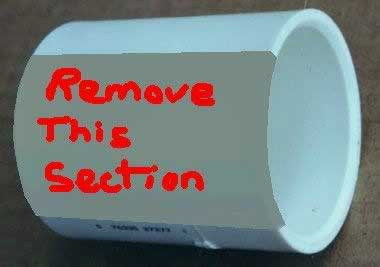
I did once see a homeowner repair for this exact problem. The homeowner took a slip coupling, cut it in half then glued the two halves over the pipe where the hole was. It actually worked. Its not right, but it worked. I would recommend repairing it correctly of course.
good luck!
mariomp
03-01-2005, 07:53 PM
I hate to say it but, in all my years of working on the houses I have tried everything from crawling in tight spaces, to putting band aid fixes, all to avoid cutting into a drywall.
You know what I found in the end?
It’s not worth it!
Cut yourself nice size hole, using inside of the studs as a guide, cut the pipe right thru the drilled hole, and install the slip coupler, not regular one. Slip coupler does NOT have a ridge inside in the middle, that allows U to slip the coupler on one pipe (all the way onto the pipe) align the pipes and slide the coupler over the other piece.
Then, attach couple of scraps of 2x4 onto the studs, and put the cut drywall piece back into the hole attaching it to the scraps of 2x4.
If you have textured drywall, after you patch it, you can buy texture spray can at H.D. or Lowe’s for few bucks and spray texture on the wall. After paint, you'll never see it and you'll never have a problem.
Oh BTW, you know what's worst than the big hole that you know its leaking when U flush? A little one that allows water to sip down the pipe, not showing on the drywall but rotting your lumber away. And that mysterious smell from the sewer that you'll have no idea where it’s coming from.
Hope this helps.
Mario P.
If you can find a slip coupling without the ridge in the middle that will be the easiest, othewise use a regular coupling and cut it in two right next to the ridge. Take the coupling, or the piece without a ridge, and make a verical cut on two sides somewhere past the centerline so you have one piece that looks like a "C" and the other on looks like ")". Take the "C" and coat it with primer and cement and do the same with the pipe around the hole. Then "snap" the coupling piece over the hole. You are done and it is permanent. hj
hj,
I've done this too. It really is a nice quick way to patch.
Terry
jimbo
03-02-2005, 07:14 AM
Most of my professional colleagues will disagree with me on this: I take some epoxy putty such as RectorSeal 400, and carefully work some into the hole, not too much, then build up a "lump" about 1½" diam on the oustide to give a good bond. The only "negative" is that if you get a protrusion of putty on the inside of the pipe, if could snag "things" and caue a buildup. On a vertical pipe, I do not see a problem, and do be careful to not force too much putty inside the pipe.
fishman
03-02-2005, 01:27 PM
Jimbo, I went to a hardware store again and got a few different opinions. The last guy I talked to said that he had done the same thing before and suggested that I use epoxy. I put it in the hole as per your directions this morning. I'll see how it goes when I get home from work tonight. By the way, that epoxy stuff is pretty amazing. I made a test "snake" out of it and its basically hard as metal in a half hour. Thanks for the advice. I'll let you guys know how it went.
- fish
Getting hard in half an hour is not the important thing, there are other things that will do the same thing. The important thing is whether it will adhere to the plastic, and do it "forever".
jimbo
03-02-2005, 09:24 PM
Are we talking epoxy or ******?
fishman
03-04-2005, 10:31 AM
Looks like the epoxy did the job. Thanks for the tip jimbo.
rmolina
12-12-2005, 06:48 PM
I know the right way to fix this problem is to cut out and replace the bad section. Given the date of the last post, I figured I'd ask whether Expoxy is still the way to go with this.
Bob NH
12-12-2005, 07:03 PM
It is not pressure pipe. I would repair the hole with one of the following methods.
1. Cut a 1" x 1" piece off a coupling or other fitting with the correct curvature. Glue it on using PVC primer and glue, and hold the piece on with a stainless clamp.
2. Using a belt sander or other tool, make a slightly tapered plug from a piece of PVC fitting. Glue it into the hole with primer and PVC cement. This has the advantage of requiring the smallest hole through the wall. Work on the plug until it fits pretty tight and doesn't stick more than about 1/8" into the inside space of the pipe.
I have done this a few times. Heat a putty knife or similar with a torch, when it is hot, hit the pipe where the hole is and melt the plastic closed. Your done.
dubldare
12-12-2005, 09:56 PM
RioHyde and mariomp have the only two answers that make a lick of sense.
I 'might' do a patch job in my house, but not in the house of my customer.
That's not about making money. It's about doing right by the guy paying for it.
RioHyde and mariomp have the only two answers that make a lick of sense.
I 'might' do a patch job in my house, but not in the house of my customer.
It is his house.
rshackleford
12-13-2005, 09:01 PM
Google "hydrowrap" it is like casting material and should seal this up. If you can't find any, contact me and i can get you some.
Let us know how it turns out
pkrsiak
12-14-2005, 05:26 AM
Here is my experience; there is no glue designed to permanently seal an open hole in the PVC pipe in order of my preference:
1.Tap 1/16-27 NPT and install a plug. (the ¼” hole diameter is OK for 1/16-27 NPT). You do not need to apply any dope or a teflon tape. If the hole is already larger, I would go with Q size drill (0.332") and tap 1/8-27 NPT thread and than plug. There is bronze or stainless steel plugs available designed to seal slightly below the surface.
2.Or tap 5/16-18 thread and use a short bolt with a larger hex head, but you must use flexible plastic washer and steel washer to protect the flexible when torquening, but you will be higher by the head + washers thickness.
3.If all this repairs are impractical, there is one remarkable sealant: Polyurethane PL. It will plug the ¼” hole, no problem, just degrease the area with acetone, or lacquer thinner (do not use paint thinner).
The first two repairs are based on assumption that we are talking about SCH 40 waste pipe with a sufficient wall thickness. These repairs will allow you to put the system into service immediately.
The last one: you will need to allow at least 48 hours (temperature sensitive) before use.
I hope this will help.
Best,
Pavel
rmolina
01-08-2006, 09:25 AM
1) First off let me say you guys are all awesome!!! I'm a novice and the discussion here has helped tremendously. I went with the Marine Epoxy given a) its my house and b) its not a pressure pipe, c) didn't want to make a bigger job of it, and d) i took the stud finder and drill away from the wife.
2) I didnt think about melting the PVC to seal the hole although that may have worked just as well. We are talking a small size drill hole here. Nevertheless, thanks you all again. I'll be back soon I'm sure.
jimbo
01-08-2006, 11:51 AM
This has been an interesting thread.
We all know that the "right" thing is to somehow replace the piece with the hole in it. Then there is the real world. I can think of some problems:
(1) Minimizing the "damage" to the finished wall is not a trivial consideration.
(2) If this is a 2x4 stud wall, the thickness of a rubber or PVC coupler may cause a bow in the drywall.
(3) Time and $$$$$
In my humble opinion, any of the alternate repair methods suggested are likely to be successful, and last the life of the house. Is there a risk? There is a risk of falling out of bed. Welcome to the world!
I think this has been a very useful debate, and the homeowner has plenty of information to make a rational decision. It is his house.
master plumber mark
01-08-2006, 03:30 PM
thread overload here....too much information
yes , you can use epoxy,
yes you can install a slip through coupling
yes you could install a fernco coupling...
another very easy way to do this...that I have not seen
mentioned yet.....
you can also just tap the pipe with a small sized tap,
then dope up and screw a tiny plug into the hole too...
the 1/8 plug is not going to be into the inside fo the
pipe enough to get anything hung up on it to matter...
that is very, very cheap and easy
so lets make this guy really fret some more...
prashster
01-15-2007, 08:07 AM
Fishman,
So how is the epoxy holding out?
I did exactly the same thing while installing shelf brackets yesterday.
- Shawn
Randyj
01-15-2007, 09:05 AM
Lots of ways to do it... things I would try rather than fixing it right:
1) get a self tapping bolt in the hole and seal the bolt thread with silicone, pipe dope, jb weld,teflon tape...or whatever works.
2) push j.b. weld in the hole and cover it with duct tape.
3) use pipe wrap which is supposed to hold up to 120# psi.
http://www.piperepair.net/pipewrap.html