What's the thing called on a freeze proof hose bibb?

Melissa2007B

Member
Messages
369
Reaction score
10
Points
18
Location
Denver, CO
We have these hose faucets that are apparently called "freeze proof hose bibbs", from what I've been able to find out on the web so far.

But when this modular house was built a couple of years ago, it looks like some parts got left out of one of them, and that thing on the top gushes water when you turn the hose on. I checked inside it by unscrewing it and then looked at one of the others, and it's missing some internal part that appears to be like a pressure valve that closes it when you turn the hose on.

So I took the whole thing with the bad one, in to Home Depot and Ace and got treated like a martian in both stores. They didn't know what the thing is, never saw one before. But I pointed out that they were selling these kinds of faucets with the durn things on them. They still didn't know and said they don't sell them separately.

So I need to know what these things are and where to get a replacement one. Anyone?
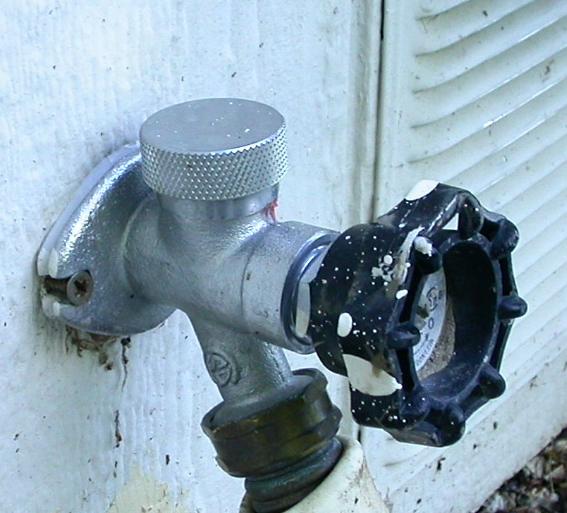
Hose faucet thing.JPG
 
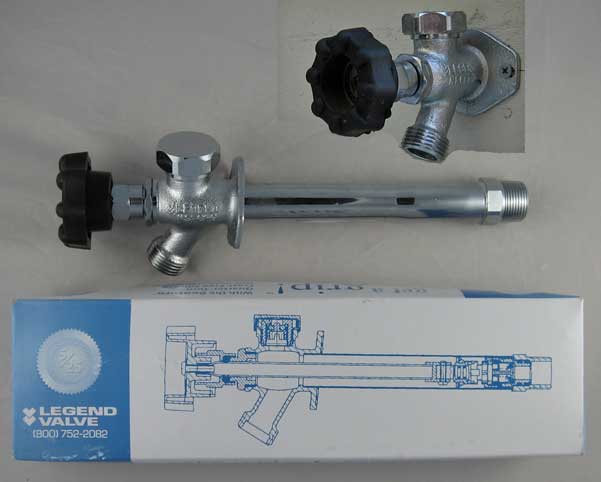
It's the aniti-sphon on the hosebib.
The faucet will have a brand name on it.
You will be able to look them up on the Internet, and they should have replacements parts for it that they can send you.
It's a very easy repair.

legend_hosebib.jpg
 
Last edited:
As Terry points out, that's the anti-syphion part that you're looking at. The frost free valves might look the same on the outside, but they extend 12" through the wall where they connect to the supply line. The actual shut-off part is clear inside so the valve will drain when turned off. That is they will drain unless one leaves the hose hooked up in the winter. Then that 12" pipe will split and you will have a flood the first time you turn the valve on.
 
The antisiphon part has nothing to do with the freeze protection, but it is the part which usually leaks. They differ by brand, so parts are not generic. Your marking is SA inside a C. It is the mark of CSA, the Canadian Standards Association. Means it is approved for use in Canada.

CSA is a government agency, but performs roughly a similar function to the private UL in the lower 48 here. They do have their fingers in more pies than UL.
 
Melissa2007B said:
... when this modular house was built a couple of years ago ...

I would try contacting the modular's manufacturer or the dealer that sold and set the unit. Having come from Indonesia, that faucet was likely supplied by a mobile/modular component importer/vendor and might not be found anywhere else ... yet a reputable modular dealer should still be able to offer some kind of help.

Can you see the plumbing connection at the other end of the faucet? Overall, you might be better off just replacing the entire assembly.
 
If it was mine, I'd just replace the whole thing. You might find the part(s) you need easily, but if they are hard to find, you would spend more time and money finding the parts than the thing is worth.
 
Gary Swart said:
If it was mine, I'd just replace the whole thing. You might find the part(s) you need easily, but if they are hard to find, you would spend more time and money finding the parts than the thing is worth.

I might just put some silicone in it and let it dry, then screw it back on there.
 
"Made in Indonesia" pretty much tells the story......that's the end of the story. Look for a new valve.
 
The silicone might work for a temporary fix, not much to lose by trying, but I'd still replace the darned thing.
 
Gary Swart said:
The silicone might work for a temporary fix, not much to lose by trying, but I'd still replace the darned thing.

Maybe when I get some money, not making enough right now.

Been wanting to replace all 3 with 1/4 turn faucets though, these require about 10 turns to fully open.
 
Was it ever established that these are frost-free as well as anti-syphon? If they are frost-free, I'm not sure they make 1/4 turn models. At any rate, you don't have to rush to replace them, it's a long time until frost season. Just a note of caution about frost-free. You must access them where they connect to the supply line and use two wrenches to remove them so as not to risk twisting the fitting where they attach. Second, always disconnect you hoses in the fall before freezing. Hoses will prevent the valve from draining and they will freeze and you will have a flood when you turn them on in the spring. Don't ask me how I learned that lesson!:D
 
Gary Swart said:
Was it ever established that these are frost-free as well as anti-syphon?

They must be, this is Denver and they've never frozen in 3 years since the house was put here.

If they are frost-free, I'm not sure they make 1/4 turn models.

Ahhh! Well I think we had 1/4 turn ones in the old house and they were frost free. The valves were about 18" back inside the house. ( assuming we mean the same thing )

At any rate, you don't have to rush to replace them, it's a long time until frost season. Just a note of caution about frost-free. You must access them where they connect to the supply line and use two wrenches to remove them so as not to risk twisting the fitting where they attach. Second, always disconnect you hoses in the fall before freezing. Hoses will prevent the valve from draining and they will freeze and you will have a flood when you turn them on in the spring. Don't ask me how I learned that lesson!:D

:) I always do anyway.
 
OK! They are frost free. If you had 1/4 turn valves elsewhere and you're sure they were frost-free, then I will assume there are such things. I believe there are frost-free with different lengths, you had 18", mine are 12", but they work the same. I'd like the 1/4 turn valves myself, in fact, I planning replacing a conventional hose bib that I have on a line that is drained in the winter with a 1/4 turn ball valve this week-end. I think you're on the right path, and if you can get that leak stopped until you can replace all of them, you'll be good to go.
 
Back
Top