Basement plumbing rough in

MikeFish

New Member
Messages
11
Reaction score
0
Points
0
I want to do this right the first time rather than failing inspection.....

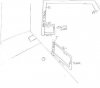
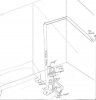
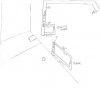
I attach 2 drawings for reference. Rough in #2 is the big picture. Obviously rudimentary and not drawn to scale (my what a gigantic tub). Rough in #1 illustrates my question, however. I need to attach the lav vent someplace. Lav vent is 2"; Main is 4".

Do I go up and into point A? It is horizontal and wet. It is easier because of the joists but it is a longer run (about 4'). It raises questions. If it is the correct spot do I 'T' in above the pipe or angle in above it? I talked to a gentlemen who suggested 'T' into the top with a spring loaded vent "studer vent?" above that? (seems like wearing a belt and suspenders and possibly not passable by the man).

If I go into point B on the verticle, I wondered if there is a problem because I am so close to the 90.

I also wondered if my 26" run from the sink drain to the lav vent is too long. I think it puts the trap further than it should be but I can't get it any closer. Will I pass?

Any other problems with this layout??

Lastly, my wife brought up something, and I need to ask the question to maintain inner peace and marital harmony: We bought this house with the plumbing rough in in place. How do I know everything under the concrete is still connected? How can I test it to be sure? One warning sign for me was that the waste pipe in the bathtub cutout was a bit out of square and I wonder if it broke off when the concrete was poured.... Perhaps paranoid, but once the wife asks and if I don't confirm, the entire substructure of the house is likely to wash away and it will come crashing to the ground.... If you're married, you're tracking. Plumbing Rough No. 1_0001.jpg
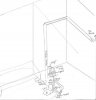
Plumbing Rough No. 2_0001.jpgThanks for help!!
 
MikeFish said:
.... into point A? It is horizontal and wet. .... because I am so close to the 90. .... 26" run from the sink drain to the lav vent is too long. I think it puts the trap further than it should be ..... Lastly, my wife ......
Tell wife not all people sign in on all days and not all visit each thread and not all answer each subquestion, so she should sleep well tonight, knowing that the answers to your various questions are coming down the line, over a few days or weeks, and that the answers will be clear soon but not right away. :)

To get lots of answers to one particular question, open a new thread for that topic alone. Its title and its focus will attract a following.

I don't know how to advise you on verifying that the DIY who learned a lot while doing it himself ultimately did the right thing with your drains. Chances are high that he didn't, in my experience, being a DIY and seeing how other people do things themselves when they do things for the first time. This topic deserves a thread of its own in my opinion. I'd predict that such a thread would become an evergrowing multiyear thread that would attract more traffic than any other thread after a slow start in the first few years.

You mentioned the trap being farther away when the vent and drain get routed one way or the other. The lav (sink) trap is not in the wall, but outside it and you will connect it later when you have the sink and vanity or countertop. Did I understand your question right? I think you may have a misconception about where the trap is going to be installed, or else I didn't understand which trap you were asking about.

You gave two choices for a vent to be routed, and the first choice is "WET"? Meaning that it's a drain and not a vent? I can't figure that out; I need more info.

A vent being connected close to a 90 is not a concern. (Vent / re-vents are 42" above floor level or 6" above flood rim height of highest fixture.) Overall you are doing fine, in my opinion, so don't sweat these confusing things I am asking you to clear up. A bigger rendition of your drawing would help; right now I used binoculars to read it.

Hope she sleeps well at night.

David
 
geniescience said:
You mentioned the trap being farther away when the vent and drain get routed one way or the other. The lav (sink) trap is not in the wall, but outside it and you will connect it later when you have the sink and vanity or countertop. Did I understand your question right? I think you may have a misconception about where the trap is going to be installed, or else I didn't understand which trap you were asking about.

I recognize that the trap will be under the sink and outside the wall. It is too far from the lav vent/drain?
 
geniescience said:
You gave two choices for a vent to be routed, and the first choice is "WET"? Meaning that it's a drain and not a vent? I can't figure that out; I need more info.
David

The first choice is marked on the first drawing at "A". It is a horizontal connected to the main stack. It leads to the middle of the house and eventually up through the roof. So the lav vent will be attached to "A" but on a horizontal. It has to be above the pipe to some degree or else it will become a drain; that would be a mess.

Thanks for your help and confidence. Enormous pix attached.

Plumbing Rough No. 1_0001.jpg

Plumbing Rough No. 2_0001.jpg
 
After further review it appears the neither point A or point B is good for me to tie in the lav vent. Both are on the main drain stack, and everything else in the house flows past the proposed wet vents. Plus point B is less than 6' higher than the flood of the sink. Studors are frowned upon in my area except for island sinks. How can I tie in this vent??
 
picture please

only someone who is there on site can answer that. Second best option is to give the right information, like by posting a picture.

Post a picture. Show where your pipes and studs are. Someone will answer the call.

david
 
Pic

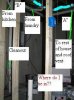
Here is a picture. It requires an alibi regarding the drawings.

Basement vent.JPG
The position of my utility sink obviously will not be under my breaker box; I just couldn't draw it properly on the opposite wall behind the tub.

I hope this pic helps. The light blue is a fresh air vent for the furnace.

The fixtures to be vented on this are toilet, sink, utility sink. Although I'm draining the utility sink right into the stack, I plan to revent back to the lav vent. I think the bathtub is wet vented into the main stack, but like I said above, I'm not sure what is going on under the concrete. I can't imagine they tied the tub into that lav vent.

All of my research to this point indicates that point A is correct. Point A is a horizontal section of the main drain stack. I think I "T" in above it. However, I'm concerned that the "T" will break the vent, and I wonder if installing a studor above the "T" will manage it. Or is there another way? Thanks for all the help!
 
it's not a vent, it's a drain.

bad news. It's not a "main drain vent", it is a DRAIN. You cannot tap into it to use it as a vent now. Your vents are farther away, either higher up somewhere or farther away on that floor level above the basement.

david
 
MikeFish said:
After further review it appears the neither point A or point B is good for me to tie in the lav vent. Both are on the main drain stack, and everything else in the house flows past the proposed wet vents. Plus point B is less than 6' higher than the flood of the sink. Studors are frowned upon in my area except for island sinks. How can I tie in this vent??


That's what I said;)

I could put a supplemental vent through the roof, but I don't want to.

How far up the wall on the floor above will I have to go to tie into the laundry or kitch vent branches?

Finally, failing all that, what argument do I make to the city that they shouldn't force me to spend thousands when a perfectly good Studor vent will solve my issues for a fraction of that cost?

Any other solutions would be appreciated.
 
You can tap in your vent 42" above the flood plane of the highest fixture that is using that as a drain. If you have an attic, and could get it up there, you could do it there, or (typically) above the highest (probably) sink. It doesn't have to run straight, since it is moving air, but it still should have slope in it so any moisture that might condense or run down from the roof will drain out. It makes it easier if it is straight if it becomes clogged for some reason - birdnest, rat, etc. so you can clean it out.
 
Back
Top