View Full Version : Hot Water Recirculation Choices
curtisjo
02-09-2005, 10:12 PM
If it's not too expensive, I want to install a recirculation system for the master bathroom of our remodel, which is about a 45' pipe run from the water heater. I estimate we would have to wait about 35 seconds without recirculation before hot water would appear. (Kitchen and downstairs bath are very close to the heater.) Pipe is 3/4" L copper. I'd like to not waste water or have to wait a long time for hot water to appear, but I also don't want to pay for something that would take 10 years to recoup the cost.
There are 2 choices which are intriguing to me.
1. Gravity fed convection system. This should work since the water heater will sit in a utility closet at ground level, first floor is 2 feet higher above a crawl space, and master bath is on second floor. My understanding is that we need a 3/4" return line from upstairs with the whole loop insulated EXCEPT for 15-20' at the end of the return line (just before the water heater), and that this cooler section is what sets up the convection flow–albeit a slow flow, which I assume is good. If this doesn't work, it may be necessary to install a check valve going into the drain side of the water heater, and if THAT doesn't work, can I assume that a recirculation pump can be installed retroactively? My contractor is not experienced with gravity-fed systems.
2. Contractor recommends a (new) product that he has used in his last 3 houses. It uses a pump but does not require the installation of a return line. Somehow, the hot water at the end of the line trickles into the cold water side. Does anyone know what this product is and what might be the pros and cons?
Thanks.
1. If the contractor is not proficient in gravity systems do not even consider it since it has to be "engineered" to very strict guidelines, and ALL the plumbing has to be higher than the water heater.
2. Forget about ever recouping the cost of a circulation system. The added fuel costs, electricity to run the pump, and shortened heater life will add to the long term costs, not reduce them.
3. Those systems are not a panacea. They give "warm" water initially, but still have some lag for "hot" water, and the cold water faucet may have an initial spurt of warm water.
jimbo
02-10-2005, 07:26 AM
If you have the option of installing a return line, by all means do so. This will eliminate some of the side effects of the retrofit pump systems. Remember to insist on complete insulation of hot lines.
curtisjo
02-10-2005, 08:16 AM
Thanks. Actually, the lowest plumbing line is in the top section of the crawl space and would be still above the drain spigot of the tank although not the main body of the tank itself. The water heater will sit on a pad 2 feet below the first floor. Does this count as "above" the water heater?
Also, I assume the luke warm water to start and some initial warmth from the cold tap refers only to the systems that use the cold water supply as a return. Are products like the Grundfos Comfort Series or Taco D'Mand systems meant for retrofit situations where installing a dedicated return line would be too difficult and expensive? Are there other problems with using the cold water supply as a return that I should be aware of?
Thanks.
Andy Ring
02-10-2005, 11:15 AM
I'm actually installing a GrundFos Comfort Series pump today. I'm actually doing it not for instant hot water, but to stop some very inaccessible pipes from freezing (slight circulation of hot water should prevent freezing, that's the idea anyway). I bought mine new on **** for $175 which was much cheaper than I could find from a plumbing supply store.
Installing it seems to be a snap. It connects right above your water heater on the hot side. On the bottom of the pump is a connector to attach to the 3/4" male on the water heater. At the top of the pump is a 3/4" male. I have 3/4 copper into my heater, so I had to cut about 6" off, sweat a 3/4 female and I was done with pump install. Now, I'm installing the comfort valve on my bathroom faucet which should be very easy.
Taking a lunch break right now, or I'd be done. If you're interested, I'll try to get back to you with a report on how it works. BTW, there's a couple threads from a couple months ago about this topic.
Good luck,
Andy
curtisjo
02-10-2005, 11:46 AM
Thanks Andy. And yes, I'm interested in hearing your results although I have given our remodeling supervisor the go-ahead to install a third 3/4" copper line as a dedicated hot water return line. The walls are completely open now; they won't be in a couple days. Normally, I believe he uses the Grundfos Comfort Series and leaves out the third return line, but overall, the cost of the third line is only slightly more. Don't know which system is more cost effective to operate; having a dedicated hot water loop (entirely insulated but is double the length of the Comfort Series that dumps its hot water into the cold water supply for the return).
By the way, I've confirmed that these lines come in from ABOVE the water heater if we were to try giving a gravity fed system a shot. How hard could it be? Plumber recommends installing a pump from the outset in order to be on the safe side–and to avoid $150 or so of retrofitting costs later. Also, uninsulated 15' of pipe at the end of the return line might be inaccessible after drywall goes up, and I guess we'd want full insulation if we did NOT end up using a gravity-based convection system.
Thanks again,
Jonathan
jadnashua
02-10-2005, 12:32 PM
I retrofitted a redytemp system. It works fine so far. It can be installed and works better if you have a dedicated return line but doesn't need one. www.redytemp.com I'm sure some of the other systems work fine, too. Taco has a retrofit system, too. www.taco-hvac.com (I think maybe without the hyphen?). called the d'mand system. The gundfos system has some advantages over either of these and would probably be less expensive unless you needed valves at multiple locations, but in my situation, the redytemp was the easiest and works.
Gary Swart
02-10-2005, 01:46 PM
I recently installed an SMC 303 in my home. It works very well. They have a model that has a timer so that you can set it to operate only at times when you will be using hot water, but mine does not have the timer. It requires a return line, an air vent, and a check valve, all easy to install. I can't tell you how much it costs to run, but it is amazing to get instant hot water at all outlets.
MrRedyTemp
09-29-2006, 01:55 PM
A closer look at thermostatic recirculation systems, particularly thermostatic valve operations, appear to validate homeowners disappointments of waiting for cold water and abnormally high gas bills, conveyed by nearly 100 professionals interviewed at the 2006 Southern California Annual PHCC trade show. Thermostatic valves connect the homes hot and cold water lines together and the internal valve opens and closes in reaction to the hot / cold water contacting them. These normally open valves constantly remain open unless 95F degree water or hotter constantly contacts them to keep the valve closed. To prevent inefficient hot water line siphoning through these valves would require homeowners to constantly maintain hot water throughout their homes hot water pipes 24 hours a day.
Any use of cold water, i.e., flushing toilet, indoor/outdoor watering, icemaker refills, etc. which drops the water pressure in the cold water line while the thermostatic valve is OPEN, causes any <95F degree water in the hot water line to rapidly pass through the open valve and into the cold water line. Resulting in additional energy consumption by the water heater to heat the cold city water which entered the water heater to replace the water which passed through the open thermostatic valve, even though only cold water was used by the homeowner. This inefficiency can result in users having to wait for cold water from their faucets for tasks which warm water is less then ideal, even unacceptable, i.e., taking vitamins/pills, brushing teeth, washing off fruit / vegetables, salad prep, filling pitchers/drinks, recipes, watering plants, etc. Depending on the distance to the water heater, a home owner could wait quite a while before water hot enough to close the valve arrives from the water heater. Read more at http://www.redytemp.com/comfort_valve_vs_outlet_install.htm
Mikey
09-30-2006, 07:02 AM
I use an on-demand circulating pump that sits under the vanity. You push a doorbell-like button and the pump draws water down the hot line and dumps it into the cold line until it reaches a preset temperature. Very satisfied so far. Simple, doesn't waste energy keeping a pipe full of hot water all the time, not too expensive, easy DIY installation. Called the "chilipepper" -- but I don't know if it's related to Taco or not :D .
http://www.chilipepperapp.com/
jadnashua
09-30-2006, 09:50 AM
Most of the pump systems can be run using that method and it is less expensive since it does not run as much. The down-side is that you have to think about it before you want to use the hot water, since it takes the pump some time to bring the hot water to the tap. I and my guests (who probably don't understand the system) prefer the system running on a timer so hot water is available under normal circumstances. You pays your money, and takes your chances...
prygaard
12-21-2008, 09:13 PM
Residential Demand-Sensing Hot Water Recirculation System
A recirculation pump with a dedicated return line and a timer has two problems:
1) Most of the time the pump is running, it is not needed
2) when Hot water is needed, the pump is often not running.
I solved the problem with a unique "on-demand" control that turns on the pump when the hot water anywhere in the house is turned on.
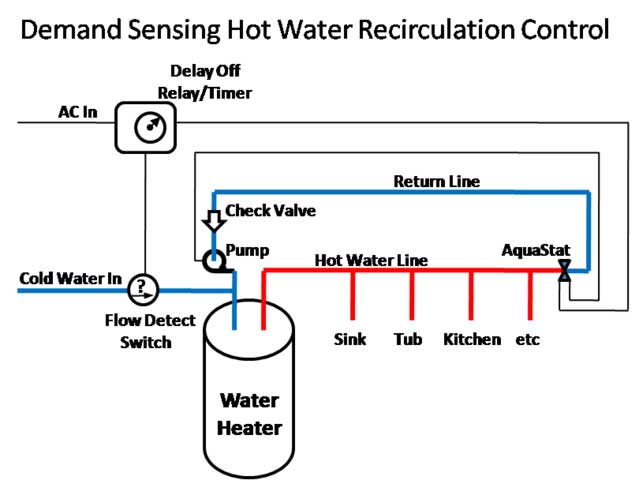
Here is a diagram of the system:
http://i480.photobucket.com/albums/rr167/PRYGAARD/RecirculationControl.png
1) On the cold water IN on the Hot Water tank, a flow switch is installed that turns on when it detects flow. (Note: This can *not* be anywhere in the circulation loop)
2) A Delay-Off timer turns the pump on immediately when the Flow Switch turns on, but does not turn off the pump for a while after the flow switch is turned off. (The delay time needs to be adjusted for the characteristics of the particular installation. Typical times range from 30-90 seconds)
3) An aquastat is used to turn off the pump when the farthest faucet in the loop reaches temp.
When the hot water is turned on, the pump comes on and hot water arrives fairly quickly (but not instantly). The innovation is this: Turn the hot water on for a second and then turn it back off...and the pump keeps going for a while. Then just wait for a little bit and turn the Hot water back on...it is hot and ready to use. However, after the water is turned off, the pump will run for the delay time and then stops till the next time there is demand.
Parts that I used to build the control circuit:
Flow Switch: Gems 26615 (I got it cheap on a bidding site). (http://www.gemssensors.com/ApplicationSearchResults.asp?nQuestionID=36 ) Others are available, but be sure to get one that has a fairly low trip point on the flow. (.75 – 1 GPM)
Delay off Timer: MX046 timer kit. (15 second to 6 min delay)
(http://www.bakatronics.com/shop/item.aspx?itemid=466) It is inexpensive but you must build it into a case. There are other delay-off timers and relays available but this seems to be the cheapest option.
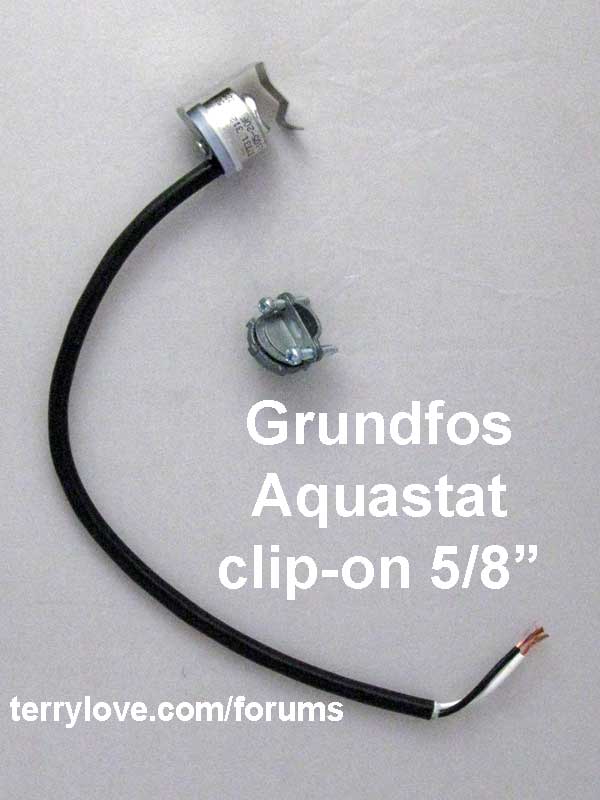
Aquastat: Grundfos 1/2" Clip-on Control 115 volts #595443.
(http://store.waterpumpsupply.com/aqhotwattemc.html) Get the ¾ inch if that is what you need for your pipes.
Redwood
12-22-2008, 06:34 AM
So you still sit and wait for hot water!
What's the point?
I would use one of these and give it a head start for no wait.
http://www.smarthomeusa.com/Products/ODS10-IDX/images/ODS10-IDX.jpg
prygaard
12-22-2008, 08:26 AM
Like any desgn problem, it is all choices and tradeoffs.
I considered the motion sensor. In fact, I may still put one in the bathrooms (I would have it drive a relay in parallel to the delay timer). However, in the kitchen/great-room, the pump would be running most of the day if I used a motion sensor (we spend most of our time there).
So....Yes, I still have to wait a little but it is a LOT shorter of a wait than before. Meanwhile, I am waisting far less energy and water.....A trade-off I decided to make. I suspect others will be willing to make the same choice.
Cheers
Paul
Mikey
12-22-2008, 08:33 AM
Damn fine post; thanks for the parts list. My situation is a little more complicated since the WH is in the center of the manifold, but I think two aqustats, maybe a valve or two, and some logic would do the trick. I'm using two Chilipepper on-demand pumps now (http://www.chilipepperapp.com/howit.htm), but they're pretty noisy.
davidrw
03-21-2010, 05:50 PM
I have a recirc system with return line. The gas usage is huge if the timer is one for even 4-6 hours per day.
I want to install a flow switch/delay off timer system similar to Prygaard's diagram below. I have read his posts and he changed the diagram over time.
Should the flow switch used to turn on and off the pump be installed in the cold water supply line or the hot water feed line?
My hot water recirc return comes into the drain line at the bottom of the tank.
I want the pump to come on instantly when any hot water valve is opened. Is there any delay in flow in the cold water supply line?
Intuitively I would think the flowswitch should be in the hot water side for faster switch response. But Prygaard has it both ways. Thanks
Mikey
03-21-2010, 06:36 PM
I'm using two Chilipepper on-demand pumps now (http://www.chilipepperapp.com/howit.htm), but they're pretty noisy.
Update on these thngs. First, make that VERY noisy. Also, looks like the life is about 4-5 years, which ain't much, IMHO. I'm happy with the concept (push a button, wait for a few seconds for hot water), but will be replacing these things with more long-lived (and quieter) pumps.
prygaard
03-21-2010, 08:44 PM
DavidRW.
Both methods can work.... I think (see my comments below).
I set up my system with the sensor on the cold water side and the delay-off timer. I still have it set up that way and it is working very well. I also have a fast acting Aquastat on the line so that when the loop is 'hot' the pump no longer runs at all. This keeps the pump time down to just a few minutes a day (15-20 min with a family of 4)
After I posted my solution, other people pointed out that with an aquastat, you could put the flow sensor on the hot water side of the heater and let the aquastat turn it off once the system is 'hot'. The advantage of this is that there is no need for the timer circuit.....just the flow sensor to turn it on and the aqustat to turn it off. Since I already had the timer and the cold-sensing set-up, I have not tried the hot-sensing set-up so I cannot personally speak to the results.... but it seems like it should work. (I was intending to but never got to it…too many other projects to work on :) .
Warning: Some of the cheaper 'clip-on' aquastats are very slow to react. This would cause the pump to run longer than needed before the aquastat kicks it off.
In both set-ups, the Aquastat should be on the return line as close to the furthest faucet as possible. However, even if the aquastat is on the return pipe near the heater.... it should still work OK.
BTW: It goes without saying.... but the full loop really should be insulated even with one of these set ups.
If you have any questions.... feel free to post them.
Good Luck
Paul
prygaard
03-21-2010, 09:05 PM
David,
I also discused the ideas (in a lot more detail) on the following forum:
http://www.dannylipford.com/home-improvement-video/watts-instant-hot-water-recirculating-system/
Cheers
Paul
davidrw
03-22-2010, 06:25 AM
Paul, thanks for the quick reply. I was hoping you were still out there. I have followed your project for some time now.
My plan for now is to install just the flow switch and delay timer. I haven't yet found a reasonably priced aquastat (immersion type).
Do you feel that there is flow in both the hot and cold sides at the same time when a faucet is opened. I was concerned that there would be a delay on the cold side.
I supposed you could add a short section of clear PVC in each side as a test.
prygaard
03-22-2010, 09:15 AM
David,
Since water is not compressable, there should be no delay between flow on the Hot side of the heater and flow on the cold side.
The only way there would be a delay is if there were some kind of expandable bladder someplace in the system.... the most likely case of this would be if there is an expansion tank someplace in the system. These tanks are seperate from the HW heater and are designed to 'absorb' extra preasure due to expansion. I don't think expansion tanks are very common in residential situations, but they are code in some places if you put a check valve on the cold water in. It is concievable that water could flow from the expansion tank for a moment before it flows from the HW heater. I have never worked with an expansion tank but my guess is the delay would be very small.
Note that if the flow sensor is on the HW but before the expansion tank you would still see any such delay.
BTW: You can see diagrams and pictures of my install at:
http://s480.photobucket.com/albums/rr167/PRYGAARD/
Diagrams are there for both the 'cold-flow-sense' and the 'hot-flow-sense' but the pictures are only for the 'cold-flow-sense'
Paul
davidrw
03-22-2010, 11:30 AM
Paul, I don't have an expansion bladder. I see your point - there should be no delay (unless the laws of nature have changed).
I will install the switch on the cold side simply due to much easier access. Your source for the delay off circuit is a good one. I had looked everywhere and couldn't find one. Thanks again.
prygaard
03-22-2010, 05:32 PM
David,
One more thing: You mentioned that you are having a hard time finding a good Aquastat.
I ordered a White-Rogers 1127-2 strap-on aquastat (cheep on E-bay). I hooked it up next to the pump at the Water Heater (The pump is on the return line at the heater)….and it makes a big difference. It reacts very fast to the changing temp and shuts the pump down quickly. I have a run-timer on the pump and before the new Aquastat the pump was running just under 2 hrs/day. With the new aquastat it seems to be about 20min/day.
I suspect an immersion aquastat would be even better..... but I am happy with the strap on.
If I get a chance, I'll try to get some pictures of it onto the PhotoBucket link in my post above.
davidrw
03-22-2010, 05:37 PM
David,
One more thing: You mentioned that you are having a hard time finding a good Aquastat.
I ordered a White-Rogers 1127-2 strap-on aquastat (cheep on E-bay). I hooked it up next to the pump at the Water Heater (The pump is on the return line at the heater)….and it makes a big difference. It reacts very fast to the changing temp and shuts the pump down quickly. I have a run-timer on the pump and before the new Aquastat the pump was running just under 2 hrs/day. With the new aquastat it seems to be about 20min/day.
I suspect an immersion aquastat would be even better..... but I am happy with the strap on.
If I get a chance, I'll try to get some pictures of it onto the PhotoBucket link in my post above.
I'll keep looking - thanks
jadnashua
03-22-2010, 07:45 PM
If your pipes don't run through the slab in contact with the ground, and they're insulated, I find it hard to believe your gas usage went way up. An occupancy sensor might also work for you to run the pump. That way, it would likely be hot when you wanted to say wash your hands after using the toilet rather than turning the faucet on, then off, and waiting. As soon as you left the room, it would stop. This would require potentially multiple switches, but eminantly possible.
davidrw
03-23-2010, 06:14 PM
Paul, I received my delay off circuit board today. I'm not sure how to wire this up with just the flow switch and delay.
On the delay circuit board:
Line power to AC In.
AC out to the recirc pump.
SW to the flowswitch.
That's what the diagram shows for the delay circuit. If that is correct, does the delay circuit provide power to activate the flowswitch through the SW terminals?
The flow switch diagram shows a hot line leg going to the common terminal on the switch. That makes sense.
I've seen the photo of your control box but I can't really follow the wiring plan. Thanks again.
davidrw
03-24-2010, 02:05 PM
Paul, I received my delay off circuit board today. I'm not sure how to wire this up with just the flow switch and delay.
On the delay circuit board:
Line power to AC In.
AC out to the recirc pump.
SW to the flowswitch.
That's what the diagram shows for the delay circuit. If that is correct, does the delay circuit provide power to activate the flowswitch through the SW terminals?
The flow switch diagram shows a hot line leg going to the common terminal on the switch. That makes sense.
I've seen the photo of your control box but I can't really follow the wiring plan. Thanks again.
Shazam! it works. I wired it as above and it works great.
That trim pot is really sensitive. At minimum setting it's about a 15 second shut off delay. After turning the trim pot an almost imperceptible amount it goes to a one minute delay.
threadhead
05-12-2010, 08:11 PM
prygaard,
I just wanted to check in with you and see how your system is working. Any reliability issues? Any changes you would make?
I'll be installing a very similar system in the next couple of weeks and would appreciate any advice from a veteran.
CoralTrout
08-18-2010, 09:28 AM
I found the solution that is best for my setup. Redwater Diverter www.redwater.net.au (http://www.redwater.net.au) No pumps, no energy use no buttons or timers and purely mechanical. Australian invention.
http://www.youtube.com/watch?v=CJfoRkHN-QQ
Hairyhosebib
08-20-2010, 11:50 AM
You are all talking about a hydraulic loop. It should work fine without a circ pump. You only need a 3/8" copper insulated line tied into the drain port of the water heater with a check valve. Heat will naturally rise forcing the loop to flow on it's own. I would not think it would cost a fortune to operate. Once everything is up to temp it should be fairly economical, but I'm no engineer. I have known home builders offer this as about a $500.00 option to the price of a house.
sutomo
12-28-2010, 08:22 PM
Prygaard,
One quick question:
On White-Rogers 1127-2 strap-on aquastat, which terminals do you use? Red-Blue or Red-White?
Thanks
Sutomo
Mikey
12-30-2010, 05:17 AM
Red is common, Blue is open on temperature rise, White is close on temperature rise. Looks like you'd use Red-Blue.
http://s3.pexsupply.com/manuals/1284661726949/39254_PROD_FILE.pdf