PDA

View Full Version : slip joint reliability and ferncos


adrianmariano
01-29-2007, 06:44 AM
I'm planning to redo my kitchen sink soon, and I was looking in Rex Cauldwell's book on Remodel Plumbing and noticed that he recommends a completely different drainage setup than what I understand to be the norm.

The usual pattern would be to connect the sinks together with a T which feeds into the trap and then out to the drain line. Many of the connections here are done with slip joints. Cauldwell claims that slip joints tend to fail after a few years or if they get bumped, and he sees tons of rotted out kitchen cabinets as a result of this construction. He also complains that this pattern uses pipes which are quite narrow and constrict the flow too much. (And I have to admit that some of the T connectors I've seen do have only a 1/2 inch wide space at the intersection.)

Instead he recommends a drainage pattern where he uses 90 degree fernco connectors at each sink and connects to sch 40 1.5 inch pipe which he runs horizontally from each sink towards the back of the cabinet. He then runs those lines down the back of the cabinet, joints them with a Y fitting, followed by the trap, and then a final fernco connector to go into the drain. (Part of his goal is to get the drainage stuff back and out of the way.) Everything is glued together except the fernco connectors. He claims that these ferncos are less likely to leak than the slip joints, even in environments where the drainage gets bumped around a lot. If you need to open it up to clean out the trap or snake the drain you disconnect the ferncos.

What do people think about this alternate drain arrangement?

jimbo
01-29-2007, 07:26 AM
A slip joint connector can last as many years as a fernco, but it may be true that under a kitchen sink, they can get bumped.

I guess there is nothing wrong with that set up. It adds about $20 to the job, which in your own home is no big deal, but to a builder or plumbing contractor would be.

Add a garbage disposal to the picture and any space saving idea are pretty much lost.

adrianmariano
01-29-2007, 09:18 AM
After spending around $1000 on the new sink, disposal, and new faucets, it seems absurd to cut corners to save $20. In other words, I'll happily pay $20 more to do it better, particularly if it's going to make the sink work better or less likely to leak down the road. (I can understand that for a plumbing contractor, things look a little different.)

Is it better to do it with ferncos? I mean, is it worth doing it that way? It does seem like the drain would flow better. The drains are actually pretty far in the back which will keep the disposal out of the way, but it's true that with a disposal you can do as well to save space. (Cauldwell doesn't actually show is special drain setup for disposals, only for a no-disposal double sink.)

hj
01-29-2007, 07:12 PM
You will spend more money, but from your description his drain setup is a candidate for major drainage problems, and might not pass most inspections. You cannot use the Fernco 90's and would not want to even if you could. That is a "handyman" type of installation.

dubldare
01-29-2007, 07:45 PM
Rex Cauldwell is a dumb-@ss.

Remember that.


Now, if you want to know my secret about slip-joints, here it is.


Hot water, lots of it. Hot water will soften the tubular piping sufficiently to create a very tough joint. Do not use tools, only your hands. No pipe dope either.

Been doing that for years without the aid of unshielded transition couplings (which are illegal above ground, by the way).

adrianmariano
01-30-2007, 05:24 AM
Assuming Cauldwell's setup doesn't leak, what sort of major drainage problems might it lead to?

Is the criticism of Cauldwell based on this one item, or on other knowledge of his methods? (I mean, should I throw away his book?)

I have to admit that when I saw the design of the T fitting for the drain where there is only a 1/2 inch wide passage for drainage from each side it made me uneasy. My existing drain setup (that came with the house) doesn't have a constriction like this.

Regarding hot water: do you put everything together and then run hot water and hand tighten more? Or do you soak the parts in hot water before assembly?

hj
01-30-2007, 07:42 PM
If this is a sample of his recommendations, then that is why I would throw the book away. All of that piping will accumulate debris. That debris will start to deteriorate and create an odor. When the odor becomes bad enough you will be coming back here wondering where it is coming from. That is the most obvious reason for not doing it. The other reason is that it will make a very bad drain.

adrianmariano
01-31-2007, 05:45 AM
I don't understand why this piping will clog more or accumulate debris faster than a standard drain. The standard drain has a 1/2 inch wide passage at the T. Surely that is going to be prone to clogging and will limit the flow rate out of the sinks in any case. My current sink drain is not a conventional one and I have to admit that when I saw the conventional one I was surprised by how tiny the passage was in that T.

The Cauldwell drain has a horizontal run from each sink. Why is that more prone to debris accumulation than the horizontal run between the sinks in a conventional drain? Then the piping is vertical which is surely not going to be prone to accumulation. And then you have the trap which is going to be similar to a regular drain. Maybe I should post a picture of his drain setup?

I would like to understand why his drain setup is worse than the standard one because to me (as a naive homeowner with very limited plumbing experience) it looks better, with the possible exception of it being kind of a pain to disconnect everything to clean out the trap.

Anybody know WHY code prohibits ferncos that aren't buried?

plumber1
01-31-2007, 06:18 AM
When you have as much practical experience as these men at this site that donate their time to help the novice, then you can make a judgement call.

Who in the world that has worked in the real world would think that someone who writes a book, has it all over plumbers that have seen just about everything, think that a Rex book would be enlightening.

But books are written to sell.........probably to appeal to a do-it yourself-er.


Rex Cauldwell is a dumb-@ss.
dubldare

adrianmariano
01-31-2007, 06:38 AM
"When you have as much practical experience as these men at this site that donate their time to help the novice, then you can make a judgement call."

You've hit the nail on the head. Various judgement calls arise throughtout any home repair/remodeling project. They can't be avoided. Sometimes I think my judgement is up to the job. Sometimes I'm not sure sure. That is exactly why I posted this inquiry. To me Cauldwell makes sense. So am I missing something? If so, what? Why shouldn't I implement the Cauldwell drain? How is it inferior to the standard drain? It doesn't help me to hear "that drain system is bad" without knowing why.

Cauldwell appears to be a professional plumber ("master plumber", according to his bio) who has been in the business for decades and has seen lots of failed drain systems in real houses out in the world. His credentials appear to be as good as anybody's, and he appears to have plenty of practical experience. It does not appear that he just writes books to appeal to gullible do-it-yourselfers. He presents this as a solution to problems he has observed in his many years of plumbing.

kordts
01-31-2007, 06:54 AM
You asked, and everybody said don't use that set-up. Then you ask again. Don't use it, but if you do, don't come crying back here.

adrianmariano
01-31-2007, 08:25 AM
Actually it's not the case that everybody said don't use it.

I need to understand what I'm doing. (I guess you can think of it as a personal quirk.) It's not enough for me to have someone say "No, it's bad" without explaining what's wrong with it. If I didn't have this concern with understanding I might have run off and implemented the Cauldwell system without even asking here. One advantage of understanding what I'm doing is that I'm not going to run back and blame other people for the outcome. In the end what I do is my decision and I accept responsibility for the result.

The reason for asking here is to get some explanations of what, specifically, is good or bad with the Cauldwell drain system.

So far I have the following claims about the system:

Cauldwell says it is (1) less likely to leak and (2) it will deliver faster drainage and (3) it keeps the pipes out of the way to make more room under the sink. Of these claims, (3) is obviously true, (2) definitely seems to be true since the Cauldwell system has twice as much pipe area, and about (1) I have no clue.

Cauldwell and jimbo note that the Cauldwell system is more expensive.

Jimbo says "I guess there's nothing wrong with it".

hj says it will (1) accumulate debris and (2) "make a very bad drain". It is not clear why either one of these is the case. My own judgement (admitedly not formed from years of practical plumbing experience) is that this drain cannot be any worse than the conventional drain in terms of debris accumulation and flow because it has less constriction than the conventional drain. So what have I missed?

It has been noted that ferncos are not to code. Why not? What goes wrong with them?

I think I'll put up a picture tonight of the system.

Terry
01-31-2007, 08:49 AM
Fernco's without the metal outside sleeve can shift over time.
For that reason Plumbing inspectors don't allow them.
Plumbers have pulled out plenty that have sagged and cut off the flow.

TedL
01-31-2007, 11:57 AM
Fernco's without the metal outside sleeve can shift over time.
For that reason Plumbing inspectors don't allow them.
Plumbers have pulled out plenty that have sagged and cut off the flow.

So, if the Ferncos with the two small bands are replaced by Fernco Proflex fittings, are there other objections? I would also like to get away from slip couplings in the "high traffic" area under the sink for all the reasons that slip couplings are not supposed to buried in inaccessible locations...leaks. And since the mere presence of some water under the sink does not necessarily mean a leak (think pull out sprayer hose that gets some water on it and what happens to that water), there can be recurring false alarms that waste time investigating.

Would an additional 12 or fewer inches of horizontal drain moved upstream of the trap really add significantly to the odor from the drain?

plumber1
01-31-2007, 03:05 PM
Jam nuts and washers shouldn't be a problem.

dubldare
01-31-2007, 04:25 PM
Regarding hot water: do you put everything together and then run hot water and hand tighten more? Or do you soak the parts in hot water before assembly?


Assemble the tubular piping first, making sure that there is adequate pipe penetration at each slip joint, the more the better! Also, make sure that all piping is cut squarely and free of burrs. To make this work in the real world, work from the strainers down, so the j-bend of the p-trap would be the last connection you make.

The hot water part, for plastic piping: after all the tubular has been assembled (hand tightened), run hot water for a few minutes. Next, snug each slip nut by hand until firm. Then fill both basins with hot water and drain both basins at the same time, monitor for leaks. Finally, try to snug the slip joints again by hand. If there are any leaks, disassemble and inspect the problem joint for defects. Don't just break out the channellocks and go to town on it. Only the tailpiece to strainer nuts are those that need wrench tigtening.

I've been using that process for all of 10 years and it has yet to fail me. Additionally, for what is charged for my services, if there was a problem, we'd definately know it.

The reason for the baffle in tubular tees is really just to mitigate water from one sink coming up in the other during normal usage. This is especially true with disposals, as they turn into pumps when the basin they're connected to has water standing in it and they are operated. Now you may say, "Using the disposal is going to easily clog that baffle tee!", but I say if that should ever happen, you are overloading the disposal. As a plus, it is much easier to clear debris from a tubular baffle tee than it is to break out a drain machine and clear it from farther down.


Now, let's disect Rex a bit more. I'm not going to go into all the minutia involved, but I will preface with this:
1)I don't know of many sink installations where the drain is low enough to afford an installation as he describes, as basins are getting deeper and deeper than years before.
2)While neoprene fittings are somewhat resilient, you're playing with fire if you think that you can make a truly water tight seal on a threaded shank---which is what you have on a strainer. Unless you overtighten the clamps far past the 60 in/# recommended torque, you will have water running up through the threads.
3)We don't need to be storing the bread machine, stock pots, the food processor and the rubbish bin under our sinks---thats just my opinion, being a plumber who has had to remove such items whenever some work needs to be done.


How about this, let's take Rex a bit farther. How about we just pipe everything in radiator hose? Less fittings to leak, it can definately take the abuse. I oughta write a book....

adrianmariano
01-31-2007, 05:55 PM
I said I would post the picture of this drain setup. It can be seen for a few days at

http://members.cox.net/jsam/plumbingpic.jpg


As it happens this installation resembles mine: the drain goes down into the floor. I hadn't even thought about the drain coming out of the wall and how that would constrain the pipes. Is it possible for the drain to go into the floor and yet still be properly vented (the connection to the vent would be below the trap).

dubldare
01-31-2007, 06:26 PM
http://www.terrylove.com/forums/attachment.php?attachmentid=1811&stc=1&d=1170296464


Hey, isn't that image from a book in the TimeLife series called "Crackhouses, Shanties and Lean-tos"?

Seriously, my friend, that's just not right.


No, that trap is not vented correctly, and it will siphon. One could argue an aav could be installed where the cleanout is shown, but, my gosh.

Are you sure this Rex character is real, or is he a cousin of those guys that did the DuctTape Book?

solsacre
01-31-2007, 06:33 PM
What state does Rex's "bio" say he's from?


wow that's not a legal install

I don't know what else to say but wow

different states have different codes.

Oregon can use furnco's (or our state inspector didn't fight me)

Arkansas allows me to put more than one trap on a trap arm.... so a 3 bowl K-sink will have 3 p-traps under there no end-outlet's....no room

but all states require vents

if he's going to print stuff for people to follow it should at least be legal in some state.

(1) less likely to leak? I've got no problem with slip joints leaking....

(2) faster drainage? I think that the "conventional" systems drain great.

(3) Out of the way? It's nice to have a little room between the drainage and the wall when you hav'to change out the faucet, or tight'n the soap dispenser when it leaks.

I use Fernco's in drainage on occasion. In commercial dishwashers and commercial disposals... In applications where the fixtures move... because they do flex and they won't break.

If you want to go ahead with this design I hope you do post pic of the finished result. oh and use no hub bands, not ferncos... they are better.

good luck

dances-with-pumps

hj
01-31-2007, 06:57 PM
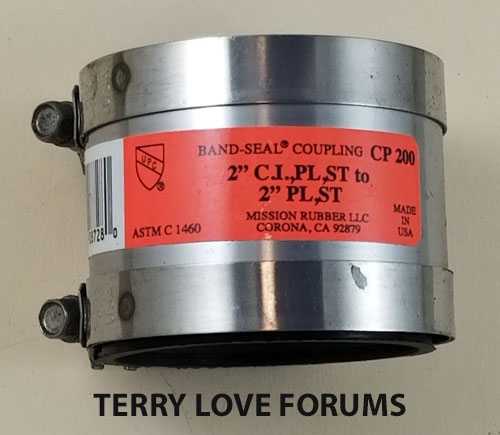
If he is a "master plumber" then I can understand why a lot of states are abandoning the designation. What is that "E" sticking out of the double Y? There is no vent for the trap. You cannot use the rubber elbows at the drains. You need a Mission, or BandSeal coupling at the floor. When the insides of all that piping accumulates a coating that begins to stink and the air starts circulating from one drain to the other THEN you will know why it is a bad system. If it were a "good" or even "marginally good" system, don't you think plumbers would be installing it so the customers would not have drain problems? Maybe you should request a copy of the errata from the book. Perhaps a revison or retraction of that drain system would be in it. I do not know of any inspector who would approve that drain configuration. And as far as the restriction in the standard tee, how much water do you really think the small openings in the bottom of the sink strainers are going to let pass through. You are trying to create a solution to a problem that you do not even have.

Dunbar Plumbing
01-31-2007, 07:31 PM
Pretty impressive picture there.

No vent, rubber fernco 90's and tee. Stuff like this keeps plumbers employed, seriously.

And the customer indirectly spends a great deal more under the sink than the regular setup of a center or end outlet waste.

Phil H2
01-31-2007, 08:35 PM
. . . What is that "E" sticking out of the double Y? . . .
My guess is the dishwasher drain. Do I win a prize?

That picture belongs in the world's funniest plumbing book. I'm still chuckling.

Racer814
02-01-2007, 04:24 AM
I don't mean to step on anyones toes that might do so but I wouldnt use tubular pvc traps....very easy to install, very fast and cheap....and very likely to end up leaking.....I see a lot, esp. under kitchen sinks where they get bumped around by mrs homeowner as she sttempts to cram yet one more bottle of cleaner under the sink

use brass tailpieces and shed 40 pipe and fittings
no problems

hj
02-01-2007, 04:45 AM
Ler's see now. Out of the thousands of tubular traps I have installed in 55+ years, as long as they are installed properly, how many have "fallen apart"? Try zero. The only exception might be when the trap has to be installed, or is, a low inlet one where the tailpiece has limited engagement into the trap inlet. Then, trying to jam one more item under the sink could dislodge it. But if the tubes are inserted all the way into the trap and wall, there is no way they can come apart by incidental contact.

Racer814
02-01-2007, 04:55 AM
see now...I stepped on your toes..didnt mean it, I just like to do it different and I told you why...I never said they fall apart...they leak...a lot....and the metal ones, which I'm guessing is what you installed 55 years ago rot out...I still use the heavy gauge chrome traps under a pedestal but honestly can't think of one advantage that a pvc tubular trap has over sched 40 except time and money

again, didnt mean to step anyones toes
we all do everything differently

carry on.

Dunbar Plumbing
02-01-2007, 06:21 AM
Interesting statement about the SCH40 application. When I owned rental properties I would do just that; install Keeney strainers (the good ones) that had actual IPS thread patterns so I could use a 1.5" FIP's and continue on with all sch40 to the wall. I also had 2" for the drains, not 1.5" I also installed a cleanout so I didn't have to worry about disassembly of anything other than a cap.

I basically wanted something that renters couldn't screw up or call me a year after it had been leaking with the cabinet totally destroyed.


It is true that slip joints will fail over time. Vibration from either the cheap sink above flexing heavily or the vibration from the disposal constantly putting those connections to the test.

I worked on a kitchen sink drain two days ago where I couldn't work with the piping/connections anymore and replaced the entire center outlet waste assembly.

It's a state farm office in their small kitchen for preparing food and coffee and the consistent dumping of hot coffee down the drains not only clogged the piping up,

but also made the piping/ferrules/plastic nuts hard as a rock and you couldn't tighten them enough to stop leaking.

The new piping is soft and conforms well.....for now.

When I was a union service plumber one of my bosses used wolverine brass tubular traps and drain assemblies only.

He told us "job security with brass" meaning the piping will eventually corrode out and have to be replaced. He used the 17 gauge which was a nightmare to use in some applications.:confused:

adrianmariano
02-01-2007, 06:21 AM
Phil H2, you win the prize. (Not sure what the prize is, maybe a case of Fernco elbows? :) ) The connection in the center (labeled E) is indeed for the dishwasher.

"And as far as the restriction in the standard tee, how much water do you really think the small openings in the bottom of the sink strainers are going to let pass through. You are trying to create a solution to a problem that you do not even have."

Cauldwell complains at length about the small openings at the bottom of the sink strainer. He recommends the Kohler 8801 sinks strainer which (based on the picture in his book) is much less constricted than the typical one. He also complains about the plastic washer at the bottom of the sink strainer which he says constricts the flow and also accumulates crud. (I was inspecting the sink strainer that I have for my new sink and it does seem like that plastic washer is a potential crud catcher and it does indeed further block the flow, but I don't know if this is a real problem.)

Regarding to use of sch 40 P-traps, I hired a plumber for my bathroom remodel. He left me a sch 40 P-trap to use because he said it was important that I use a good trap. But this trap still attaches with slip joints---slip joints with chrome nuts, but slip joints nonetheless. My current kitchen drain system is done entirely with sch 40 piping as well, including two traps with those same slip joints and the chrome nuts. If I don't have some slip joints somewhere then how can I take the system apart to clean it? It seems like ease of disassembly for cleaning is a huge advantage of assembling a drain system with slip joints (or ferncos) as opposed to gluing everything together. And if I'm going to use slip joints am I better off with slip joints in the sch 40 vs the slip joints in the lighter weight drain piping. I mean, they're all slip joints. Does it matter?

Gary Swart
02-01-2007, 07:52 AM
Why do you suppose this is not common, normal practice in the trade? The answer is obvious. It's a hack job that no plumber, and I would hope no DIYer, would consider. I'd trash that book and do the job right.

adrianmariano
02-01-2007, 08:21 AM
There are a couple issues. One is, how do I know what constitutes "normal practice"? My house did not come with a single drain made of that lightweight PVC drain tubing. Essentially the only guide I have about the normal is to look at several books and see if they all agree. If I find something which seems odd such as the drain in the Cauldwell book, how do I know who is installing it? Maybe all the good plumbers install Cauldwell drains but general contractors and clueless do-it-yourselfers install the other kind of drains because they're cheaper and easier to install. How can I tell which it is? (The one time I hired a plumber he seemed concerned that I install a sch 40 drain instead of the thin PVC tubing drain.)

In addition, suppose I figure out that the Cauldwell drain is unusual. If someone asks me, "Why is this method not normal practice?" there are multiple possible answers. Certainly one answer is "that method is inferior". But another one is "that method, though superior, is more expensive".

I'm afraid that in general I would expect cost to win out over quality in the world of "normal practice". Everyone wants things cheap, cheap cheap! I wouldn't have had a 2 ft hole in the subfloor of my bathroom if the contractor had used a moisture barrier in the tile installation. It would appear, however, that "normal practice" is to NOT use a moisture barrier. (My plumber saw the moisture barrier and said that in 30 years of plumbing for bathroom remodels he'd never seen such a thing before.) In this case normal practice is wrong. From my own experience I have a limited respect for normal practice.

Racer814
02-01-2007, 10:02 AM
well it seems as though your mind was made up on this issue before you even started the thread.

go ahead and install it EXACTLY as in the diagram...:rolleyes:

adrianmariano
02-01-2007, 10:42 AM
Actually my reaction to seeing the Cauldwell drain was that it seemed like a lot more trouble to install than the conventional drain. Furthermore, he doesn't show how to do it with a disposal (and I do have one). So I'd have to make some changes. (Now I wonder about having vertical room. Elsewhere in the book he has disposal installation instructions and he shows a conventional drain setup.) On the other hand, his justification for his setup sounded reasonable, and if it really is better then I figured maybe it's worth doing. As I noted above, my goal in starting this thread iwas basically to get criticisms of the Cauldwell drain so I could understand why it would NOT be something I should implement. (I figure Cauldwell already listed all the good points.)

I have observed a rather strong reaction to his setup, and it evidently gave everyone a good laugh. So far I've seen the following specific criticisms of the system. Is there anything else wrong with it?

1) ferncos are not to code, and won't make a good seal on the threaded pipe coming down from the sink

2) the piping will acumulate crud and create a bad odor

3) it requires too much vertical space

4) not vented

5) the problems it aims to solve don't exist

It's unclear to me why (2) doesn't apply just as well to the conventional drain. Is it simply that there is more piping before the trap?

At the moment my tentative plan is to install a normal drain with slip joints using the light weight drain tubing (does this stuff have a standard name?). The last slip joint will connect to a sch 40 sanitary T to go down the vertical drain pipe and there will be an AAV at the top of that T to correct my venting problem. But my plans are not set in stone. I still might consider switching to sch 40 for the trap.

jadnashua
02-01-2007, 12:04 PM
Unless the trap gets sucked dry because it isn't vented properly or evaporates from disuse, yes, the smells would be because there is a lot of piping open to the air before the trap. You can't typically smell anything beyond the trap from your drains, but anything up to that point is open to your house.

Racer814
02-01-2007, 01:28 PM
take the clean out off and repalce it with a AAV and it "would" work...even if that sink line is vented within the proper distance downstream you have an "S" trap in that picture and it will siphon itself dry without a source of air above it

but is the extra "engineering" worth while?...I don't think so....in fact, my opinion is that it creates more problems than it solves....a sched 40 male or female adapter on a brass tailpiece is pretty secure...can it leak?...certainly....no installation is bulletproof...but it will likely not

by using fernco's you are simply trading one mechanical connection for another....a fernco can leak also

also have what appear to be short sweep elbows in the horizontal.....if this guy is a master(whatever that is) plumber he should know that is wrong

you are going to have to use an AAV in this installation and that is the mother of all mechanical fittings that will fail at some point...not to mention the fact that they are inherently inferior to a good old fashioned "standard practice" vent that exhausts to the open air..

not to mention the fact that you are just making it even more difficult to clean the trap by using a glue type..

sometimes the "better" way isnt better just different and the tried and true methods stick around for a reason....problems usually are a result of poor workmanship, not the method..

sure, plumbing evolves like everything else and new ideas come around all the time that actually make an improvement over the old way

this just isnt one of them


and as Forrest Gump would say...."thats all I got to say about that"

Good Luck:)

solsacre
02-01-2007, 05:38 PM
I'm afraid that in general I would expect cost to win out over quality in the world of "normal practice". Everyone wants things cheap, cheap cheap!


I worked for a shop for 4 years that had a two year warranty. Cost was always an issue with our work and materials.... We didn't waist money on materials we didn't need... but we didn't waist time on Cheap, cheap, cheap parts... if the parts where of poor quality than we would be back repairing them within two years on our dime. It doesn't pay to skimp on parts.... the conventional ways always worked for us... Solid piping doesn't come apart and works great too.... just hard to repair when the FIP at the bottom of the sink splits.


OH.... and I looked up old Rex's books, and he has Electrical how-to books also. "Safe electrical Practices"..... Is he a master Electrician also?????

and I still want a picture of your finished project.

good luck

Dances-with-pumps

Terry
02-01-2007, 07:27 PM
http://terrylove.com/images/sink_dw.jpg

The trap should be vented.

When slip joint fittings are used, it's easy to take them apart and run a hose through them, or knock out the crud into the garbage can.

Nobody plumbs the waste line from the bottom of the cabinet if they could put it in a wall.
The best plumbing, involves a vent through the roof.

adrianmariano
02-02-2007, 01:21 PM
People who want to see Rex Cauldwell's bio can go here: http://ltmtnele.tripod.com/mybio/

When you say don't use cheap parts does that mean don't use the cheap, lightweigh drain lines that connect together with slip joints? I was inspecting the drain I put together with slip joints for my utility sink and there are 7 slip joints plus the two connections at the sink drain. That's a lot of failure points... Should I be worried? Is it better to put the T between the sink drains or at the end?

Well, somebody did plumb my waste line through the bottom of the cabinet when it must have been possible to put it through the wall. Unless that vent pipe does something REALLY weird in the wall.

As I see it I have two ways to avoid an AAV. One is to rip out my kitchen cabinets so I can find the vent pipe that is in the wall to connect to it horizontally. I'm not doing that. The other one is to put in a loop setup to vent. Right now I'm definitely leaning towards using an AAV. (The venting problem can be fixed properly next time the kitchen cabinets are replaced.)

kordts
02-02-2007, 07:33 PM
How could you have 9 slip joints at a slop sink? You should have one for the flanged tailpiece to the drain. One for the return bend to the bottom of the tailpiece. One for the wall tube to the return bend and one for the marvel adapter to the wall tube. That's 4.

hj
02-02-2007, 07:51 PM
Certainly one answer is "that method is inferior". But another one is "that method, though superior, is more expensive". Both of these answers presuppose that the "alternate" way is better, it is just stated differently. I do not care about the cost of the drain, or the labor to install it, because it is a time and material job. My concern is for the customer's future ease of service, which is why I use the tubular materials. I do not know of any schedule 40 slip joint connections. Many new construction plumbers do use sch. 40 sink drains, but it it more for "job security", because the system often has to be cut apart and redone when something has to be repaired.

Racer814
02-03-2007, 06:46 AM
I've only seen one sched 40 sink drain that had to be cut out and replaced in the last three years and that was because the original plumber tightened the trap nut too tight in lieu of using teflon paste

in that same period of time I have replaced countless tubular traps
I use sched 40 because I think it's a better job. period. It takes much more labor and cost to install it vs tubular.

to say that anyone who uses sched 40 is doing it for job security is like saying that anyone who uses tubular is fat and lazy.....

it's not true

harleysilo
02-03-2007, 07:05 AM
Sorry nothing to add but...."Hey, isn't that image from a book in the TimeLife series called "Crackhouses, Shanties and Lean-tos"?

Seriously, my friend, that's just not right."

LOL :p :D :) :eek:

SteveW
02-03-2007, 07:15 AM
Interesting discussion.

To expose my ignorance, what exactly is the difference between a schedule 40 trap and a tubular trap?

kordts
02-03-2007, 07:23 AM
About 3 times the volume of water it will drain. One's glued, the other isn't.

plumber1
02-03-2007, 07:42 AM
I would go with HJ's experience and know how. I think along the same line and I'll bet HJ is using 17 gauge and not 20 gauge p-traps.

Racer814
02-03-2007, 08:27 AM
I disagree with HJ all the time
but he sounds like a very knowledgeable plumber


on most things:D

Terry
02-03-2007, 10:43 AM
If you plumbing comes up from the bottom of the cabinet, then you will want either an "island vent" some call it a loop vent, or at least an AAV.

adrianmariano
02-05-2007, 06:30 AM
Here are some pictures showing the installation I already completed of a new utility sink. The old concrete sink was cracked in half and leaking, and it was covered with paint that was flaking off in big pieces and helping to clog the drain. My wife complains about cleaning the paintbrushes in the kitchen. With a decent faucet down there I may actually be able to clean my paintbrushes at the utility sink:

http://members.cox.net/jsam/plumbing/oldsink.jpg

Here's the new sink with a closeup of the drain. You can count the slipjoints. There's a bunch:

http://members.cox.net/jsam/plumbing/utilitysink_top.jpg

http://members.cox.net/jsam/plumbing/utilitysink_bot.jpg

Since I was posting pictures I also included a picture of the kitchen sink that's up next for replacement. You can see that the existing installation is done entirely with sch 40 (except for the tailpieces) and has two traps. The drain line disappears into the floor and the bottom half shows how the pipes connect in the basement.

http://members.cox.net/jsam/plumbing/kitchen.jpg

Note that the presence of the window means there's not a lot of room down there.

TedL
02-05-2007, 06:46 AM
Perhaps it's an optical illusion because of the angle, but the trap arm on the slop sink looks like it's going uphill.............

Dunbar Plumbing
02-05-2007, 09:22 AM
seeing. A kitchen sink faucet instead of a laundry tub faucet.


Reason?


See that short piece of hose connected to the laundry tub spout? That right there is notorious for a potential cross-connection. (Below flood level rim) Just about every time I go to someone's house there is usually a hose connected to the spout hanging down in the bottom of the tub.

A small leak on either cold or hot and a reversal of flow and you have contaminates in your potable water system.

That faucet installed will never have a garden hose attached to it, the likelihood of it hanging down into the tub is less of a chance and there is a backflow device integrated into the faucet itself.

Good work daniel son. :thumbsup:

adrianmariano
02-05-2007, 12:02 PM
I checked the trap arm with a level and it definitely slopes down hill (though I'm not sure if it slopes downhill by the proper amount).

The old utility sink faucet was unusable without the hose attached. With the hose it was barely usable. The odd thing is that I got advised by the guy at the plumbing supply store as well as by one plumbing book that it was impossible to install a kitchen faucet on a utility sink because the holes in the utility sink are supposedly in the wrong place. (My utility sink came with no holes predrilled so I could install whatever kind of faucet I wanted.)

Terry
02-05-2007, 01:29 PM
I always use a kitchen sink on a laundry tray.

Two ways:

I get a single hole version, and use a soap dispenser for the second hole.
I get a single hole version, with side spray for the second hole.

It's much nicer for things like washing paint trays.

markts30
02-05-2007, 01:41 PM
http://members.cox.net/jsam/plumbing/kitchen.jpg

When you come to re-doing the kitchen sink, please make allowances for including a vent...
The current setup does not have one - It would not pass code....

Rancher
02-05-2007, 02:06 PM
How close to the sink does the vent have to be? It appears that could be a vent on the C.I. pipe in the second, under the floor photo.

Rancher

kordts
02-05-2007, 09:07 PM
If that branch for the kitchen stayed horizontal, the c.i. pipe going up could be a vent. Since the kitchen drain line goes vertical, that c.i. riser can't be a vent for the kitchen.

Randyj
02-05-2007, 11:11 PM
WHY? Looks like it vents the kitchen sink to me... not dealing with an s-trap...whats the deal? I'd say it's not "ideal" but that it does vent that line.

Racer814
02-06-2007, 02:55 AM
looks like an "S" trap to me

if the 90 was replaced by a tee and the vent took off from there it would be kosher......

Cass
02-06-2007, 04:03 AM
yep, remove the 90 after the trap and install a T, Fem. Adp. an AAV and its alllll gooood.

adrianmariano
02-06-2007, 07:25 AM
I believe the requirement is that the connection to the vent pipe must be higher than the water level in the trap being vented. Since in this case the connection to the vent pipe is a couple feet below the trap, that requirement is not met by my installation, hence my installation does not qualify as vented.

I guess we've been lucky since we only rarely have noticed an unpleasant odor coming from the sink. My plan is to put in an AAV to fix it.

I am a bit puzzled, though, because it appears like the plumbing was actually designed wrong when the house was built in 1954, and everyone in the neighborhood will have the same problem. Did they not understand venting in 1954? (In principle the kitchen was inspected when it was remodeled 11 years ago, which would have been an opportunity to fix it. I know the electrical was inspected, but maybe not the plumbing? In my area they are very lax about permits and inspections.)

Rancher
02-06-2007, 07:57 AM
I am a bit puzzled, though, because it appears like the plumbing was actually designed wrong when the house was built in 1954, and everyone in the neighborhood will have the same problem. Did they not understand venting in 1954? Since I was confused about what an "S" trap really was, I went and looked it up, and it answered my question, Randy's question and the plumbing code question... Here's the Link:

http://www.usinspect.com/plumbing/VentsTraps.asp

That pretty much says it all.

http://www.usinspect.com/plumbing/Images/20_5.jpg

Rancher

adrianmariano
02-06-2007, 09:40 AM
I've seen some talk about 17 gauge or 20 gauge P-traps. What does this gauge designation mean? Does it apply to the tubular plastic traps?

I have approximately a 15" separation between the drains on my double basin kitchen sink. Is it preferable to use a center outlet drain or an end outlet drain? (Mr. Cauldwell thinks the center outlet drains are less reliable. Is he wrong about this too?)

plumber1
02-06-2007, 10:52 AM
The lower the number, the thicker the material.

I prefer to use an end outlet.....

adrianmariano
02-06-2007, 12:22 PM
So do the plastic tubular PVC drain pipes come in different gauges?

markts30
02-06-2007, 02:22 PM
As stated earlier in this thread "The vent pipe must open at or above the level of the water seal in the PTrap..."

To quote the 1994 UPC (AZ code till July 1st 2007- then we adopt UPC 2006)
Sect 1002.4 - "The vent pipe opening from a soil or waste pipe, except for water closets and similar fixtures, shall not be below the trap weir"

Les IsMore
02-06-2007, 03:45 PM
You see comment 35 above? ( http://www.terrylove.com/forums/showpost.php?p=66473&postcount=35 ). That's the right way to do it, but there's an easy way to do it wrong. This is off the subject, but it may be interesting.

Just connect the trap and drain to the garbage disposal instead of the sink on the right. That horizontal pipe will now collect all the crud that's spit out by the garbage disposal, and it's hard as heck to keep it clean. As a result, the sink on the right will stink.

It may be obvious to you guys. Or maybe not. The pros got it wrong in my house, and the inspector missed it too. Just thought I'd point it out. Unfortunately, I think the only ways to fix it would be to move the garbage disposal to the other sink (the wrong one, really), to move the whole house over a couple of feet, or to do an amazing plumbing job that I wouldn't care to post here. :eek:

plumber1
02-06-2007, 04:19 PM
Less, you've got it wrong, that 10" part of the drain really doesn't collect a lot of crud. I've worked a lot of years and usually the only place that really is messy to deal with is after the trap all the way to the stack.

Les IsMore
02-06-2007, 04:32 PM
Less, you've got it wrong, that 10" part of the drain really doesn't collect a lot of crud.
So we're just imagining the smell? I think I see the problem here. :)

dubldare
02-06-2007, 04:58 PM
Start running more water down that basin, Les, especially when using the disposal.

Additionally, get some of these to help your imagination. No, you don't eat them, you feed them to the disposal, and you can get 'em at a grocery store.

http://www.improvementscatalog.com/home/improvements/70068-Plink-Disposal-Cleaner.html

Rancher
02-06-2007, 05:05 PM
Ice cubes work just as well as a garbage disposal cleaner, and they're normally closer to grab a handfull and send them down the disposal, I perfer rinsing them with bourbon before I do that... :D

Rancher

Les IsMore
02-06-2007, 06:25 PM
dubldare and Rancher,
Read it again. You're cleaning the wrong drain. That's not the one that stinks.

What happens is that a little waste from the garbage disposal backs up in that pipe. And why shouldn't it? It's horizontal. Then a little solid is left behind. Every time you use the garbage disposal. And it rots. And dries out enough to stick in there.

You can control it by running water through BOTH sinks every time you use the garbage disposal. And we sometimes run bleach through there, etc. But you shouldn't have to do that to use a garbage disposal.

We know how to control it. The point is that we wouldn't have to if it had been installed according to Terry's drawing.

Les IsMore
02-07-2007, 11:54 AM
OK, maybe this will help. Here are pictures of the right and wrong way.

Dunbar Plumbing
02-07-2007, 03:07 PM
OK, maybe this will help. Here are pictures of the right and wrong way.


Only way that "wrong" picture would accumulate debri is only if someone that doesn't know what they are doing didn't use a directional tee like what is required on all center and end outlet configs.


So whoever installed that tee in that system that is collecting debri is using the wrong piping under the sink. That area where you think it should collect should never have food debri there....just the wastewater that comes from the opposite side strainer.

dubldare/plumber1/rancher and I are right.

Do you know what a directional tee is?

Rancher
02-07-2007, 04:07 PM
I agree to some extent, but perhaps part of the problem is that horizontal run doesn't have any slope to it, or a negative slope. But it does look like the plumber had to go out of his way to plumb it wrong.

Rancher

Les IsMore
02-07-2007, 08:18 PM
Do you know what a directional tee is?
I do now, I think. Would this be it?: http://images.google.com/images?hl=en&q=directional+tee+plumbing&btnG=Search+Images

The guy used a straight tee, and the pipe is dead level. So that explains it, all right. I'll have to see if there is room to put in a directional tee. If there is, that should fix it.

Thanks a lot for your insight. You see, we were all right.

Dunbar Plumbing
02-07-2007, 09:27 PM
Directional tee aka baffled tee.

I wasn't going to "give it away" by mentioning the word baffle.

On end outlet or center outlet configurations the tee will have a baffle in it to allow the opposing flow from either direction to not affect the other.


Without that baffle will cause huge problems. It is a flow restricting tee and easily clogs sometimes depending on the end user but for the most part it is effective and required by code in most states to prevent opposing flows of drainage from conflicting with each other.

Sometimes impossible to get a 1/4" open hook cable down one of those baffled tees when it is a center outlet waste.

I prefer to go top down on clogged drains since hydropressure is your friend in removing clogs.

Cass
02-08-2007, 03:47 AM
Baffle Ts have 1 draw back. They will catch and clog on potato, and carrot peels and also spaghetti when forced into the disposal to quickly..... of course I like it. Had 1 customer pay me twice in 2 weeks to do it. They didn't believe me when I told them the disposal wasn't grinding well and needed to be replaced.

Les IsMore
02-08-2007, 01:29 PM
I looked around in some plumbing catalogs, and didn't see any baffle tees. They do have sanitary tees, however, which is what my link above shows. I don't see how one of those could clog. I still prefer Terry's setup.

But since I can't have that, it seems like the sanitary tee would be an improvement. A long turn tee should be even better. Better still would be a 45 degree wye, if that will fit. Is any of these acceptable and up to code?

Dunbar Plumbing
02-08-2007, 03:58 PM
I looked around in some plumbing catalogs, and didn't see any baffle tees. They do have sanitary tees, however, which is what my link above shows. I don't see how one of those could clog. I still prefer Terry's setup.

But since I can't have that, it seems like the sanitary tee would be an improvement. A long turn tee should be even better. Better still would be a 45 degree wye, if that will fit. Is any of these acceptable and up to code?


because I care :hugs:

http://img.photobucket.com/albums/v70/DUNBAR/20807005.jpg

http://img.photobucket.com/albums/v70/DUNBAR/20807004.jpg

http://img.photobucket.com/albums/v70/DUNBAR/20807003.jpg

http://img.photobucket.com/albums/v70/DUNBAR/20807002.jpg


These fittings are as common in hardware stores along with any plumbing supply house like grapes in the produce aisle at your grocery store.


You're viewing a end outlet tee, a center outlet tee, and a disposer kit tee which is notorious for having a baffle, just like the rest of those pictured above.

adrianmariano
02-09-2007, 05:49 AM
I would imagine that you were looking at catalogs of schedule 40 plumbing parts rather than drain parts. The sanitary T is a schedule 40 part. Is your drain made from schedule 40 parts, glued together? Or is it made from parts that look like the ones in the pictures posted by RUGGED? (For a picture of schedule 40 parts look back in this thread to my picture of my existing kitchen drain or the picture of the Cauldwell drain.)

Les IsMore
02-09-2007, 07:45 AM
OK, here are two pictures. Thanks to both of you for showing me the fittings.

It does look like the guy did it right -- directional tee and all (see the arrow) -- but it still collects debris. The horizontal run from the other sink doesn't get as much use as the other, and that's where the problem is.

Unless the problem is in the slip joint or something....

Reasonable Perfectionist
02-11-2007, 01:51 AM
So do the plastic tubular PVC drain pipes come in different gauges?

I don't think anyone attempted to answer this question after this thread went off on a few side tangents. Plastic (PVC or polypropylene) tubular PVC traps and connected waste components do not come in different gauges, only their chrome plated brass counterparts do. If you want heavier plastic, you have to use schedule 40 PVC and glue (I've seen slip joint schedule 40 tub waste & overflows and sump pump check valves, but not traps or connected wastes) If someone did make slip joint schedule 40 fittings, I would try them. I believe it might solve the bowing and bending problem I've seen on tubular PVC traps that drain very hot dishwasher water.

If it's not too late, I would like to put in my two cents on this thread's original subject: slip joint reliability and Ferncos.

As a Philadelphia area master plumber for 32 years, I have used tubular plastic traps (S & P) and connected wastes (preferably end outlet, not center outlet) connected to basket strainers and waste pipes with grey PVC (not rubber or neoprene) Fernco 2-clamp connectors for more than 20 years. I came to this forum for the first time today searching for better quality PVC tubular products than the crap I've been finding lately at local and mail-order suppliers. The number of comebacks we've had for defective and poor quality plastic traps over the last year have forced me to re-think how we do traps and wastes. We've also had our share of clogs in baffle tees for customers whose "disposer abuse" never clogged their drains before we installed the tee.

I refuse to go back to the expensive and corrosion-prone brass tubular I used 30 or so years ago. Unless I find something as good as the Sanitary-Dash double-seal traps and baffle-less wastes I used with few problems for years, I will soon start using schedule 40 traps and sanitary wye (if space allows) or tee fittings for connected wastes.

By the way, the problems we've had have nothing to do with our use of Fernco couplings or fittings. I have never had a leak from a Fernco connection, including the connection to threaded basket strainers. (We slide a grey 1 1/2" x tubular Fernco over a tubular PVC tailpiece to connect to the strainer, thereby eliminating the leak-prone and flow restricting plastic tailpiece washer) I've also never seen a "sagged" Fernco, or one that "cut off the flow". The bare connector between the clamps actually acts as a shock absorber for garbage disposer vibrations.

The Cauldwell drain arrangement actually makes alot of sense to me, since the 24" sink cabinet in my own kitchen holds a fullsize garbage disposer, a hot water dispenser, a two-cartridge water filtration system, a soap dispenser, and a small commercial slicer in a roll out basket.
(Yes, it's a bit of a pain replacing the faucets) Since S-traps have been legal in Philly and it's burbs and vent fine as long as the vented line in the basement isn't too far away, I wouldn't even bother with the "AAV", unless you notice odors right from the start. If you do, take off the handy test plug from the Fernco tee and install the AAV on as long a piece of PVC pipe as you can fit in the sink cabinet, preferably higher than the bottom of the sink bowl. Cauldwell's use of wyes to join the two drains should prevent backup from one bowl to the other as long as the drain from the cabinet floor to the stack or main drain in the basement is new or very clear. (2" PVC works well here for drainage and venting reasons)

Time for some shut-eye.

Cass
02-11-2007, 04:07 AM
As I look at the last 2 pic you posted the T is going directly into the trap. The debris has no where to go but float in the trap if enough water is not run through the disposer.

To correct the problem reconfigure the drain set up by putting the T on the other side of the sink. Have a Tail piece coming directly out of the disposer and going directly to the T with a little pitch. Then drop from the T into the trap which will now be lower than where it is now in relation to where the trap is. Then run from the trap over and out the wall being sure to have some pitch all the way, I bet this cures the problem.

Pretty much it will be set up similar to the right Pic in post #69 of this thread with a little more drop between the T and trap.

This added drop should cure your problem.

molo
02-11-2007, 09:10 AM
Hello all,

I recently installed a pedestal sink. The drain comes up from the floor. I noticed the picture that Rancher posted of the S-trap, and this is how the pedestal sink is trapped. It sounds like this is wrong. How can I trap this?

TIA,
Molo

markts30
02-11-2007, 06:56 PM
look at pantry to half bath conversion thread...
Some suggestions on how to trap it...
There are others as well - do a search on the forum for s-traps

adrianmariano
02-12-2007, 06:03 AM
Reasonable Perfectionist: When you said you use a fernco to connect to the strainer basket with a tubular PVC tailpiece do you mean that you put one end of the fernco on the threaded part of the strainer basket and the other on the tailpiece?

I'm planning to use the Kohler 8801 drain (which Rex Cauldwell recommends) which has a rubber washer instead of the plastic washer and it provides very little obstruction/crud catching potential. (It comes with a brass tailpiece.) I inspected another drain with the plastic washer and it seemed like the washer is huge, and would get dirty and trap dirt and be hard to clean. (And the washer blocks about 30% of the drainage space.)

There seems to be a preference for end outlet waste over center outlet. Does this apply even if I have a 15" space between by drains? I believe the disposal is about 4" radius so I'd have an 11" run from the disposal to the end outlet baffle-T.

In my case, over five years living with the existing setup which features an S-trap I have noticed every so often a bad odor coming from the sink. Not very often, but occasionally. I have been assuming that this must be a result of venting issues. Because we use the sink constantly the trap will presumably get refilled fairly soon if it gets siphoned empty, so this problem would tend to go away, as indeed it has. I figured an AAV would cure it completely...unless there's some other possible source for the odor. But why does the AAV need to be as high as possible? I thought it just had to be 4" above the water level.

In my house I'm connecting to 50 year old 1 1/2" steel drain line, so I can't assume that I have totally clean 2" drain lines. (I got a look at the line when I replaced my utility sink, though, and it didn't look too bad.)

adrianmariano
03-28-2007, 06:15 AM
I had been asked to post pictures of my kitchen sink after the work was completed. I had some trouble scheduling the work, but finally was able to tackle the job last weekend. Over all things went fairly smoothly, though rather slowly. I removed the old sink and test fit the new sink and found that the hole was the right size for the new sink. But the hot water supply was going to be in the way of the disposal.

So I relocated the hot water supply and then glued down a piece of formica to protect the cabinet floor from future leaks. (The floor had taken some substantial water damage in the past and the particle board had suffered.)

I did have one weird problem I didn't understand. I capped the 1/2" copper supply lines by soldering on caps. (I did this so I could turn the water back on while I was fitting and gluing down the formica because I didn't want to have to cut stop-valve sized holes in the formica.) When I went to remove those caps I heated the first one for a brief time and the cap popped right off. When I went to remove the second one it wouldn't come off, wouldn't come off. I kept heating more and trying to take it off and it wouldn't come off. Then the copper started to glow red and I still couldn't get it off. Finally I gave up and cut the pipe. So what could be the explanation for this?

The sink (stainless steel Blanco) was the one troublesome thing. When I test fit it I noticed that it didn't sit flat on the counter but there was a small gap. I figured this gap would disappear when it was screwed down. When I went to screw it down I found that the counter top was too thick in the front and I had to cut out recesses for the clips. And then when I did screw it down, the gap did not entirely disappear, so I have a (caulk filled) gap maybe 1/16" at its largest. Is this normal?

I was going to use an end outlet drain but when I started assembling it I thought there wasn't room for the trap. In retrospect I think it would have worked: I just needed to point the trap the other way. Hopefully the center outlet drain won't cause me any trouble. (People seem to prefer end outlet.)

Thanks to everyone who replied to my questions in this forum.


Here's the before picture:

http://members.cox.net/jsam/plumbing/kitchensink.jpg

And after:

http://members.cox.net/jsam/plumbing/sinkpipes1.jpg
http://members.cox.net/jsam/plumbing/sinkpipes2.jpg

http://members.cox.net/jsam/plumbing/newsink1.jpg